
Brandgans vs Moorente
Tadorna tadorna gegen Aythya nyroca
Ein Quiz mit Brandgans und Moorente spielen
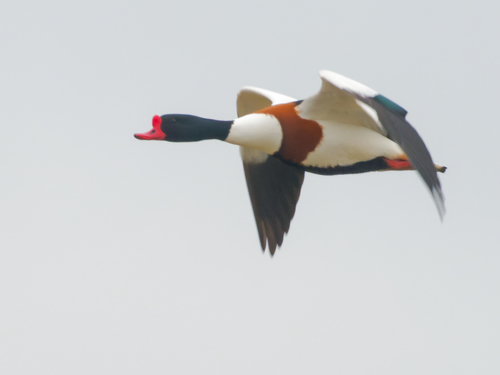 Brandgans
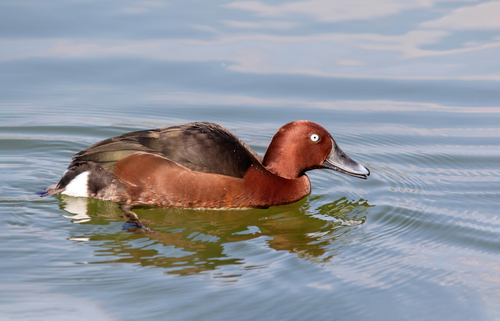 Moorente
Kurz gesagt
The most reliable field mark between Common Shelduck and Ferruginous Duck is the shelduck’s bold, high-contrast wing pattern in flight, with extensive white on the coverts and underwing, versus the ferruginous duck’s more limited white on the underwing and belly. Even at rest, Common Shelduck appears much larger, goose-like, with a distinctive reddish-pink bill and a striking white, chestnut, and dark green plumage, while Ferruginous Duck is a compact, dark chestnut diving duck with a white undertail and, in males, a yellow eye. Juvenile shelducks already show the adult wing pattern, making flight views especially diagnostic for all ages. Structure, bill color, and overall size further separate these species in almost any context.
Bestimmungstipps
- Flight pattern (all ages): Look for the shelduck’s bold white wing coverts and underwing, black primaries/secondaries, and green speculum. Ferruginous Duck shows a white belly and underwing patch but lacks the shelduck’s extensive white and green gloss.
- Size and shape: Shelduck is much larger and more goose-like, with a long neck and upright stance. Ferruginous Duck is compact, short-necked, and typical of diving ducks.
- Bill color and shape: Shelduck has a thick, reddish-pink bill (with a knob in adult males); Ferruginous Duck has a dark, smaller bill with no knob.
- Body pattern at rest: Shelduck is mostly white with a dark green head/neck and chestnut breast band; Ferruginous Duck is uniformly rich chestnut with a white undertail, lacking any white on the upperparts or strong color contrasts.
- Head color: Shelduck’s head and neck are dark green with possible white flecks (female); Ferruginous Duck’s head is chestnut (male) or dull brown (female), never greenish.
- Eye color: Adult male Ferruginous Duck has a yellow eye; female’s is dark. Shelduck’s eye is dark in both sexes.
- Leg and foot color: Shelduck has pink feet; Ferruginous Duck’s are not described as such and are typically dark.
- Juvenile confusion: Juvenile shelducks already show the adult’s bold wing pattern in flight, while juvenile Ferruginous Ducks are similar to females but never show the shelduck’s wing contrast.
- Habitat context: Shelduck is more likely on open coasts, estuaries, and saline pools; Ferruginous Duck prefers vegetated freshwater lakes and ponds.
- Behavior: Shelduck may be seen grazing or walking far from water, sometimes in huge flocks; Ferruginous Duck is almost always on or near water, diving or dabbling.
- Flock composition: Shelduck flocks are often pure; Ferruginous Duck often mixes with other diving ducks (e.g., Tufted Duck, Common Pochard).
- Vocalization: Shelduck’s loud honk is distinctive; Ferruginous Duck is quieter and less vocal.
- Sex/seasonal differences: Shelduck males are brighter with a bill knob in breeding season; Ferruginous Duck males have a yellow eye and richer chestnut plumage.
- Bill knob: Only male shelduck shows a prominent bill knob; Ferruginous Duck never does.
- White undertail: Ferruginous Duck always has a white undertail, which can be a useful mark at rest, but is never as extensive or as sharply contrasted as the shelduck’s white body.
Größe
Common Shelduck is dramatically larger and bulkier than Ferruginous Duck, with an average mass of 1152 g versus 551.5 g for Ferruginous Duck [wikidata]. In the field, shelduck looks almost goose-sized, with a long body and neck, while Ferruginous Duck is a typical medium-sized diving duck, much more compact and short-necked. This size difference is obvious when both are seen together, but even singly, the shelduck’s bulk and upright stance stand out.
Gefieder
- Juvenile and adult in flight: Common Shelduck of all ages shows a bold wing pattern: white wing coverts, black primaries and secondaries, and a strong green iridescent speculum on the secondaries, with white underwings except for the black flight feathers. Juveniles already have this pattern. Ferruginous Duck in flight shows a white belly and underwing patch, but the upperwing is mostly dark; the white is much less extensive and lacks the shelduck’s crisp, blocky contrast.
- At rest: Shelduck is white-bodied with a dark green head and neck, chestnut breast band, black belly, and a prominent reddish-pink bill (with a knob in adult males). Ferruginous Duck is rich chestnut overall, with a white undertail and (in males) a yellow eye; females are duller brown with a dark eye. There is no green gloss or chestnut banding as in shelduck.
- Sex/age differences: Shelduck sexes are similar, with males brighter and a bill knob; females may have white flecks on the face. Ferruginous Duck males are brighter with a yellow eye; females are browner and dark-eyed.
Verhalten
Common Shelduck is often found in pairs or very large flocks, especially during molt, and is more likely to be seen walking on land or grazing, reflecting its goose-like habits. Both parents tend ducklings, and adults may decoy predators. Ferruginous Duck is less social than other diving ducks but can form large winter flocks, often mixed with other Aythya species. It feeds mainly by diving or dabbling, often at night, and is rarely seen far from water.
Lebensraum
Common Shelduck is strongly associated with estuaries, tidal mudflats, saline pools, and increasingly freshwater lakes and rivers in open country. It breeds in open, often coastal habitats, sometimes far from water. Ferruginous Duck prefers well-vegetated lakes, ponds, and marshes, nesting close to or among emergent vegetation, and is less likely to be found in open, tidal, or saline habitats. Habitat overlap is possible on large inland lakes, but context can help separate them.
Stimme
Common Shelduck gives a loud honk, which is quite different from the quieter, less distinctive vocalizations of Ferruginous Duck. Voice is rarely the primary field mark but can support identification if heard.