
Aigle d'Ayres vs Autour unibande
Hieraaetus ayresii contre Kaupifalco monogrammicus
Faire un quiz avec Aigle d'Ayres et Autour unibande
 Aigle d'Ayres
 Autour unibande
En bref
The most reliable field mark to separate Ayres's Hawk-Eagle from Lizard Buzzard is the underwing pattern in flight: Ayres's Hawk-Eagle (all ages) shows dark, heavily barred flight feathers below with brown and white-marked underwing coverts and no pale panel, while Lizard Buzzard has white underwings with dark tips and a much cleaner look. Juveniles of both are similar to adults, so this mark works year-round. Structurally, Ayres's Hawk-Eagle is a much larger, longer-winged, and longer-tailed bird, with a small crest and feathered legs, while Lizard Buzzard is compact and stocky with a short tail and no crest. Perched, the Lizard Buzzard's unique black vertical throat stripe is diagnostic, while Ayres's Hawk-Eagle shows a white supercilium and more extensive spotting below. Both species can occur in woodland, but Lizard Buzzard is much smaller and often perches lower.
Conseils d’identification
- Underwing pattern in flight (all ages): Ayres's Hawk-Eagle shows dark, heavily barred flight feathers below with brown and white-marked underwing coverts, lacking any pale panel; Lizard Buzzard has white underwings with dark tips, creating a much cleaner and paler look.
- Perched throat pattern: Lizard Buzzard always shows a bold, vertical black stripe down the center of its white throat—unique among African raptors and instantly diagnostic. Ayres's Hawk-Eagle lacks this mark, instead showing a white supercilium and sometimes a small crest.
- Tail pattern: Ayres's Hawk-Eagle has an ashy grey tail with a broad black tip and 3–4 narrower dark bars; Lizard Buzzard has a black tail with a single white band and a white tip.
- Legs and tarsi: Ayres's Hawk-Eagle has feathered legs (booted), which are pure white; Lizard Buzzard has bare, red to orange-red legs.
- Crest: Ayres's Hawk-Eagle often shows a small, sometimes raised crest; Lizard Buzzard lacks any crest.
- Bill and cere color: Lizard Buzzard has a red to orange-red cere and legs (yellow-orange in juveniles); Ayres's Hawk-Eagle has a yellow cere and feet, with a bluish horn bill (paler at base, black tip).
- Size and structure: Ayres's Hawk-Eagle is much larger, longer-winged, and longer-tailed; Lizard Buzzard is compact, short-tailed, and stocky. In direct comparison or with experience, this is obvious, but beware lone birds at a distance.
- Underpart markings: Ayres's Hawk-Eagle (adult) has heavy dark brown spots and blotches on the breast and belly, becoming sparser on the thighs and vent; Lizard Buzzard has a clean white belly with fine dark barring and a plain grey breast.
- Head pattern: Ayres's Hawk-Eagle shows a white supercilium and white forehead; Lizard Buzzard's head is plain grey with no supercilium.
- Eye color: Ayres's Hawk-Eagle has yellow to orange eyes; Lizard Buzzard has dark reddish brown to black eyes.
- Flight style: Lizard Buzzard's flight is rapid and undulating, often low and direct, rarely soaring except during courtship; Ayres's Hawk-Eagle is more likely to soar or glide high above the canopy, appearing more eagle-like.
- Perch height and behavior: Lizard Buzzard often perches low (6–10 m) and hunts from exposed branches; Ayres's Hawk-Eagle typically perches higher or soars.
- Juvenile confusion: Juvenile Ayres's Hawk-Eagle is dark brown above, white below with sparse dark markings; juvenile Lizard Buzzard is similar to adult but with a brown tinge to the wings and orange-yellow cere/legs. The underwing pattern remains a reliable separator.
- Habitat context: Both are woodland birds, but Lizard Buzzard is more often found in open or edge habitats and tolerates more disturbed areas.
- Voice: If heard, Lizard Buzzard gives a clear, melodious whistle (klu-klu-klu) in early breeding season; Ayres's Hawk-Eagle's call is not described here, so this is only useful if the buzzard is vocalizing.
Taille
Ayres's Hawk-Eagle is significantly larger and heavier than Lizard Buzzard: average adult mass is about 839.5 g versus 275.5 g. Ayres's Hawk-Eagle measures 44–57 cm in length with a wingspan of 106–137 cm, while Lizard Buzzard is 35–37 cm long with a wingspan of about 79 cm. In the field, Ayres's Hawk-Eagle appears long-winged and long-tailed, with a more powerful, rangy build, whereas Lizard Buzzard is compact, short-tailed, and stocky, more reminiscent of a small buzzard or large sparrowhawk.
Plumage
- Juvenile and immature flight (upperwing/underwing):
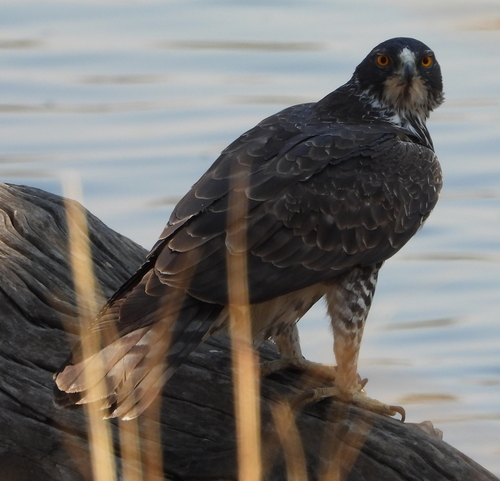
- Ayres's Hawk-Eagle (juvenile and adult): Underwings are dark and heavily barred throughout, with brown and white-marked underwing coverts; no pale or translucent panel. Upperparts are dark brown in juveniles, with a white belly and sparse dark markings. Adults have blackish upperparts mottled with white, white forehead/supercilium, and heavily spotted underparts.
- Lizard Buzzard (juvenile and adult): Underwings are white with dark tips, creating a strong contrast and a clean, pale look in flight. Upperparts, head, and breast are grey; belly is white with fine dark barring. Juvenile is similar to adult but with a slight brown tinge to the wings and orange-yellow cere/legs.
- Perched:
- Ayres's Hawk-Eagle: White supercilium, small crest (sometimes raised), heavily spotted underparts, feathered white legs, ashy grey tail with multiple dark bars and broad black tip.
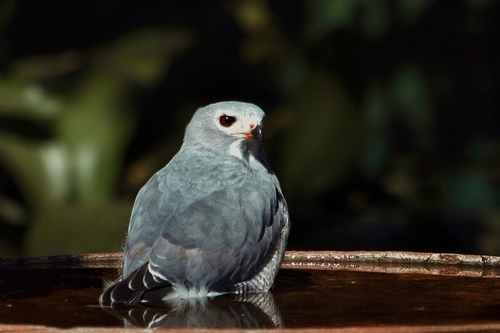
- Lizard Buzzard: Diagnostic black vertical throat stripe on white throat, plain grey head and breast, white belly with fine barring, black tail with a single white band and white tip, red to orange-red cere and legs.
Comportement
Lizard Buzzard is typically solitary, silent, and hunts by perching low (6–10 m) and swooping onto prey, rarely soaring except during courtship. Its flight is rapid and undulating, more like a thrush, and it rarely catches prey in flight. Ayres's Hawk-Eagle, while not described in detail here, is generally more likely to soar and appears more eagle-like in flight due to its size and proportions. Lizard Buzzard's flight is more direct and low, while Ayres's Hawk-Eagle is more likely to be seen soaring or gliding high above the canopy.
Habitat
Both species occur in African woodlands, but Lizard Buzzard is more likely to be seen in open woodland, forest edge, or even wooded savanna, often perching low and hunting from exposed branches. Ayres's Hawk-Eagle is also a woodland species but, due to its larger size and hunting style, may be seen soaring above the canopy or perched higher. Lizard Buzzard is more tolerant of fragmented or altered habitats, while Ayres's Hawk-Eagle is less often seen in heavily disturbed areas.
Voix
Lizard Buzzard is mostly silent except for a clear, melodious whistle (klu-klu-klu) during early breeding season (September–October). No vocalization details are given for Ayres's Hawk-Eagle here, so voice is not a reliable separator except when the Lizard Buzzard is calling.