

Mésangeai du Canada vs Plectrophane des neiges
Perisoreus canadensis contre Plectrophenax nivalis
Faire un quiz avec Mésangeai du Canada et Plectrophane des neiges
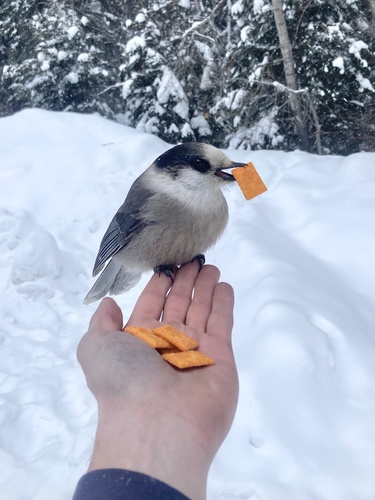 Mésangeai du Canada
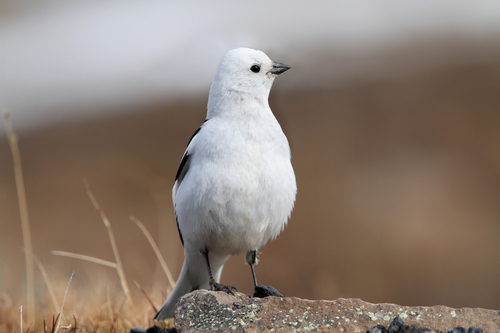 Plectrophane des neiges
En bref
The most reliable field mark for separating Canada Jay from Snow Bunting is overall structure and plumage: Canada Jay is a bulky, long-tailed, thick-necked corvid with a pale face and dark nape, while Snow Bunting is a smaller, sparrow-like bird with a short tail and striking black-and-white wing pattern, especially obvious in flight. Juvenile Canada Jays are uniformly dark grey, unlike any Snow Bunting. In all ages, Snow Buntings show white underparts and black-and-white wings, with males especially crisp in breeding plumage. Canada Jays are found in boreal forests, while Snow Buntings are ground-dwelling birds of open Arctic or tundra habitats. If you see a large, fluffy, pale-faced bird in a tree, it's a Canada Jay; a small, white-and-black bird on the ground or in a flock is a Snow Bunting.
Conseils d’identification
- Juvenile Canada Jay is uniform dark grey: If you see a bird that is entirely dark grey with no white or black pattern, especially in summer, it's a juvenile Canada Jay. Snow Buntings of any age are never uniform grey.
- Canada Jay has a pale face with dark nape: Adult Canada Jays show a white or pale grey face with a sharply contrasting dark grey or black nape/hood. Snow Buntings never show this face pattern.
- Snow Bunting shows black-and-white wing pattern in flight: In all ages and sexes, Snow Buntings have striking black-and-white wings, especially obvious in flight. Canada Jays have plain grey wings without strong contrast.
- Canada Jay is large, fluffy, and long-tailed: The jay is noticeably bigger and bulkier than a bunting, with a thick neck, large head, and long, broad tail. Snow Buntings are smaller, with short tails and a more delicate, sparrow-like build.
- Snow Bunting has white underparts and often a white head: Especially in breeding males, the bunting is brilliant white below and often above, with black back and wings. Canada Jays are never pure white below or above.
- Bill shape and color: Canada Jay has a short, thick, all-black bill. Snow Bunting has a small, conical bill that is yellow with a black tip in winter, all black in breeding males.
- Habitat context: Canada Jays are found in coniferous forests, often perched in trees. Snow Buntings are seen in open, treeless areas, often on the ground or in flocks.
- Behavior: Jays are often solitary or in small family groups, moving deliberately in trees. Buntings are often in flocks, running or hopping on the ground, and rarely perch in trees.
- Tail shape: Canada Jay's tail is long and broad with pale tips; Snow Bunting's tail is shorter and not as broad.
- Plumage seasonality: Snow Buntings in winter have orangey-brown fringes on the back, but always retain white underparts and black-and-white wings. Canada Jays do not show seasonal color changes except for the molt from juvenile to adult.
- Sexual dimorphism: Canada Jay sexes are similar; Snow Bunting males are whiter and crisper than females, especially in breeding season.
- Vocalizations: Canada Jay's calls are varied, harsh, and can mimic other species; Snow Bunting's calls are musical, rippling whistles. Listen for context but use visual marks first.
- Flock size: Large flocks in open country are almost always Snow Buntings; Canada Jays are rarely in large groups.
- Legs and feet: Canada Jay has black legs and feet; Snow Bunting has feathered tarsi (not usually visible in the field, but a cold-adapted trait).
- Common pitfalls: Do not confuse a pale-faced Canada Jay for a white-headed bunting; check for the black-and-white wing pattern and overall size/structure to confirm.
Taille
Canada Jay is substantially larger, measuring 25–33 cm in length with a wingspan around 45 cm and weighing 65–70 g [wikipedia]. In contrast, Snow Bunting is much smaller at about 15 cm long, with a wingspan of 32–38 cm and a weight of 30–40 g [wikipedia]. The jay is bulkier, with a thicker neck, larger head, and longer tail, while the bunting is more compact and sparrow-like. In the field, the size difference is usually obvious if both species are seen in similar contexts.
Plumage
-
Juvenile/First-year: Juvenile Canada Jays are uniform dark grey overall, lacking any white or black patterning, and look entirely different from any Snow Bunting age. Young Snow Buntings, like adults, show white underparts and black-and-white wings, never uniform grey.
-
Adult Canada Jay: Adults have a pale grey body, white face, and a dark grey or black nape/hood. The wings and tail are medium grey with paler tips, and the head is distinctly pale with a contrasting nape. There is no strong wing pattern in flight; the upperwing is plain grey.
-
Adult Snow Bunting: Males in breeding plumage are brilliant white below and on the head, with black back and black wingtips; females are similar but with brownish fringes on the back. In winter, both sexes show orangey-brown fringes on the back feathers, but always retain white underparts and extensive white in the wing. The wings in flight show a bold black-and-white pattern, unlike the plain grey of Canada Jay. The bill is yellow with a black tip in winter, all black in breeding males.
-
Key contrast: Canada Jay never shows the crisp black-and-white wing pattern or the extensive white underparts of Snow Bunting, and Snow Bunting never shows the pale face with dark nape or the fluffy, thick plumage of the jay.
Comportement
Canada Jays are arboreal, often seen perched in trees or gliding between branches, sometimes coming down to investigate campsites. They move deliberately and may appear tame, often approaching humans. Snow Buntings are ground-dwelling, walking or running on open ground, and rarely perch in trees. They form flocks in winter, often seen flying low over fields or tundra with undulating, bounding flight. In flight, Snow Buntings show a distinctive black-and-white flash, while Canada Jays have a slower, more buoyant flight with less contrast in the wings.
Habitat
Canada Jays are birds of boreal forest and subalpine coniferous woods, often north to the treeline or in mountain forests [wikipedia]. They are rarely seen in open country. Snow Buntings breed in the high Arctic and winter in open, treeless areas such as tundra, windswept fields, or mountain tops. If you see the bird in dense coniferous forest, it's almost certainly a Canada Jay; in open, treeless, windswept areas, especially in flocks, it's likely a Snow Bunting.
Voix
Canada Jays have a varied repertoire of calls, including whistled 'quee-oo', clicks, and chuckles, and are capable mimics of other birds and mammals [wikipedia]. Their alarm calls are harsh clicks or repeated whistles. Snow Buntings have a distinctive rippling whistle call ('per,r,r,rit') and a brief, loud warbling song. In the field, the jay's calls are more varied and often harsher; the bunting's calls are more musical and liquid. Vocalizations can help in context, but are less reliable than visual marks for these two species.
Mésangeai du Canada · Plectrophane des neiges · Mes oiseaux difficiles