

Sporophile de Morelet vs Cici verdinère
Sporophila morelleti contre Melanospiza bicolor
Faire un quiz avec Sporophile de Morelet et Cici verdinère
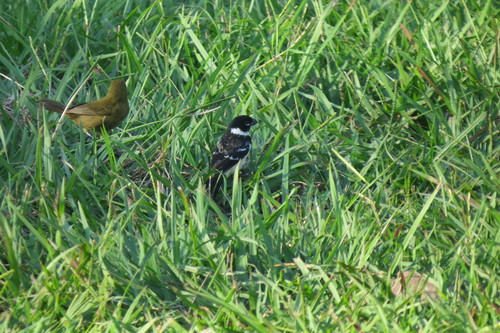 Sporophile de Morelet
 Cici verdinère
En bref
The most reliable field mark between Morelet's Seedeater and Black-faced Grassquit is the male head and underpart pattern: male Morelet's Seedeater shows a blackish crown and face with a bold white crescent below the eye, while male Black-faced Grassquit has an entirely black head and throat without any white crescent. Females and immatures are trickier, but Morelet's Seedeater females are grayer-olive and show thinner, paler wingbars, while Black-faced Grassquit females are drab olive-green overall with little to no wingbar contrast. In flight or perched, check for the white at the base of the primaries and wingbars on male Morelet's Seedeater, which are lacking in Black-faced Grassquit. Bill color also helps: female Morelet's Seedeater has a two-toned bill, while female Black-faced Grassquit has a darker bill. Both are small, chunky seedeaters, but subtle differences in plumage and structure are key for separation.
Conseils d’identification
- Male head pattern: Male Morelet's Seedeater always shows a blackish crown and face with a bold white crescent below the eye; Black-faced Grassquit males have an entirely black head and throat with no white crescent. This is the single best field mark for adult males.
- Male underparts: Morelet's Seedeater males (especially nominate) show a wide black band or patch below the throat, separated from the face by a white crescent; Black-faced Grassquit males are black from face through throat and underparts, sometimes with dark greenish flanks.
- Wing pattern (males): Male Morelet's Seedeater has white at the base of most primaries and two buffy white wingbars; Black-faced Grassquit lacks both the white primary bases and distinct wingbars. This is visible both perched and in flight.
- Female/immature upperparts: Female Morelet's Seedeater is grayish olive to brownish olive, often a bit paler and with more contrast than Black-faced Grassquit females, which are drab olive-green and browner or grayer below.
- Female/immature wingbars: Female Morelet's Seedeater shows thin, pale wingbars; female Black-faced Grassquit has little to no wingbar contrast. This is subtle but can be seen in good light.
- Bill color (females): Female Morelet's Seedeater has a two-toned bill (brown maxilla, pale mandible); female Black-faced Grassquit has a darker bill overall (dark maxilla, paler mandible but less contrast).
- Tail tips: Morelet's Seedeater has a black tail with thin gray feather tips; Black-faced Grassquit's tail is greenish to dusky and matches the upperparts, lacking pale tips.
- Size: Not a reliable separator; both are small, chunky seedeaters with overlapping measurements.
- Leg color: Morelet's Seedeater has gray legs; Black-faced Grassquit has dusky pinkish legs. This is subtle and not always visible in the field.
- Iris color: Both have dark or brown irises; not useful for separation.
- Song: If heard, Black-faced Grassquit gives a buzzy, emphatic song, unlike the more typical seedeater vocalizations (not described for Morelet's in the notes). Use this when birds are singing.
- Habitat and range: If in the West Indies or Caribbean islands, Black-faced Grassquit is likely; if in mainland Central America or southern Texas, Morelet's Seedeater is more probable. In overlap zones, rely on plumage.
- Courtship behavior: Black-faced Grassquit males may display with aerial song flights and wing vibrations; this behavior is not noted for Morelet's Seedeater.
- Juvenile confusion: Juvenile Black-faced Grassquit resembles the adult female, so use wingbar and bill color to separate from Morelet's Seedeater juveniles.
- Subspecies variation: Some Black-faced Grassquit subspecies (e.g., marchii) have paler or white bellies, but none show the white crescent or wingbars of Morelet's Seedeater. Always check for the eye crescent and wing pattern in males.
Taille
Both species are very similar in size, with Morelet's Seedeater averaging about 11 cm in length and 8.7 g in weight, and Black-faced Grassquit ranging from 10.2 to 11.5 cm and 7 to 13 g. In the field, size is not a reliable separator, as their measurements overlap almost completely. Both appear as small, compact finch-like birds.
Plumage
-
Juvenile/Immature/Female: Female and immature Morelet's Seedeater is grayish olive to brownish olive, with thin, pale wingbars and no white on the primaries. Female Black-faced Grassquit is a drab olive-green, browner or grayer below, with little to no wingbar contrast and no white on the wings. Juvenile Black-faced Grassquit resembles the adult female.
-
Adult Male (breeding): Male Morelet's Seedeater (S. m. sharpei) has a blackish crown, nape, and sides of head, a bold white crescent below the eye, olive-gray back, black wings with white at the base of most primaries, two buffy white wingbars, and cinnamon buff to whitish buff underparts. The nominate male (S. m. morelleti) has a larger white crescent and a wide black band across the breast. Male Black-faced Grassquit has an entirely black head, throat, and underparts (with some subspecies variation), greenish upperparts, wings, and tail, and no white crescent or wingbars.
-
Bill: Male Morelet's Seedeater has a black bill; female has a brown maxilla and pale mandible. Black-faced Grassquit males have a black bill; females have a dark maxilla and paler mandible, but overall bill appears darker than in female Morelet's.
-
Tail: Both have dark tails, but Morelet's Seedeater's tail is black with thin gray tips; Black-faced Grassquit's tail is greenish to dusky, matching the upperparts.
Comportement
Both species are typically seen foraging low in grass or shrubs, often in small groups. Black-faced Grassquit males may perform a distinctive aerial courtship display with wing vibrations and song, which is not described for Morelet's Seedeater. Both are generally unobtrusive and feed on seeds.
Habitat
Morelet's Seedeater is found from Texas to Panama, favoring open grassy areas, edges, and disturbed habitats. Black-faced Grassquit is restricted to the West Indies, some Caribbean islands, and northern coastal South America, also favoring grassy and shrubby areas. Overlap is limited to parts of Central America and the Caribbean; range is a strong clue if known.
Voix
Black-faced Grassquit has a distinctive buzzy song, described as an emphatic buzz or a buzzy 'tse-tsee-tsee-tsizzle-tsizzle-tsizzle,' sometimes preceded by a soft 'tsip.' Morelet's Seedeater's vocalizations are not described in the provided notes, so song is more likely to be useful for identifying Black-faced Grassquit, especially if the buzzy quality is heard.
Sporophile de Morelet · Cici verdinère · Mes oiseaux difficiles