

Marouette de Caroline vs Foulque d'Amérique
Porzana carolina contre Fulica americana
Faire un quiz avec Marouette de Caroline et Foulque d'Amérique
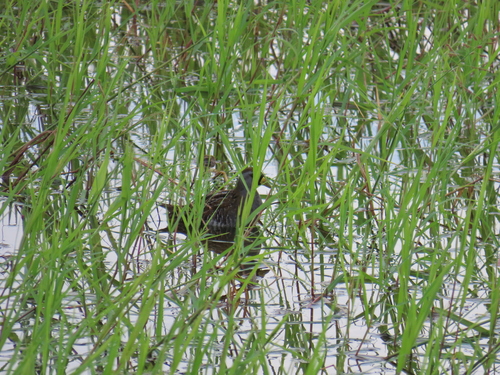 Marouette de Caroline
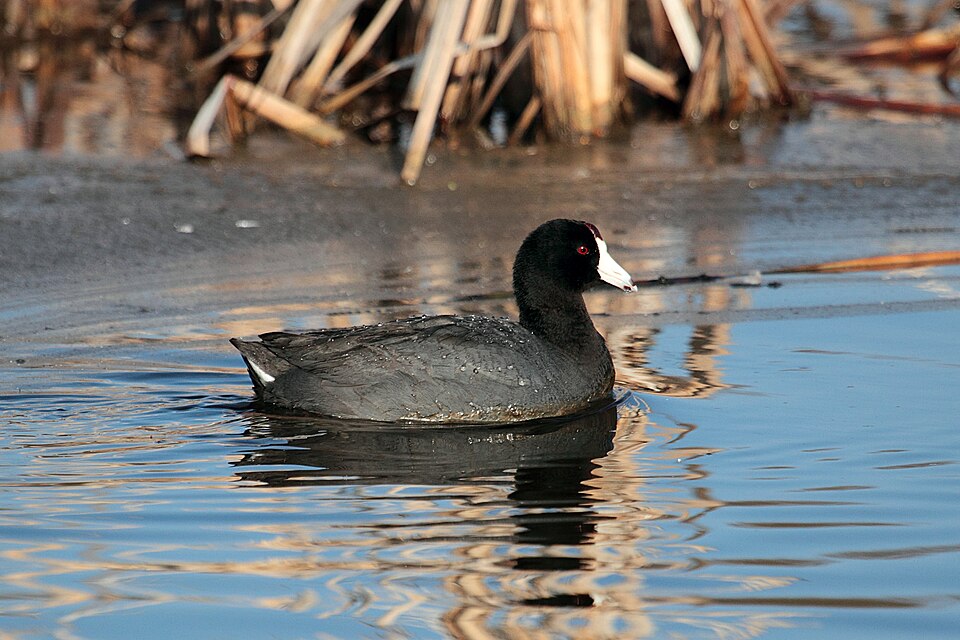 Foulque d'Amérique
En bref
The most reliable field mark to separate Sora from American Coot is overall size and structure: Sora is a much smaller, short-billed rail with a yellow bill and black facial markings, while American Coot is a chunky, chicken-sized bird with a white bill and shield. Juvenile Soras lack the black face but are still much smaller and more delicate than any coot. In flight, Sora shows short rounded wings and a fluttery, weak flight, while coots have longer wings and a more direct, duck-like flight. Both species can be found in marshes, but coot is much larger, darker, and often seen swimming in open water, unlike the secretive Sora.
Conseils d’identification
- Size is the first check: Sora is sparrow-sized; coot is chicken-sized. If the bird is nearly as big as a duck, it's a coot.
- Bill color and shape: Sora has a short, thick yellow bill; coot has a longer, white bill with a white shield extending onto the forehead, often with a reddish spot. Juvenile Sora's bill is paler but never white with a shield.
- Facial markings: Adult Sora shows black on the face and throat; coot has a plain dark face with a white shield. Juvenile Sora lacks the black but still shows a pale face and never a white shield.
- Flank pattern: Sora has bold black and white barring on the flanks (all ages); coot's flanks are plain dark gray, never barred.
- Body color: Sora is brown above, blue-grey below; coot is uniform dark slate-gray to black, never blue-grey or brown above.
- Legs and feet: Not always visible, but coot has large, lobed toes (not webbed) and greenish legs; Sora has much finer legs and toes.
- Flight style: Sora flushes with short, rounded wings in a weak, fluttery flight, quickly dropping into cover. Coot flies with longer, broader wings, often running on water to take off, and flies in a more direct, duck-like manner.
- Swimming behavior: Coots swim confidently in open water and dive; Sora rarely swims and prefers to walk or skulk along the water's edge.
- Habitat context: If the bird is in dense reeds or marsh vegetation, especially if only glimpsed, Sora is more likely. If in open water or with a flock, it's almost certainly a coot.
- Vocalizations: Sora's descending whinny is unique; coot never gives this call, instead making grunts and croaks.
- Juvenile confusion: Juvenile Sora lacks black face but still shows barred flanks and is much smaller than any coot. Juvenile coot is gray with olive-brown crown, no barring, and is still large and chunky.
- Group size: Soras are usually solitary or in loose association; coots often gather in large flocks.
- Bill shield: Only coot has a white frontal shield above the bill; Sora never does, at any age.
- Seasonal context: Both can occur in migration, but Sora is more likely in dense marshes in spring and fall; coot is present year-round in many areas and more likely in winter on open water.
- Direct comparison: If both species are present, the size and structure difference is immediately obvious—Sora is dwarfed by coot.
Taille
Sora is dramatically smaller: adults are 19–30 cm long with a 35–40 cm wingspan and weigh 49–112 g. American Coot is much larger: 34–43 cm long, 58–71 cm wingspan, and weighs 427–848 g ([wikipedia], [avonet]). Even a juvenile coot dwarfs an adult Sora. In the field, Sora appears sparrow-sized next to the chicken-sized coot.
Plumage
- Juvenile/immature Sora: Lacks black facial markings, has a whitish face and buff breast, but still shows blue-grey tones and barred flanks. No white bill or shield.
- Adult Sora: Blue-grey face and underparts, black face and throat, short yellow bill, black and white barring on flanks. No white on bill or forehead.
- Juvenile Coot: Olive-brown crown, gray body, lacks the adult's white bill and shield. Still much larger and bulkier than Sora, and never shows Sora's barred flanks or blue-grey face.
- Adult Coot: Uniform dark slate-gray to black, white bill with reddish-brown spot and white frontal shield. No barring on flanks, no blue-grey tones, and no yellow on bill.
- Wing pattern in flight: Not specifically described for either species, but Sora has short, rounded wings and weak, fluttery flight; coot has longer, broader wings and steadier, duck-like flight.
Comportement
Sora is secretive, often skulking in dense marsh vegetation or walking at the water's edge, rarely swimming in open water. When flushed, it flies weakly and quickly drops back into cover. American Coot is bold and gregarious, often seen swimming in open water, diving, and walking on land with a distinctive bobbing gait. Coots form large flocks, especially outside the breeding season, while Soras are usually solitary or in loose association.
Habitat
Both species use marshes, but Sora prefers dense emergent vegetation and is rarely seen in open water. Coots are common on open lakes, ponds, and marshes, often far from cover. If you see a rail-like bird swimming in the middle of a pond, it's almost certainly a coot; Sora is almost never found in such exposed situations.
Voix
Sora gives a distinctive, descending whinny or a slow whistled 'ker-whee.' These calls are often heard at dawn or dusk and are quite different from the coot's repertoire. American Coots are noisy, giving a variety of grunts, croaks, and cackles, but never the Sora's whinny. If you hear the whinny, it's a Sora.
Marouette de Caroline · Foulque d'Amérique · Mes oiseaux difficiles