

オウチュウ 対 ハシブトオウチュウ
Dicrurus macrocercus 対 Dicrurus annectens
オウチュウとハシブトオウチュウのクイズ
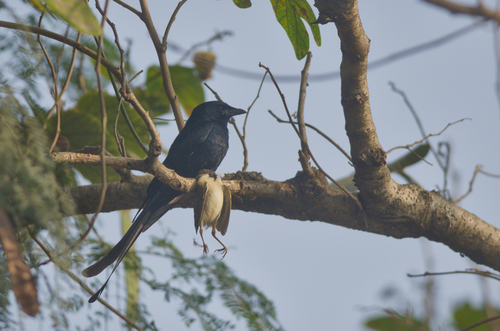 オウチュウ
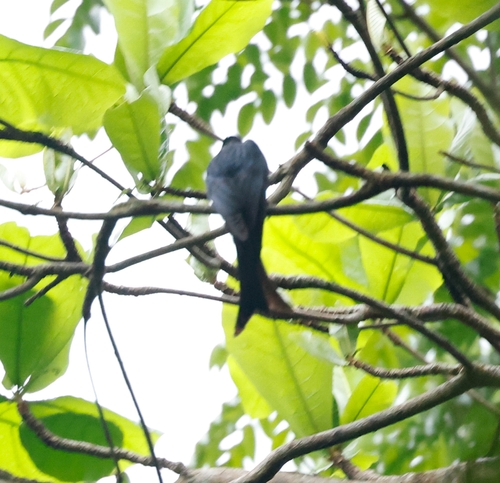 ハシブトオウチュウ
要点
The most reliable field mark between Black Drongo and Crow-billed Drongo is the tail shape: Black Drongo shows a distinctly deep, wide forked tail, while Crow-billed Drongo has a shallower fork. Bill structure is also key—Crow-billed Drongo has a noticeably stouter, heavier bill. Juvenile Black Drongos may show brownish tones and white barring or speckling on the underparts, which Crow-billed Drongo lacks. Both species are all-black and superficially similar, but careful attention to tail shape, bill size, and subtle plumage details (especially in young birds) will separate them in the field.
識別のコツ
- Tail shape is the most consistent separator: Black Drongo has a deep, wide forked tail, while Crow-billed Drongo’s fork is shallow. This is best seen when perched or in flight, but beware of tail wear or molt.
- Bill structure: Crow-billed Drongo’s bill is noticeably stouter and heavier, giving the head a more robust look. Black Drongo’s bill is slimmer and more delicate.
- Juvenile plumage: Young Black Drongos are brownish with white barring or speckling on the belly/vent (juveniles) or white-tipped belly feathers (first-year). Crow-billed Drongo is jet-black at all ages, so any brownish or barred underparts point to Black Drongo.
- Gape spot: Adult Black Drongo often shows a small white spot at the base of the gape. This is absent in Crow-billed Drongo.
- Gloss: Black Drongo is described as glossy black, sometimes with a greenish gloss in some subspecies. Crow-billed Drongo is jet-black but gloss differences are subtle and unreliable in the field.
- Perching behavior: Black Drongo often perches upright on wires, exposed branches, or even livestock. Crow-billed Drongo is less likely to be seen in such exposed, anthropogenic settings.
- Aggression: Black Drongo is famously bold, often mobbing larger birds and joining mixed flocks at fires or ploughed fields. Crow-billed Drongo is not noted for such behavior.
- Habitat: Black Drongo is common in open country, farmland, and urban edges. Crow-billed Drongo prefers moist tropical forests and is rarely in open or urban habitats. Context can be a strong clue.
- Voice: If you hear a two-note 'tee-hee' call, it is likely Black Drongo. Crow-billed Drongo’s voice is not described here, so absence of this call is not diagnostic.
- Sexual dimorphism: Both species lack obvious sex differences in plumage.
- Size: Crow-billed Drongo is heavier and more robust, but size overlap is significant. Use structure and tail shape over size.
- Flight style: Black Drongo is described as agile, with strong flapping and aerobatic maneuvers. Crow-billed Drongo’s flight style is not detailed, so this is only a supporting clue.
- Molt timing: Black Drongo molts from June to October in southern India, but molt sequence is not a field mark for separation from Crow-billed Drongo.
- Potential confusion: Juvenile Black Drongo may be confused with other drongos (e.g., White-bellied Drongo) due to pale underparts, but Crow-billed Drongo is always uniform black.
- Range overlap: Both species can occur in parts of India and Southeast Asia, but Crow-billed Drongo is more restricted to forested regions.
大きさ
Direct size data is limited, but Crow-billed Drongo is heavier (body mass about 56 g [wikidata]), while Black Drongo is described as smaller and slimmer (length 28 cm [wikipedia]). In the field, Crow-billed Drongo may appear more robust, especially in the head and bill, but overall length is similar. Size alone is not a strong separator unless birds are side by side.
羽色
Juvenile Black Drongos are brownish with some white barring or speckling on the belly and vent, and first-year birds have white-tipped belly feathers, which can be confused with other drongos but not with Crow-billed Drongo, which is described as jet-black at all ages. Adult Black Drongo is glossy black with a wide, deep forked tail and may show a small white spot at the base of the gape. Crow-billed Drongo is also all black but with a shallower forked tail and a stouter bill; no pale gape spot or underpart markings are noted for any age. Both species lack sexual dimorphism in plumage.
行動
Black Drongo is notably aggressive and fearless, often attacking larger birds and even mobbing raptors. It perches upright on exposed perches, including wires and grazing animals, and is very active at dawn and dusk. Crow-billed Drongo's behavior is less described but is not noted for the same level of aggression or conspicuous mobbing. Both species are aerial insectivores, but Black Drongo’s boldness and tendency to join mixed flocks at fires or ploughed fields may be more obvious.
生息環境
Black Drongo is common in open country, agricultural fields, and urban edges across much of southern Asia. Crow-billed Drongo prefers moist tropical forests and is less likely in open country. Thus, habitat can be a strong clue: Black Drongo in open, human-modified landscapes; Crow-billed Drongo in forested or wetter, more natural habitats.
声
Black Drongo produces a wide range of calls, with a typical two-note 'tee-hee' reminiscent of a shikra. No specific vocalization is described for Crow-billed Drongo in the notes, so voice is not a reliable separator unless Black Drongo’s distinctive call is heard.