

ヒメクロアジサシ 対 シロビタイアジサシ
Anous minutus 対 Sterna striata
ヒメクロアジサシとシロビタイアジサシのクイズ
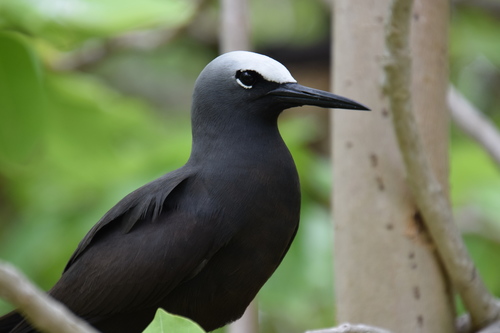 ヒメクロアジサシ
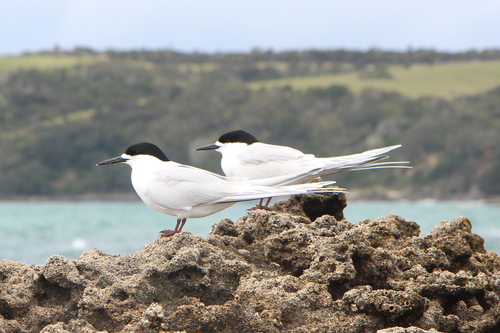 シロビタイアジサシ
要点
The most reliable field mark to separate Black Noddy from White-fronted Tern is the head pattern: Black Noddy shows a white cap with dark lores, while White-fronted Tern has a black cap (in breeding) or mottled dark cap (immature), always leaving a white forehead band. In flight, White-fronted Tern is strikingly pale overall with a silvery-grey upperwing and deeply forked tail, while Black Noddy is uniformly dark with a white crown and lacks the tern's long swallow-like tail. Juvenile and immature White-fronted Terns show brownish-cream and grey flecking on the upperwing and back, never present in Black Noddy. Both species are medium-sized terns, but their structure and coloration are distinct at all ages.
識別のコツ
- Head pattern is diagnostic: Black Noddy shows a sharply defined white cap with dark lores and a dark face, while White-fronted Tern has a black cap (breeding) or mottled dark cap (immature), always leaving a white band above the bill. This is the single most reliable field mark at all ages.
- Upperwing and back in juveniles/immatures: Juvenile White-fronted Terns have obvious brownish-cream and grey flecking on the upperwing, back, and mantle, plus a mottled dark cap—never seen in Black Noddy, which is uniformly dark with a white cap at all ages.
- Overall coloration: Black Noddy is sooty black to dark brown all over except for the white cap and small white facial spots; White-fronted Tern is pale, with a white body, underwing, and tail, and a silvery-grey upperwing.
- Tail shape: White-fronted Tern has a long, deeply forked tail, especially obvious in flight and in breeding adults. Black Noddy's tail is short and squared-off, never deeply forked.
- Bill color and shape: Both have black bills, but White-fronted Tern's is slender and pointed, sometimes duller at the tip; Black Noddy's is sharply pointed and uniformly black. Bill shape is subtle but may help at close range.
- Leg color: Both have dark legs, but Black Noddy's are fully webbed and black (orange in some subspecies), while White-fronted Tern's are stumpy and deep burgundy-black.
- Flight jizz: White-fronted Tern is buoyant, with long wings and a swallow-like tail; Black Noddy is steadier and more compact, with shorter, more tapered wings and a squared tail.
- Facial markings: Black Noddy has a small white crescent under each eye and a white spot above, lacking in White-fronted Tern.
- Lores color: Black Noddy has dark lores (between eye and bill), while White-fronted Tern's lores are pale or white, especially obvious in breeding plumage.
- Seasonal changes: White-fronted Tern's black cap recedes and becomes mottled in non-breeding adults and immatures, but always leaves a white forehead band. Black Noddy's white cap is always present and sharply bordered.
- Perched posture: White-fronted Tern appears elongated and slender when perched; Black Noddy is stockier and sits more upright.
- Habitat context: In New Zealand, a pale tern with a black cap is almost certainly White-fronted Tern; a uniformly dark tern with a white cap would be exceptional and likely a vagrant Black Noddy.
- Group behavior: White-fronted Tern often forms large, dense flocks, especially at breeding colonies; Black Noddy may nest in colonies but is less likely to be seen in such large, tight groups in New Zealand.
- Confusion risk: Immature White-fronted Terns are most likely to cause confusion due to their mottled caps and brownish upperwings, but their overall pale appearance and lack of a white cap should prevent mix-ups.
- When in doubt: Focus on the combination of overall darkness, white cap, and dark lores for Black Noddy; versus pale body, black cap (or mottled cap), and white forehead for White-fronted Tern.
大きさ
Both species are medium-sized terns with similar body lengths (Black Noddy: 35–37 cm; White-fronted Tern: 35–43 cm) [wikipedia], and their masses overlap (Black Noddy: 98–144 g, White-fronted Tern: ~128 g) [wikidata]. In the field, size alone is not a reliable separator. However, White-fronted Tern has a slightly longer wingspan (79–82 cm vs. Black Noddy's 66–72 cm) and a more elongated, slender appearance, especially in flight due to its deeply forked tail.
羽色
Juvenile and immature White-fronted Terns are distinctive: they show flecks of light to dark grey and warm milky browns on the upperwing, back, and mantle, with a mottled, incomplete dark cap—these marks are never present in Black Noddy of any age. Adult and older immature White-fronted Terns have a pure white body, underwing, and tail, with a pale silvery-grey upperwing and a black cap that recedes in non-breeding birds. Black Noddy, by contrast, is uniformly dark sooty brown to black except for a sharply defined white cap, with dark lores (the area between the eye and bill), a small white crescent under each eye, and a white spot above. The Black Noddy's upperparts, underparts, and wings are all dark, lacking any pale or silvery panel. Its tail is short and squared-off, not deeply forked. The bill and legs are black (except orange feet in some subspecies), while White-fronted Tern always has black legs and a slender black bill. In summary: White-fronted Tern is always much paler, with a black cap and white forehead, while Black Noddy is dark with a white cap and dark face.
行動
Both species are agile fliers, but White-fronted Tern is especially graceful and buoyant, often feeding by dipping and hovering over shoaling fish, and its long, deeply forked tail is conspicuous in flight. Black Noddy flies with steady, direct wingbeats and appears more compact and less buoyant, with a shorter, squared tail and less pronounced fork. When perched, White-fronted Tern often appears more elongated and slender, while Black Noddy is stockier and sits more upright.
生息環境
White-fronted Tern is most abundant along the New Zealand coastline and offshore islands, often seen in large flocks feeding over inshore waters or nesting on rocky cliffs, shingle, or sand. Black Noddy is a tropical seabird, typically found around coral islands and atolls, nesting in trees or on rocky ledges. In New Zealand, White-fronted Tern is common and widespread, while Black Noddy would be highly unusual. Context of location is a strong clue.