
Motmot

ハネビロノスリ 対 アレチノスリ

Buteo platypterus 対 Buteo swainsoni

ハネビロノスリとアレチノスリのクイズ
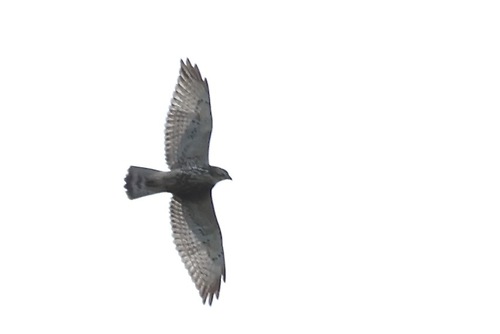
ハネビロノスリ (Buteo platypterus) ハネビロノスリ
アレチノスリ (Buteo swainsoni) アレチノスリ

メディア

読み込み中…

要点

The best way to separate Broad-winged Hawk from Swainson's Hawk is by size and wing/tail structure: Broad-winged is a compact, short-tailed, broad-winged Buteo, while Swainson's is much larger, longer-winged, and longer-tailed. In flight, Broad-winged Hawks show short, broad wings with a unique tapered tip, and a short tail with bold black-and-white bands; Swainson's Hawks have long, pointed wings (especially in adults) and a longer, more finely banded tail. Adult Swainson's Hawks (light morph) show a contrasting dark chest 'bib' and white throat, while Broad-winged adults have a horizontally barred chest and lack the bib. Juvenile plumage and flight patterns can be confusing, but tail and underwing patterns remain key. If you see a soaring Buteo with a compact shape and bold tail bands, think Broad-winged; if it's lankier with a bibbed chest and long wings, it's likely Swainson's.

識別のコツ

  1. Size and Structure: Swainson's Hawk is much larger and heavier than Broad-winged Hawk. In direct comparison, Swainson's looks lanky and long-winged; Broad-winged is compact, with short, broad wings and a short tail. This is reliable for all ages and seasons.
  2. Tail Pattern (All Ages): Broad-winged Hawk shows a short tail with 2–3 bold white bands (including a broad subterminal band) on a dark background. Swainson's Hawk has a longer, gray-brown tail with about six narrow dark bands and a less obvious subterminal band. This is a key mark in flight and perched.
  3. Wing Shape in Flight: Broad-winged Hawk's wings are short, broad, and distinctly tapered at the tip, giving a compact, paddle-shaped look. Swainson's Hawk has long, pointed wings, especially noticeable in adults, and often holds them in a shallow dihedral while soaring.
  4. Adult Underparts: Adult Broad-winged Hawks have a white belly and chest with horizontal brown barring. Adult Swainson's Hawks (light morph) have a white belly, a dark reddish 'bib' across the chest, and a white throat/face patch. The bib is a strong field mark for Swainson's.
  5. Juvenile Underparts: Juvenile Broad-winged Hawks are whiter below with vertical streaks, while juvenile Swainson's Hawks are pale with scattered darker mottling and lack the strong bib or horizontal barring.
  6. Underwing Pattern (Adults): Swainson's Hawk (light morph) shows pale underwing coverts (leading edge) and dark flight feathers (trailing edge), creating a sharp contrast. Broad-winged Hawk's underwings are less contrasting and more evenly patterned.
  7. Dark Morphs: Both species have rare dark morphs. Swainson's dark morphs are dark brown with a pale patch under the tail; Broad-winged dark morphs are more uniformly dark. The pale under-tail patch is a Swainson's clue.
  8. Perched Posture: Broad-winged Hawk appears compact and short-tailed when perched. Swainson's Hawk looks longer-legged, longer-tailed, and more upright.
  9. Habitat Context: In forests or at the edge of woodlands, Broad-winged is more likely. In open country, grasslands, or agricultural fields, Swainson's is expected.
  10. Behavior: Swainson's often perches on the ground, follows tractors or fires, and soars with wings in a dihedral. Broad-winged is less likely to be seen on the ground and is more secretive outside migration.
  11. Migration Flocks: Both species migrate in large flocks, but Broad-winged forms dense 'kettles' in the east, while Swainson's migrates in massive groups across the Great Plains.
  12. Head Pattern: Adult Swainson's has a white throat and face patch, lacking in Broad-winged. Broad-winged's head is more uniformly brown.
  13. Tail Length: Even at rest, Swainson's tail projects well past the wing tips, while Broad-winged's tail is relatively short.
  14. Flight Jizz: Swainson's looks buoyant, with long wings and tail; Broad-winged is more compact and stiff-winged in flight.
  15. Pitfalls: Juvenile plumages can be confusing, especially at a distance. Focus on tail banding, wing shape, and overall structure rather than color alone.

大きさ

Swainson's Hawk is substantially larger and heavier than Broad-winged Hawk. Swainson's averages about 958.5 g in body mass [wikidata], while Broad-winged is much lighter (265–560 g). Broad-winged is a small Buteo (32–44 cm length), with a short tail (14.5–19 cm) and relatively short wings (wingspan 74–100 cm). Swainson's Hawk is a large Buteo, with a noticeably longer body, wings, and tail. In the field, Swainson's often looks lanky and long-winged, while Broad-winged is compact and stubby by comparison.

羽色

Juvenile Broad-winged Hawks have more white overall and show longitudinal streaking on the underparts, while adults have horizontal barring. Their tails are dark with 2–3 bold white bands (including a broad subterminal band), and the wings are short and broad with a unique taper. Juvenile Swainson's Hawks are pale below with some darker mottling, and the tail is gray-brown with about six narrow dark bands and a less obvious subterminal band; the chest is pale with scattered marks, lacking the strong horizontal barring of adult Broad-winged. Adult Swainson's (light morph) show a distinctive dark reddish 'bib' on the chest, a white throat and face patch, and underwings with pale linings and dark flight feathers. Broad-winged adults lack the bib and have a more uniform brown head and chest with horizontal barring. Both species have rare dark morphs, but Swainson's dark morphs are dark brown with a contrasting pale patch under the tail, while Broad-winged dark morphs are more uniformly dark. In flight, Swainson's shows long, pointed wings and a long tail with fine barring; Broad-winged shows short, broad wings and a short, boldly banded tail.

行動

Swainson's Hawk often hunts by soaring with wings held in a dihedral, gliding over open country, or perching on the ground and following tractors or fires for insects. Broad-winged Hawk is more forest-associated, typically seen soaring in migration or perching in trees. Swainson's is more likely to be seen on the ground or following agricultural activity, while Broad-winged is less terrestrial and more secretive outside migration. Both species soar on migration, but Broad-winged forms large kettles in eastern North America, while Swainson's migrates in massive flocks across the Great Plains and into South America.

生息環境

Broad-winged Hawk breeds in eastern North American forests and is rarely found in open country. Swainson's Hawk prefers open habitats—prairies, grasslands, and agricultural fields—across western and central North America. If you see a Buteo soaring over dense woods, Broad-winged is more likely; over open grassland or farmland, Swainson's is the default. During migration, both can be seen in a variety of habitats, but their breeding habitats are quite distinct.

より良い説明を送る

比較と同じ項目を使ってください。文章はすぐに公開されます。

The best way to separate Broad-winged Hawk from Swainson's Hawk is by size and wing/tail structure: Broad-winged is a compact, short-tailed, broad-winged Buteo, while Swainson's is much larger, longer-winged, and longer-tailed. In flight, Broad-winged Hawks show short, broad wings with a unique tapered tip, and a short tail with bold black-and-white bands; Swainson's Hawks have long, pointed wings (especially in adults) and a longer, more finely banded tail. Adult Swainson's Hawks (light morph) show a contrasting dark chest 'bib' and white throat, while Broad-winged adults have a horizontally barred chest and lack the bib. Juvenile plumage and flight patterns can be confusing, but tail and underwing patterns remain key. If you see a soaring Buteo with a compact shape and bold tail bands, think Broad-winged; if it's lankier with a bibbed chest and long wings, it's likely Swainson's.

  1. Size and Structure: Swainson's Hawk is much larger and heavier than Broad-winged Hawk. In direct comparison, Swainson's looks lanky and long-winged; Broad-winged is compact, with short, broad wings and a short tail. This is reliable for all ages and seasons.
  2. Tail Pattern (All Ages): Broad-winged Hawk shows a short tail with 2–3 bold white bands (including a broad subterminal band) on a dark background. Swainson's Hawk has a longer, gray-brown tail with about six narrow dark bands and a less obvious subterminal band. This is a key mark in flight and perched.
  3. Wing Shape in Flight: Broad-winged Hawk's wings are short, broad, and distinctly tapered at the tip, giving a compact, paddle-shaped look. Swainson's Hawk has long, pointed wings, especially noticeable in adults, and often holds them in a shallow dihedral while soaring.
  4. Adult Underparts: Adult Broad-winged Hawks have a white belly and chest with horizontal brown barring. Adult Swainson's Hawks (light morph) have a white belly, a dark reddish 'bib' across the chest, and a white throat/face patch. The bib is a strong field mark for Swainson's.
  5. Juvenile Underparts: Juvenile Broad-winged Hawks are whiter below with vertical streaks, while juvenile Swainson's Hawks are pale with scattered darker mottling and lack the strong bib or horizontal barring.
  6. Underwing Pattern (Adults): Swainson's Hawk (light morph) shows pale underwing coverts (leading edge) and dark flight feathers (trailing edge), creating a sharp contrast. Broad-winged Hawk's underwings are less contrasting and more evenly patterned.
  7. Dark Morphs: Both species have rare dark morphs. Swainson's dark morphs are dark brown with a pale patch under the tail; Broad-winged dark morphs are more uniformly dark. The pale under-tail patch is a Swainson's clue.
  8. Perched Posture: Broad-winged Hawk appears compact and short-tailed when perched. Swainson's Hawk looks longer-legged, longer-tailed, and more upright.
  9. Habitat Context: In forests or at the edge of woodlands, Broad-winged is more likely. In open country, grasslands, or agricultural fields, Swainson's is expected.
  10. Behavior: Swainson's often perches on the ground, follows tractors or fires, and soars with wings in a dihedral. Broad-winged is less likely to be seen on the ground and is more secretive outside migration.
  11. Migration Flocks: Both species migrate in large flocks, but Broad-winged forms dense 'kettles' in the east, while Swainson's migrates in massive groups across the Great Plains.
  12. Head Pattern: Adult Swainson's has a white throat and face patch, lacking in Broad-winged. Broad-winged's head is more uniformly brown.
  13. Tail Length: Even at rest, Swainson's tail projects well past the wing tips, while Broad-winged's tail is relatively short.
  14. Flight Jizz: Swainson's looks buoyant, with long wings and tail; Broad-winged is more compact and stiff-winged in flight.
  15. Pitfalls: Juvenile plumages can be confusing, especially at a distance. Focus on tail banding, wing shape, and overall structure rather than color alone.

Swainson's Hawk is substantially larger and heavier than Broad-winged Hawk. Swainson's averages about 958.5 g in body mass [wikidata], while Broad-winged is much lighter (265–560 g). Broad-winged is a small Buteo (32–44 cm length), with a short tail (14.5–19 cm) and relatively short wings (wingspan 74–100 cm). Swainson's Hawk is a large Buteo, with a noticeably longer body, wings, and tail. In the field, Swainson's often looks lanky and long-winged, while Broad-winged is compact and stubby by comparison.

Juvenile Broad-winged Hawks have more white overall and show longitudinal streaking on the underparts, while adults have horizontal barring. Their tails are dark with 2–3 bold white bands (including a broad subterminal band), and the wings are short and broad with a unique taper. Juvenile Swainson's Hawks are pale below with some darker mottling, and the tail is gray-brown with about six narrow dark bands and a less obvious subterminal band; the chest is pale with scattered marks, lacking the strong horizontal barring of adult Broad-winged. Adult Swainson's (light morph) show a distinctive dark reddish 'bib' on the chest, a white throat and face patch, and underwings with pale linings and dark flight feathers. Broad-winged adults lack the bib and have a more uniform brown head and chest with horizontal barring. Both species have rare dark morphs, but Swainson's dark morphs are dark brown with a contrasting pale patch under the tail, while Broad-winged dark morphs are more uniformly dark. In flight, Swainson's shows long, pointed wings and a long tail with fine barring; Broad-winged shows short, broad wings and a short, boldly banded tail.

Swainson's Hawk often hunts by soaring with wings held in a dihedral, gliding over open country, or perching on the ground and following tractors or fires for insects. Broad-winged Hawk is more forest-associated, typically seen soaring in migration or perching in trees. Swainson's is more likely to be seen on the ground or following agricultural activity, while Broad-winged is less terrestrial and more secretive outside migration. Both species soar on migration, but Broad-winged forms large kettles in eastern North America, while Swainson's migrates in massive flocks across the Great Plains and into South America.

Broad-winged Hawk breeds in eastern North American forests and is rarely found in open country. Swainson's Hawk prefers open habitats—prairies, grasslands, and agricultural fields—across western and central North America. If you see a Buteo soaring over dense woods, Broad-winged is more likely; over open grassland or farmland, Swainson's is the default. During migration, both can be seen in a variety of habitats, but their breeding habitats are quite distinct.

変更を破棄しますか?

保存していない編集があります。今離れると失われます。

ハネビロノスリ · アレチノスリ · 苦手な鳥