

ミナミクロクイナ 対 シロスジキンパラ
Zapornia tabuensis 対 Mayrimunia tristissima
ミナミクロクイナとシロスジキンパラのクイズ
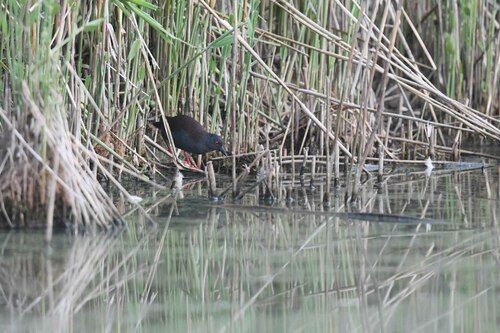 ミナミクロクイナ
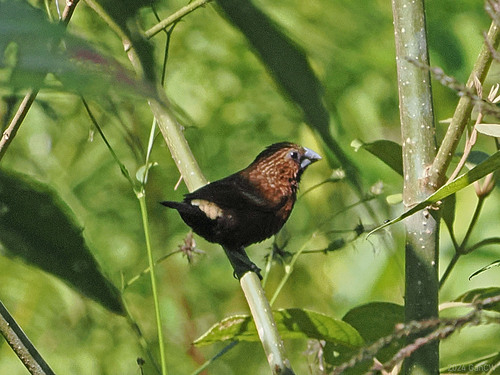 シロスジキンパラ
要点
The most reliable field mark between Spotless Crake and Streak-headed Munia is overall structure and posture: Spotless Crake is a secretive, rail-like bird with a short tail, long legs, and a slate-blue to brownish body, while Streak-headed Munia is a compact, short-tailed finch with a distinctively streaked head and yellowish rump. Juvenile Spotless Crakes are duller and browner but still lack the fine head streaking and yellow rump of the munia. In flight or perched, the crake’s longer legs and reddish-pink (or duller in juveniles) legs contrast with the munia’s typical finch proportions. Habitat is also a strong clue: Spotless Crake favors dense wetlands, while Streak-headed Munia is found in more open, grassy or edge habitats. Voice and behavior further separate them, as the crake is shy and skulking, while the munia is more likely to be seen in small, active flocks.
識別のコツ
- Head pattern: Streak-headed Munia always shows fine, pale streaks on the head; Spotless Crake never does, regardless of age.
- Rump color: Munia has a yellowish rump, visible in flight and often when perched; Spotless Crake’s rump is dark, matching the back and tail.
- Leg color: Adult Spotless Crake has reddish-pink legs; juveniles have duller, brownish legs. Munia’s legs are not reddish and are typical finch color.
- Eye color: Adult Spotless Crake has deep red eyes, a striking feature at close range; juveniles have brownish-orange eyes. Munia’s eyes are dark, never red.
- Bill shape: Spotless Crake has a slender, rail-like black bill; munia has a short, conical finch bill, adapted for seed eating.
- Body shape and posture: Crake is longer-legged, with a horizontal, rail-like stance and a short tail often held down; munia is compact, upright, and short-tailed.
- Plumage tones: Crake is blue-grey to brownish with no streaks or yellow; munia is dark brown with streaks and yellow rump, sometimes with white spots (leucosticta).
- Juvenile confusion: Young Spotless Crake is paler and browner but still lacks streaking and yellow rump; legs and eyes are duller but still not like a munia.
- Flight style: Crake flies low and weakly, usually only when flushed, and quickly drops back into cover; munia flies in short, bounding flights between perches, often in groups.
- Habitat: Crake is in dense, wet vegetation near water; munia is in open grassland or edge, rarely near dense wetlands.
- Social behavior: Crake is solitary or in pairs, very secretive; munia is gregarious, often in small flocks.
- Voice: Munia gives a short, buzzing note, especially in flight; crake’s calls are more varied, including high-pitched 'pit-pit' and purring, but are rarely heard unless you are in dense wetland habitat.
- Tail: Crake’s tail is short and often hidden; munia’s tail is also short but more visible and squared off.
- Sexual dimorphism: Neither species shows obvious sex differences in the field; both sexes look alike.
- When in doubt: If you see a small, streaked brown bird in open grass or edge habitat, it is almost certainly a munia. If you glimpse a blue-grey, reddish-legged bird skulking in reeds, it is a crake.
大きさ
Spotless Crake is significantly larger and heavier, measuring 17–20 cm in length with a wingspan of 26–29 cm and weighing 40–50g [wikipedia]. In contrast, Streak-headed Munia is much smaller at about 10 cm in length [wikipedia]. The crake’s bulkier, rail-like body and longer legs are apparent when seen side by side or with experience. The munia is a compact, small finch, noticeably lighter and shorter, with a proportionally shorter tail and smaller bill.
羽色
- Juvenile/immature Spotless Crake: Duller, paler brown overall with a white chin/throat patch, dull brown back, and dull grey-brown underparts. Eyes are brownish-orange, legs/feet are olive-brown to brownish-flesh, turning red with age. No streaking or yellow rump.
- Adult Spotless Crake: Bluish-grey slate head, neck, and underparts; dark reddish-brown back and wings; blackish tail; deep red eyes; reddish-pink legs. Occasional light grey/white chin patch. No streaking or yellow rump.
- Streak-headed Munia (all ages): Mainly dark brown with fine light streaks on the head; yellowish rump is a key field mark. Subspecies leucosticta adds white spotting on face, breast, and upper wing-coverts. No blue-grey tones, no reddish legs, and no red eyes.
- Key contrast: Only the munia shows fine head streaking and a yellowish rump; only the crake has blue-grey tones, reddish legs, and red eyes (adults).
行動
Spotless Crake is extremely shy, secretive, and typically stays hidden in dense wetland vegetation, moving quietly and rarely flying unless flushed. It is usually solitary or in pairs. Streak-headed Munia is much more social, often seen in small flocks, and is active, feeding openly on seeds in grasslands or edges. Munias are more likely to be observed perched in the open or flying short distances between perches, while crakes are rarely seen in the open and tend to run or creep rather than fly.
生息環境
Spotless Crake is almost always found in dense, tall wetland vegetation—reeds, sedges, rushes, or grass tussocks—near water. It avoids open areas and is rarely seen away from thick cover. Streak-headed Munia prefers more open habitats such as grasslands, edges of forests, and sometimes gardens or cultivated areas, typically away from dense wetlands. If you see a small, streaked brown bird in open grassy areas, it is almost certainly a munia, not a crake.
声
Spotless Crake has a variety of calls, including a high-pitched 'pit-pit', a 'mook' sound, and a rapid, loud 'purring' series of notes (its song), but these are rarely heard except in dense wetland habitat and are not likely to be confused with finch-like calls. Streak-headed Munia gives a short, buzzing note, often repeated in flight, typical of estrildid finches. The munia’s call is much simpler and more finch-like, while the crake’s calls are more varied and rail-like.