
Motmot

milhafre-preto vs bútio-mourisco

Milvus migrans versus Buteo rufinus

Jogue um quiz com milhafre-preto e bútio-mourisco
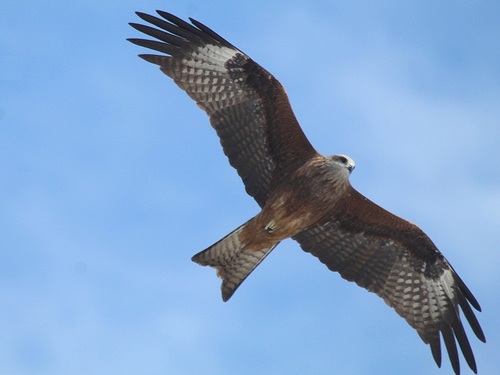
milhafre-preto (Milvus migrans) milhafre-preto
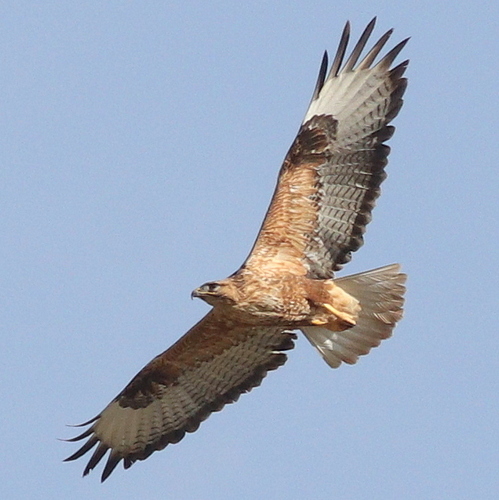
bútio-mourisco (Buteo rufinus) bútio-mourisco

Mídia

Carregando…

Em resumo

The most reliable field mark to separate Black Kite from Long-legged Buzzard is the tail shape in flight: Black Kite shows a distinctly less forked, shallowly notched tail, while Long-legged Buzzard has a long, rounded (not forked) tail. Juvenile plumage can be confusing, but Black Kite juveniles lack the neat pale covert edgings and banded tails typical of young Long-legged Buzzard. In structure, Black Kite is slimmer and more buoyant in flight, with narrower wings and a more agile, tilting flight style, while Long-legged Buzzard is bulkier, with broader wings and a more Buteo-like, steady flight. Perched, Black Kite is darker overall, with a paler head and streaked body, while Long-legged Buzzard is highly variable but often shows a paler, sandy or rufous head and a contrastingly pale or rufous tail.

Dicas de identificação

  1. Tail shape in flight: Black Kite always shows a shallowly forked tail, most visible when spread; Long-legged Buzzard has a long, rounded tail with no fork. This is reliable for all ages.
  2. Juvenile upperwing pattern: Juvenile Long-legged Buzzard has neat, pale edging to the greater and median coverts, giving a patterned look to the upperwing; Black Kite juveniles lack these pale edgings and appear more uniformly dark above.
  3. Tail pattern in juveniles: Young Long-legged Buzzard shows a pale tail with irregular brown bars (often three broad bands in dark morphs); Black Kite juveniles have a darker, less obviously banded tail.
  4. Overall plumage tone: Black Kite is generally dark brown above and below, with a paler (sometimes whitish) head and streaked body; Long-legged Buzzard is highly variable but often paler, with sandy, rufous, or even dark morphs, and a paler or rufous tail.
  5. Head and nape: Long-legged Buzzard (especially pale/intermediate morphs) often has a pale, sandy or rufous head with a darker nape and a dark eye-stripe; Black Kite has a paler head but not as contrasting, and the nape is not as distinctly marked.
  6. Flight silhouette: Black Kite is slimmer, with longer, narrower wings and a more agile, tilting flight; Long-legged Buzzard is bulkier, with broad wings, a protruding head, and a more eagle-like, steady flight.
  7. Perched structure: Black Kite appears slender and less upright; Long-legged Buzzard perches very upright, often on prominent rocks or poles, and looks heavier-bodied with longer legs.
  8. Leg color: Both species have yellow legs, so this is not a useful separator.
  9. Bill color: Black Kite has a black bill with yellow cere and gape; Long-legged Buzzard has a large bill with dull yellow cere, but this is subtle at distance.
  10. Flight behavior: Black Kite is buoyant, often seen soaring in groups, with elastic wingbeats; Long-legged Buzzard is more solitary, with slower, steadier flight.
  11. Habitat context: Black Kite is common in urban and open habitats, often near water and human activity; Long-legged Buzzard prefers open, dry, rocky, or steppe habitats.
  12. Vocalization: Listen for Black Kite's shrill whistle and whinnying call; Long-legged Buzzard is generally silent or gives less distinctive calls.
  13. Dark morph confusion: Dark morph Long-legged Buzzard can appear very dark, but always lacks the forked tail of Black Kite and may show pale streaks on the nape or a banded tail.
  14. Group behavior: Black Kite often soars in flocks; Long-legged Buzzard is more often seen singly or in pairs.
  15. Season and age: Juvenile marks (pale covert edges, banded tail) are most useful from fledging up to 2–3 years in Long-legged Buzzard; adult marks (tail shape, overall color) are reliable year-round.

Tamanho

Black Kite is a medium-sized raptor (body mass ~828g [wikidata]), while Long-legged Buzzard is among the larger Buteos and appears bulkier and heavier-bodied in the field. Black Kite is more slender, with longer, narrower wings relative to its body, whereas Long-legged Buzzard is broader-chested, with longer legs and a more robust build. In direct comparison, expect Long-legged Buzzard to look larger and more powerful, especially when perched, though overlap in size can occur.

Plumagem

Juvenile Long-legged Buzzard (all morphs) shows neat, pale edging on the upperwing coverts and a banded tail (pale with irregular brown bars, often three broad bands in dark morphs), which is not seen in Black Kite juveniles. Black Kite juveniles are overall dark brown with streaked underparts, lacking the pale covert edgings and with a less obviously banded tail. Adults of both species differ: Black Kite is uniformly dark brown above, with a paler (sometimes whitish) head and a shallowly forked, dark tail; Long-legged Buzzard adults vary from pale sandy to rufous to dark brown, but typically have a paler head, contrasting upperparts, and a long, rounded, often pale or rufous tail (not forked). In flight, Black Kite shows a less forked tail and more uniform dark plumage, while Long-legged Buzzard often shows contrasting pale panels on the upperwing and a paler tail. Dark morph Long-legged Buzzards can be very dark overall, but still lack the forked tail of Black Kite.

Comportamento

Black Kite is agile and buoyant in flight, often seen soaring, circling, and tilting with quick, elastic wingbeats. It is more likely to be seen gliding and wheeling in thermals, sometimes in flocks. Long-legged Buzzard is more sluggish and steady in flight, with broader wings and a heavier, more deliberate flight style. When perched, Black Kite often appears more slender and upright, while Long-legged Buzzard perches more upright and prominently, often on rocks, crags, or utility poles, and sometimes stands or walks on the ground with a slow, waddling gait.

Habitat

Both species overlap in range across Eurasia and North Africa, but Black Kite is much more abundant and is often found in urban areas, open country, and near water, frequently scavenging. Long-legged Buzzard prefers open, arid, or semi-arid landscapes, steppe, and rocky hills, and is less likely to be seen in urban areas. Context may help, but is not always diagnostic.

Voz

Black Kite gives a distinctive shrill whistle followed by a rapid, whinnying call, which is quite characteristic. Long-legged Buzzard is generally quieter and does not share this whistling call; its vocalizations are less frequently heard and not as distinctive for field separation.

Enviar uma descrição melhor

Use as mesmas seções da comparação. Seu texto é publicado na hora.

The most reliable field mark to separate Black Kite from Long-legged Buzzard is the tail shape in flight: Black Kite shows a distinctly less forked, shallowly notched tail, while Long-legged Buzzard has a long, rounded (not forked) tail. Juvenile plumage can be confusing, but Black Kite juveniles lack the neat pale covert edgings and banded tails typical of young Long-legged Buzzard. In structure, Black Kite is slimmer and more buoyant in flight, with narrower wings and a more agile, tilting flight style, while Long-legged Buzzard is bulkier, with broader wings and a more Buteo-like, steady flight. Perched, Black Kite is darker overall, with a paler head and streaked body, while Long-legged Buzzard is highly variable but often shows a paler, sandy or rufous head and a contrastingly pale or rufous tail.

  1. Tail shape in flight: Black Kite always shows a shallowly forked tail, most visible when spread; Long-legged Buzzard has a long, rounded tail with no fork. This is reliable for all ages.
  2. Juvenile upperwing pattern: Juvenile Long-legged Buzzard has neat, pale edging to the greater and median coverts, giving a patterned look to the upperwing; Black Kite juveniles lack these pale edgings and appear more uniformly dark above.
  3. Tail pattern in juveniles: Young Long-legged Buzzard shows a pale tail with irregular brown bars (often three broad bands in dark morphs); Black Kite juveniles have a darker, less obviously banded tail.
  4. Overall plumage tone: Black Kite is generally dark brown above and below, with a paler (sometimes whitish) head and streaked body; Long-legged Buzzard is highly variable but often paler, with sandy, rufous, or even dark morphs, and a paler or rufous tail.
  5. Head and nape: Long-legged Buzzard (especially pale/intermediate morphs) often has a pale, sandy or rufous head with a darker nape and a dark eye-stripe; Black Kite has a paler head but not as contrasting, and the nape is not as distinctly marked.
  6. Flight silhouette: Black Kite is slimmer, with longer, narrower wings and a more agile, tilting flight; Long-legged Buzzard is bulkier, with broad wings, a protruding head, and a more eagle-like, steady flight.
  7. Perched structure: Black Kite appears slender and less upright; Long-legged Buzzard perches very upright, often on prominent rocks or poles, and looks heavier-bodied with longer legs.
  8. Leg color: Both species have yellow legs, so this is not a useful separator.
  9. Bill color: Black Kite has a black bill with yellow cere and gape; Long-legged Buzzard has a large bill with dull yellow cere, but this is subtle at distance.
  10. Flight behavior: Black Kite is buoyant, often seen soaring in groups, with elastic wingbeats; Long-legged Buzzard is more solitary, with slower, steadier flight.
  11. Habitat context: Black Kite is common in urban and open habitats, often near water and human activity; Long-legged Buzzard prefers open, dry, rocky, or steppe habitats.
  12. Vocalization: Listen for Black Kite's shrill whistle and whinnying call; Long-legged Buzzard is generally silent or gives less distinctive calls.
  13. Dark morph confusion: Dark morph Long-legged Buzzard can appear very dark, but always lacks the forked tail of Black Kite and may show pale streaks on the nape or a banded tail.
  14. Group behavior: Black Kite often soars in flocks; Long-legged Buzzard is more often seen singly or in pairs.
  15. Season and age: Juvenile marks (pale covert edges, banded tail) are most useful from fledging up to 2–3 years in Long-legged Buzzard; adult marks (tail shape, overall color) are reliable year-round.

Black Kite is a medium-sized raptor (body mass ~828g [wikidata]), while Long-legged Buzzard is among the larger Buteos and appears bulkier and heavier-bodied in the field. Black Kite is more slender, with longer, narrower wings relative to its body, whereas Long-legged Buzzard is broader-chested, with longer legs and a more robust build. In direct comparison, expect Long-legged Buzzard to look larger and more powerful, especially when perched, though overlap in size can occur.

Juvenile Long-legged Buzzard (all morphs) shows neat, pale edging on the upperwing coverts and a banded tail (pale with irregular brown bars, often three broad bands in dark morphs), which is not seen in Black Kite juveniles. Black Kite juveniles are overall dark brown with streaked underparts, lacking the pale covert edgings and with a less obviously banded tail. Adults of both species differ: Black Kite is uniformly dark brown above, with a paler (sometimes whitish) head and a shallowly forked, dark tail; Long-legged Buzzard adults vary from pale sandy to rufous to dark brown, but typically have a paler head, contrasting upperparts, and a long, rounded, often pale or rufous tail (not forked). In flight, Black Kite shows a less forked tail and more uniform dark plumage, while Long-legged Buzzard often shows contrasting pale panels on the upperwing and a paler tail. Dark morph Long-legged Buzzards can be very dark overall, but still lack the forked tail of Black Kite.

Black Kite is agile and buoyant in flight, often seen soaring, circling, and tilting with quick, elastic wingbeats. It is more likely to be seen gliding and wheeling in thermals, sometimes in flocks. Long-legged Buzzard is more sluggish and steady in flight, with broader wings and a heavier, more deliberate flight style. When perched, Black Kite often appears more slender and upright, while Long-legged Buzzard perches more upright and prominently, often on rocks, crags, or utility poles, and sometimes stands or walks on the ground with a slow, waddling gait.

Both species overlap in range across Eurasia and North Africa, but Black Kite is much more abundant and is often found in urban areas, open country, and near water, frequently scavenging. Long-legged Buzzard prefers open, arid, or semi-arid landscapes, steppe, and rocky hills, and is less likely to be seen in urban areas. Context may help, but is not always diagnostic.

Black Kite gives a distinctive shrill whistle followed by a rapid, whinnying call, which is quite characteristic. Long-legged Buzzard is generally quieter and does not share this whistling call; its vocalizations are less frequently heard and not as distinctive for field separation.

Descartar as alterações?

Você tem edições não salvas. Se sair agora, elas serão perdidas.

milhafre-preto · bútio-mourisco · Minhas aves difíceis