

frango-d'água-filipino vs franga-d'água-de-tongatapu
Gallirallus philippensis versus Zapornia tabuensis
Jogue um quiz com frango-d'água-filipino e franga-d'água-de-tongatapu
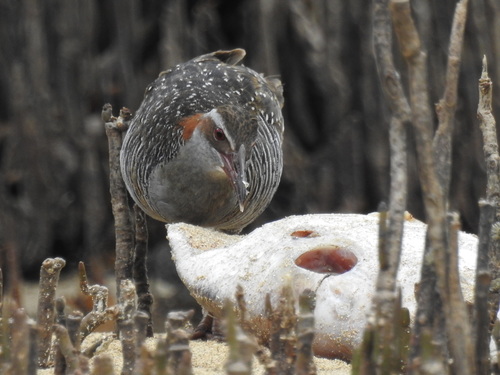 frango-d'água-filipino
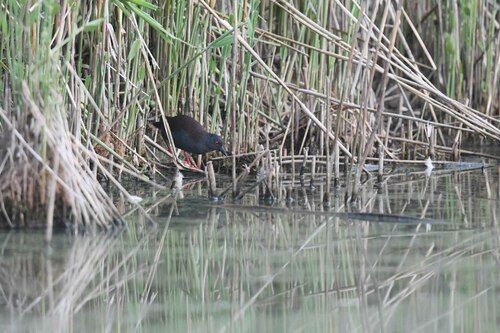 franga-d'água-de-tongatapu
Em resumo
The most reliable field mark between Buff-banded Rail and Spotless Crake is overall size and plumage pattern: Buff-banded Rail is much larger and boldly patterned with a buff breast band, white eyebrow, and black-and-white barring below, while Spotless Crake is much smaller, plain bluish-grey below, and lacks any breast band or strong facial markings. Juvenile Spotless Crakes are duller and paler but never show the rail's strong banding or eyebrow. In flight or on the ground, Buff-banded Rail looks bulkier and longer, with a more contrasting and complex plumage; Spotless Crake is compact, dark, and plain. Both species are shy and skulk in dense vegetation, but their size and color differences are usually clear with a good view.
Dicas de identificação
- Size is the fastest separator: Buff-banded Rail is nearly twice the length and many times the mass of Spotless Crake. If the bird looks chicken-sized, it's a rail; if it's sparrow-sized, it's a crake. This holds for all ages and sexes.
- Buff-banded Rail shows a bold white eyebrow and chestnut nape band: These facial markings are absent in Spotless Crake of all ages. Even in poor light, look for the pale eyebrow and warm nape.
- Buff breast band and black-and-white barring below: Buff-banded Rail always shows a broad buff band across the breast and fine black-and-white barring on the underparts. Spotless Crake is plain bluish-grey below, never banded or barred.
- Spotless Crake is overall plain and dark: Adults are bluish-grey on head and underparts, with reddish-brown upperparts. No banding, no eyebrow, no chestnut nape. Juveniles are duller but still lack any strong markings.
- Leg and eye color: Spotless Crake has reddish-pink legs and deep red eyes as an adult; juveniles have brownish-orange eyes and duller legs. Buff-banded Rail's leg and eye color are less distinctive for field separation.
- Bill color: Spotless Crake has a black bill; Buff-banded Rail's bill color is not specified here but is less likely to be diagnostic in the field.
- Structure and jizz: Buff-banded Rail is longer-legged, bulkier, and has a longer tail and neck. Spotless Crake is compact, short-tailed, and round-bodied. In flight, the rail looks large and strong; the crake is quick and low to the ground.
- Habitat context: If seen in open grassy areas or even around human habitation, Buff-banded Rail is more likely. Spotless Crake almost never leaves dense, wet vegetation.
- Juvenile confusion: Young Spotless Crakes are paler and browner but never show the rail's bold banding or eyebrow. If you see a dull, plain, small rail with a pale chin, it's a young crake, not a rail.
- Behavior: Both skulk, but Buff-banded Rail may walk in the open, especially on islands. Spotless Crake is almost always hidden.
- Vocalizations: Spotless Crake has a distinctive high-pitched 'purr' and other calls, but Buff-banded Rail's voice is not described here—do not rely on voice unless you know the crake's song.
- Season and sex: Neither species shows strong sexual dimorphism; all field marks above apply year-round and to both sexes.
- Flight views: No distinctive upperwing pattern is described for either, but Buff-banded Rail's size and contrast are obvious in flight; Spotless Crake remains small and plain.
- Pitfall: Do not confuse a dull juvenile Spotless Crake for a young Buff-banded Rail—look for the presence or absence of facial markings and barring.
- Geographic overlap: Both occur in Australasia and the Pacific, so do not use range alone for separation.
Tamanho
Buff-banded Rail is a medium-sized rail: 25–33 cm long, wingspan 40–52 cm, and males averaging 185 g (females 172 g) [wikipedia][avonet]. Spotless Crake is much smaller: 17–20 cm long, wingspan 26–29 cm, and weighs only 40–50 g [wikipedia][avonet]. This size gap is dramatic in the field—Buff-banded Rail is nearly twice as long and several times heavier, appearing chicken-sized compared to the sparrow-sized Spotless Crake.
Plumagem
- Juvenile/immature birds: Spotless Crake juveniles are dull brown above and dull grey-brown below, with a pale chin/throat patch and brownish-orange eyes. They lack any strong banding or facial pattern. Buff-banded Rail juveniles are not described in detail here, but even young birds show the species' signature strong facial markings and banded underparts.
- Adults: Buff-banded Rail is boldly patterned: brown upperparts, white eyebrow, chestnut nape band, buff breast band, and black-and-white barred underparts. Spotless Crake adults are plain bluish-grey on head, neck, and underparts, with reddish-brown upperparts and a black bill. No barring, breast band, or strong facial pattern. Their eyes are deep red, legs reddish-pink.
- In flight: No distinctive wing pattern is described for either species, but Buff-banded Rail's larger size and contrasting plumage are obvious even in flight. Spotless Crake remains compact and plain, with no white flashes or banding.
Comportamento
Both species are shy and prefer to skulk in dense, low vegetation near water, making them difficult to observe. Buff-banded Rail can become surprisingly tame in some island settings, while Spotless Crake is generally elusive and rarely seen in the open. Both walk and run rather than fly when flushed, but Buff-banded Rail is more likely to be seen walking in open areas or even around human habitation on islands. Spotless Crake is more secretive and typically remains hidden.
Habitat
Both species use dense, moist or wetland vegetation for cover, but Buff-banded Rail is more flexible, occurring in a wide range of wetland and grassy habitats, sometimes far from water, and even at high elevations (up to 3,600 m). Spotless Crake is more strictly tied to dense, tall stands of reeds, rushes, sedges, and grass tussocks, with nests built above water. Both can occur in the same general regions, but Spotless Crake is less likely to be seen in open or drier habitats.
Voz
Spotless Crake has a variety of calls, including a high-pitched 'pit-pit', 'mook', and a rapid, loud 'purring' song. Buff-banded Rail's voice is not described in the provided notes, so vocalization is not a reliable separator here.
frango-d'água-filipino · franga-d'água-de-tongatapu · Minhas aves difíceis