

plaintive cuckoo vs Brush Cuckoo
Cacomantis merulinus versus Cacomantis variolosus
Jogue um quiz com plaintive cuckoo e Brush Cuckoo
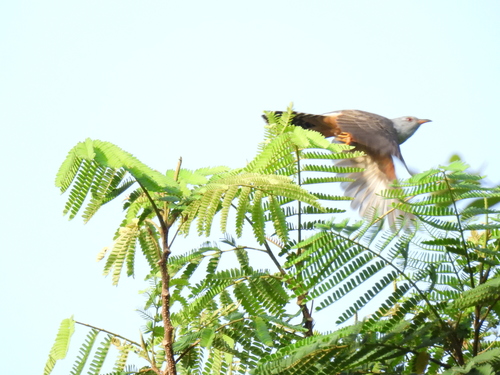 plaintive cuckoo
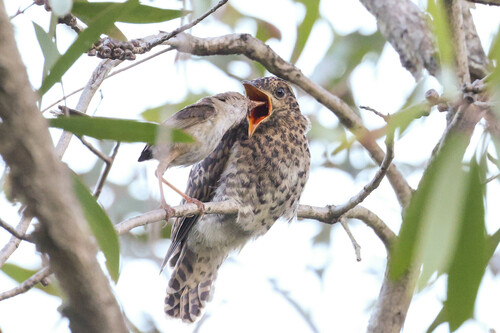 Brush Cuckoo
Em resumo
The most reliable field mark between Plaintive Cuckoo and Brush Cuckoo is the underpart color and barring: adult Plaintive Cuckoo males are orange below with a grey head and throat, while Brush Cuckoo adults have a buff breast and uniform pale grey head. Juvenile and hepatic (reddish-brown) female Plaintive Cuckoos are paler and streaked or barred, but Brush Cuckoo juveniles are heavily barred dark brown overall. In flight, Brush Cuckoo shows grey-brown underwings with a pale buff bar, a feature not described for Plaintive. Both species are similar in size and structure, so careful attention to plumage and age-specific patterns is essential. Habitat overlap is possible in Southeast Asia and Indonesia, but range is a strong clue elsewhere.
Dicas de identificação
- Juvenile/Immature Pattern: Juvenile Brush Cuckoos are heavily barred dark brown all over, including underparts and upperparts. Juvenile Plaintive Cuckoos are paler, with dark streaks (not bars) on the crown and throat, and less extensive barring elsewhere. If you see a streaked (not barred) head/throat, think Plaintive.
- Underwing in Flight: Brush Cuckoo (all ages) shows grey-brown underwings with pale buff coverts and a pale bar, visible in flight. This underwing pattern is not described for Plaintive Cuckoo, so a clear pale underwing bar suggests Brush.
- Adult Underparts: Adult male Plaintive Cuckoo is orange below with a grey head, throat, and upper breast. Brush Cuckoo adults (both sexes) have a buff breast and pale grey head, lacking the strong orange wash.
- Hepatic Female: Plaintive Cuckoo females often show a reddish-brown ('hepatic') morph with dark barring above, paler and faintly barred underparts, a pale eyebrow, and a tail with dark bars. Brush Cuckoo females do not show this morph and resemble the males.
- Tail Pattern: Both have white-tipped tails, but Brush Cuckoo's tail is brown below with white tips and bars, while Plaintive Cuckoo's tail (especially in males) is more uniformly white-tipped, and in hepatic females, the tail is barred along its length.
- Eye and Bill: Plaintive Cuckoo has a red eye and a bill that is black above and yellow below; Brush Cuckoo has a narrow pale eye-ring and olive-pink feet, but eye color is not highlighted as distinctive.
- Leg Color: Plaintive Cuckoo has yellow legs and feet; Brush Cuckoo has olive-pink feet. This may be visible at close range.
- Head Color: Plaintive Cuckoo males have a grey head and throat, contrasting with orange underparts. Brush Cuckoo has a pale grey head blending into a buff breast, with less contrast.
- Supercilium: Hepatic female Plaintive Cuckoo has a distinct pale stripe above the eye, not present in Brush Cuckoo.
- Flight Jizz: Brush Cuckoo is described as having sharply pointed, backswept wings in flight. Plaintive Cuckoo's flight style is not detailed, so use this with caution.
- Vocalization: Plaintive Cuckoo gives distinctive, plaintive, whistled calls (ascending or descending series). If heard, this is a strong indicator, especially where ranges overlap.
- Range: Plaintive Cuckoo is found from India to Indonesia; Brush Cuckoo is in Malesia, New Guinea, Solomon Islands, and Australia. In areas outside Indonesia, range is usually decisive.
- Sexual Dimorphism: Plaintive Cuckoo shows sexual dimorphism (hepatic female morph), while Brush Cuckoo does not—both sexes look alike.
- Habitat: Both use edge and open woodland, so habitat is not diagnostic in overlap zones, but can help elsewhere.
- Host Interaction: Both are brood parasites, but if you see a cuckoo being mobbed by small birds in South Asia, Plaintive is more likely; in Australia, Brush Cuckoo is the default.
Tamanho
Both species are very similar in size, with Plaintive Cuckoo measuring about 21–24 cm and Brush Cuckoo 22–26 cm in length [wikipedia]. There is significant overlap, and both are slender, medium-small cuckoos. Size is not a reliable separator in the field.
Plumagem
-
Juvenile/Immature: Juvenile Plaintive Cuckoos resemble hepatic females but are paler, with dark streaks (not bars) on the crown and throat. Juvenile Brush Cuckoos are heavily barred dark brown overall, lacking the streaked effect of Plaintive. In flight, Brush Cuckoo juveniles and adults show a grey-brown underwing with pale buff coverts and a pale bar, which is not described for Plaintive Cuckoo at any age.
-
Adult Male: Plaintive Cuckoo males are grey-brown above, orange below, with a grey head, throat, and upper breast. Tail feathers have white tips. Brush Cuckoo adults (both sexes) are grey-brown above, with a pale grey head and buff breast, and the underside of the tail is brown with white tips and bars.
-
Adult Female/Hepatic Morph: Plaintive Cuckoo females are often in a 'hepatic' morph: reddish-brown above with dark bars, paler underparts with faint barring, a pale supercilium, and a tail with dark bars along its length. Brush Cuckoo females look like males (no hepatic morph), with uniform grey-brown and buff tones and barred undertail.
-
Tail: Both have white-tipped tails, but Plaintive Cuckoo's tail is more obviously white-tipped in males, while Brush Cuckoo's tail is brown below with white tips and bars.
Comportamento
Both species are solitary and secretive, often difficult to see, and are brood parasites. Plaintive Cuckoo is often mobbed by small birds. Both feed on invertebrates. In flight, Brush Cuckoo is described as having sharply pointed, backswept wings, which may help with quick, direct flight, but this is not described for Plaintive Cuckoo.
Habitat
Plaintive Cuckoo prefers forest edge, open woodland, scrub, grassland, farmland, parks, and gardens across South and Southeast Asia. Brush Cuckoo is found in Malesia, New Guinea, Solomon Islands, and northern/eastern Australia, in similar wooded and edge habitats. In areas of overlap (e.g., Indonesia), habitat alone is not diagnostic, but elsewhere, range is a strong separator.
Voz
Plaintive Cuckoo has distinctive plaintive, whistling calls: an ascending series of three-note phrases and a series of 11–12 descending notes. Brush Cuckoo's voice is not described in the notes, but is known to differ from Plaintive and is often used for separation in the field, especially in areas of overlap. If you hear the classic 'plaintive' whistling, it's likely Plaintive Cuckoo.