
Bar-tailed Godwit vs Common Snipe
Limosa lapponica versus Gallinago gallinago
Play a quiz with Bar-tailed Godwit and Common Snipe
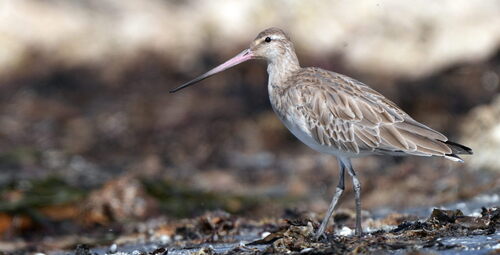 Bar-tailed Godwit
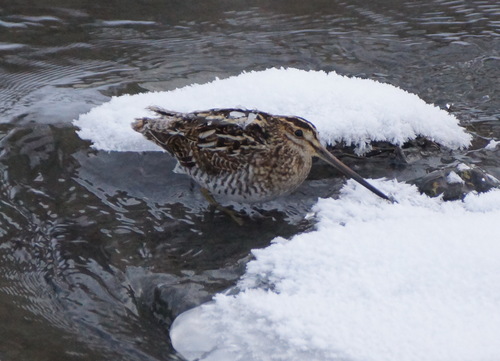 Common Snipe
In short
The most reliable field mark to separate Bar-tailed Godwit from Common Snipe is overall structure and size: godwits are much larger, longer-legged, and have a long, slightly upturned bill, while snipes are small, stocky, and short-legged with a straight, needle-like bill. In flight, godwits show plain upperwings without bold stripes or trailing edges, whereas snipes have pointed wings and a compact, zig-zagging flight. Juvenile and non-breeding godwits can look plain and pale, but snipes always show strong camouflage with yellowish stripes on the back and a dark eye-stripe. Habitat and behavior also help: godwits are seen on open mudflats and estuaries, snipes in dense, wet grass or marsh. Even at a distance, the godwit's size and shape are unmistakable compared to the much smaller, chunkier snipe.
Identification tips
- Size and structure: Bar-tailed Godwit is much larger and longer-legged than Common Snipe. If the bird looks goose-sized among waders, it is a godwit; if it is small and squat, it is a snipe.
- Bill shape: Godwit has a long, slightly upturned, bi-colored bill (pink at base, black at tip); snipe has a straight, dark, needle-like bill nearly as long as its body, but never upturned.
- Leg color and length: Godwit legs are blue-grey and long, making it stand tall; snipe legs are short, greenish-grey, and the bird sits low to the ground.
- Flight style: Godwit flies with steady, direct wingbeats, often in straight lines or wide circles; snipe flushes with a rapid, zig-zagging flight, often uttering a sharp call.
- Upperwing pattern (all ages): Godwit wings are plain above, lacking bold stripes or trailing edges; snipe wings are pointed and the bird appears compact in flight.
- Back and upperparts: Godwit (especially juveniles and non-breeding) is plain grey-brown with subtle striping; snipe is always strongly patterned with straw-yellow stripes and a dark eye-stripe.
- Breast and belly: Breeding godwits (males) are brick red below; snipe is always pale or buff with streaks, never red or rufous.
- Head pattern: Snipe has a bold dark stripe through the eye with pale lines above and below; godwit’s head is plain or only subtly marked.
- Tail shape: Snipe has a short tail, often fanned in flight; godwit’s tail is longer and less noticeable in flight.
- Habitat: Godwit is on open mudflats/estuaries; snipe is in dense, wet grass or marsh.
- Behavior when approached: Godwit remains in the open or flies off steadily; snipe flushes suddenly from cover, often zig-zagging.
- Courtship display: Snipe males perform aerial 'winnowing' with drumming tail sound; godwit displays are silent or lack this mechanical sound.
- Sex and age confusion: Female and juvenile godwits are duller and paler, but never as cryptically patterned as snipe. Snipe never shows the plainness of a godwit.
- Voice: Snipe gives a sharp 'scape' call when flushed; godwit is mostly silent in flight (per these notes).
- Flock context: Godwits often in loose flocks on mud; snipe usually solitary or in small groups, well hidden.
Size
Bar-tailed Godwit is substantially larger and heavier (average adult mass ~333.5g) than Common Snipe (~119.5g). Godwits measure 37–41 cm in length with a 70–80 cm wingspan, while snipes are only 25–27 cm long with a 44–47 cm wingspan. The godwit stands tall on relatively long blue-grey legs, whereas the snipe is short-legged and appears much more compact. Even at a distance or in mixed flocks, the godwit’s size and long-legged stance are obvious compared to the snipe’s squat, low-to-the-ground profile.
Plumage
- Juvenile/immature and non-breeding plumage: Bar-tailed Godwit juveniles and non-breeding adults are plain grey-brown above with darker feather centers, giving a subtle striped look, and are whitish below. Juveniles are more buff overall with streaked flanks and breast. Common Snipe, of any age, is much more intricately patterned: brown above with straw-yellow stripes, a bold dark eye-stripe, and pale underparts. Snipe upperparts always show strong camouflage, never the plain look of a godwit.
- Breeding plumage: Adult male godwits in breeding plumage have a striking unbroken brick red neck, breast, and belly, with dark brown upperparts; females are duller, chestnut to cinnamon below. Snipe does not show any red or rufous tones, remaining cryptically streaked and mottled year-round.
- Wings in flight: Godwits have plain upperwings without bold panels or trailing edges. Snipe wings are pointed and, while not described as having a bold trailing edge in these notes, the overall effect is a more compact, angular look in flight compared to the godwit’s longer, broader wings.
Behaviour
Bar-tailed Godwit is usually seen feeding in the open on mudflats and estuaries, walking steadily on long legs and probing with its long bill. It often forms loose flocks and can be seen flying in straight lines or wide circles during display, with a steady, direct flight. Common Snipe is shy and secretive, typically hiding in dense marsh or grass. It flushes only when approached closely, flying off in a rapid, zig-zagging pattern to confuse predators. Snipe forages by probing in soft mud, often remaining motionless and relying on camouflage. During courtship, snipe males perform aerial 'winnowing' displays, circling high and diving to produce a drumming sound with their tail feathers.
Habitat
Bar-tailed Godwit is found on open coastal mudflats and estuaries, especially during migration and winter. It is rarely found in dense vegetation or freshwater marshes. Common Snipe prefers marshes, bogs, wet meadows, and tundra with dense ground cover, often far from open tidal flats. If you flush a bird from thick grass or a bog, it is almost certainly a snipe, not a godwit. Conversely, a large wader striding across open mud is almost never a snipe.
Voice
Bar-tailed Godwit is not noted for distinctive flight calls in these notes. Common Snipe, when flushed, gives a sharp 'scape, scape' call and, during display, produces a unique 'drumming' or 'winnowing' sound with its tail feathers in flight. This mechanical sound is diagnostic for snipe during the breeding season.