
Black-backed Puffback vs Fork-tailed Drongo
Dryoscopus cubla versus Dicrurus adsimilis
Play a quiz with Black-backed Puffback and Fork-tailed Drongo
 Black-backed Puffback
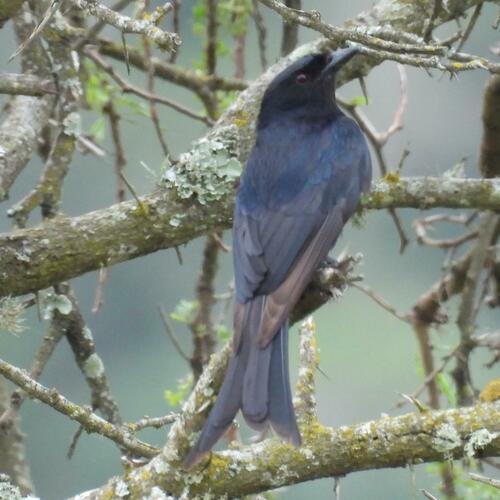 Fork-tailed Drongo
In short
The most reliable field mark to separate Black-backed Puffback from Fork-tailed Drongo is the drongo’s deeply forked, long black tail, which is never matched by the puffback. Immature birds can be confusing, but even then, the drongo’s tail shape and overall glossy black coloration (lacking white underparts) stand out. Puffbacks, even in young or female plumages, show contrasting black-and-white patterns and never have a forked tail. If you see a small, restless black-and-white bird with a red or orange eye and a short tail, it’s a puffback; a larger, all-black bird with a long, forked tail is a drongo.
Identification tips
- Tail shape is decisive: Fork-tailed Drongo always shows a long, deeply forked tail (even in juveniles, though less pronounced), while Black-backed Puffback has a short, rounded or slightly graduated tail with no fork. This is the quickest field check.
- Overall color: Drongo is all-black (glossy in adults, dark brownish in juveniles), while puffbacks are always black-and-white or grey-and-white, never all-black.
- Underparts: Puffback has pure white or off-white underparts (male/female/immature), contrasting sharply with black upperparts; drongo has uniformly black underparts.
- Wing pattern: Puffbacks (especially males and some subspecies) show white edging to remiges and a white scapular bar; drongo’s wings are entirely black with no pale markings at any age.
- Eye color: Both can have red eyes as adults, but immature puffbacks have brown irides, and drongo juveniles have brown or grey eyes. Not diagnostic alone, but can help in combination.
- Bill structure: Drongo has a robust, slightly hooked black bill; puffback’s bill is shorter, less robust, and more shrike-like.
- Size and build: Drongo is heavier and bulkier, with a longer tail and more upright posture. Puffback is smaller, more compact, and often appears more rounded.
- Flight style: Drongo often sallies out from a perch to catch insects, showing its long, forked tail in flight. Puffback moves restlessly through foliage, rarely sallying, and its short tail is obvious in flight.
- Perching behavior: Drongo perches openly, often on exposed branches or wires; puffback prefers denser cover and is less likely to perch in the open.
- Juvenile confusion: Juvenile drongos are dark brown with buff tips and a less forked tail, but still lack any white underparts or wing markings. Juvenile puffbacks are greyer and buffier, with some white and no forked tail.
- Sex differences: Female puffbacks are greyer and less contrasting than males, but still show black-and-white patterning and lack a forked tail. Drongo sexes are similar.
- Subspecies variation: Some puffback subspecies have more or less white in the wings and scapulars, but never approach the all-black look of drongo.
- Habitat context: In open savanna or at woodland edges, drongo is more likely; in dense woodland or forest edge, puffback is more likely, though there is overlap.
- Behavioral cues: If the bird is aggressively chasing other birds or mobbing predators, drongo is more likely; puffbacks are less overtly aggressive.
- Leucism: Rare pale drongos can confuse, but will still show forked tail and lack white wing bars or underparts.
Size
Fork-tailed Drongo is noticeably larger and heavier (43.4g vs 26.0g) than Black-backed Puffback. The drongo also has a much longer tail, which is both longer in absolute terms and proportionally longer relative to body size. Puffbacks are more compact, with shorter tails and a more rounded, bushshrike-like silhouette. In direct comparison, the drongo’s bulk and tail length are obvious, especially when both are seen perched or in flight.
Plumage
-
Juvenile/immature birds: Juvenile Fork-tailed Drongos are dark brown with buff-tipped feathers, a less pronounced tail fork, and brown or grey eyes. They lack the adult's glossy sheen and have pale feathering in some areas, but are still overall dark and lack strong white contrasts. Juvenile Black-backed Puffbacks resemble adult females: they have greyish upperparts, buffy or greyish underparts, brown irides, and brownish bills. Critically, even young puffbacks show some black-and-white contrast, especially on the wings and underparts, and never appear all-black or all-brown.
-
Adults: Adult drongos are glossy black all over, with a blue-green iridescence in certain lights, red eyes, and a deeply forked tail. Adult male puffbacks have deep blue-black upperparts, black cap, red or orange eyes, and pure white underparts; females are similar but with greyer backs, paler ear coverts, and buffy or greyish white underparts. Both sexes of puffback show black-and-white contrast, especially on the wings and scapulars, and never have a forked tail.
-
Wing pattern: Puffbacks (especially some subspecies) may show white edging to remiges and a white scapular bar, most prominent in males. Drongos lack any white in the wings or scapulars at all ages.
Behaviour
Black-backed Puffbacks are restless, often moving singly, in pairs, or family groups, and typically stay in the tree canopy, flicking and fanning their tails but rarely sallying out. Fork-tailed Drongos are more aggressive, often seen perched conspicuously in open, sallying out to catch insects in flight, and are known for their boldness towards other birds and predators. Drongos may also perform duets and display more overt territorial or mobbing behavior. Puffbacks are more secretive and less likely to be seen in open or aggressive displays.
Habitat
Both species occur in wooded habitats, but Fork-tailed Drongo is more often found in open woodlands and savannas, including edges and clearings, and is more tolerant of open country. Puffbacks are more strictly associated with denser woodland, forest edges, and well-wooded gardens south of the equator. Overlap is common, but drongos are more likely in open or semi-open areas, while puffbacks prefer thicker cover.
Black-backed Puffback · Fork-tailed Drongo · My Tricky Birds