
Blue-throated Bee-eater vs Blue-tailed Bee-eater
Merops viridis versus Merops philippinus
Play a quiz with Blue-throated Bee-eater and Blue-tailed Bee-eater
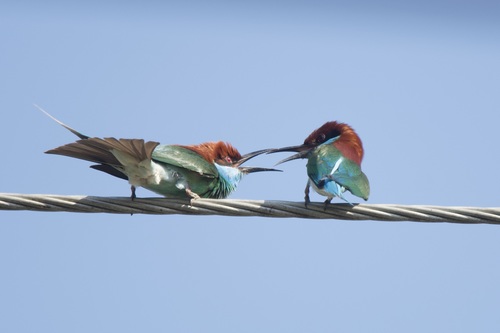 Blue-throated Bee-eater
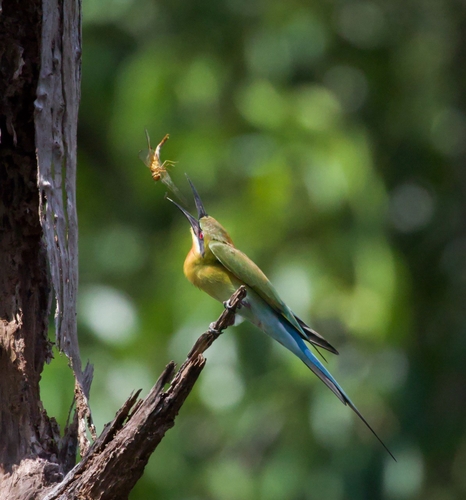 Blue-tailed Bee-eater
In short
The most reliable field mark to separate Blue-throated Bee-eater from Blue-tailed Bee-eater is the throat color: Blue-throated has a vivid blue throat, while Blue-tailed shows a yellow and brown throat. Adults of Blue-throated also have a distinctive red-brown crown and nape, contrasting with the predominantly green and blue tones of Blue-tailed. Juveniles of both are drabber, but Blue-throated juveniles are greenish all over with a dark green head, lacking the blue throat and tail. Both species have elongated central tail feathers as adults, but Blue-throated's are longer. Habitat can help: Blue-throated favors mangroves and forest edges, while Blue-tailed is more often in open areas near water. In flight or perched, focus on throat, crown, and overall color balance for the quickest separation.
Identification tips
- Throat color is key: Blue-throated Bee-eater always shows a bright blue throat (adults), while Blue-tailed has a yellow and brown throat (all ages).
- Crown and nape: Blue-throated has a striking red-brown crown and nape in adults; Blue-tailed's crown is green, blending with the rest of the upperparts.
- Juvenile confusion: Juvenile Blue-throated is green all over with a dark green head and no blue on the throat or tail; juvenile Blue-tailed is also drab but shows a yellowish-brown throat and some blue in the tail.
- Tail feathers: Both species have elongated central tail feathers as adults, but Blue-throated's are longer (9 cm vs. 7 cm) and more prominent. Juveniles of both lack these extensions.
- Underparts: Blue-throated has a light green breast and belly; Blue-tailed is more uniformly green below, sometimes with a yellowish wash near the throat.
- Face pattern: Both have a black eye-stripe, but Blue-tailed has a narrow blue face patch, while Blue-throated's face is dominated by the blue throat and rufous crown.
- Tail and rump: Blue-tailed has a blue tail and rump, which can be prominent in flight; Blue-throated also has a blue tail but lacks the blue rump.
- Habitat clues: In mangroves or forest edge, expect Blue-throated; in open country, sandbanks, or river valleys, Blue-tailed is more likely.
- Group behavior: Blue-tailed often breeds and roosts colonially, sometimes with helpers at the nest; Blue-throated is less colonial, more often seen in pairs or small groups.
- Flight style: Both use a mix of flapping and gliding, but Blue-tailed is more likely to be seen in large migratory flocks in open areas.
- Voice: Blue-tailed's 'teerp' call is distinctive if heard, but calls are not always diagnostic without experience.
- Sex differences: Both are sexually similar to the eye; minor differences in tail length and UV reflectance are not useful in the field.
- Size: Blue-tailed is slightly larger, but overlap is significant; use color and structure first.
- Seasonal context: Both migrate, but Blue-tailed is more strongly migratory and likely to appear in new areas seasonally.
- Perched vs. in flight: When perched, focus on throat and crown color; in flight, look for tail length and overall color balance, but beware that juveniles of both can look similar at a distance.
Size
Blue-tailed Bee-eater is slightly larger overall, measuring about 29 cm in body length (excluding the 7 cm central tail feathers) and weighing 29–43 grams. Blue-throated Bee-eater is about 21 cm in body length (excluding the longer 9 cm central tail feathers) and weighs 34–41 grams. The difference in body length is mostly due to the tail feather extensions, with Blue-throated's being proportionally longer. Both are slender, medium-large bee-eaters, and size alone is rarely diagnostic in the field.
Plumage
Juveniles of both species are duller than adults and lack the elongated central tail feathers. Blue-throated juveniles are mostly green with a dark green head and wings and light green breast, lacking any blue on the throat or tail. Blue-tailed juveniles are also drab but already show a hint of blue in the tail and have a yellowish-brown throat, not blue. In adults, Blue-throated stands out with a red-brown crown and nape, blue throat, dark green wings, blue tail, and light green underparts. Blue-tailed adults are predominantly green with a blue tail and rump, yellow and brown throat, and a narrow blue face patch. Both have a black eye-stripe, but only Blue-throated shows the strong blue throat and rufous crown. Sexes are similar in both, but male Blue-tailed may have slightly longer tail feathers and subtle UV differences not visible in the field.
Behaviour
Both species catch flying insects on the wing and often perch openly. Blue-tailed Bee-eater is more likely to be seen in groups, breeding colonially in sandy banks and foraging communally. Blue-throated is also social but is more often associated with forest edges and mangroves, sometimes seen resting on trees or man-made structures during migration. Both species migrate in flocks, sometimes together, but Blue-tailed is more strongly migratory and forms larger visible flocks in open country.
Habitat
Blue-throated Bee-eater prefers subtropical or tropical mangrove forests and forest edges in Southeast Asia, often near water but within more wooded or semi-wooded settings. Blue-tailed Bee-eater is typically found in open habitats near water—river valleys, lakeshores, sandbanks, and even estuaries—avoiding dense forest. If you see a bee-eater in a mangrove or forest edge, Blue-throated is more likely; in open, sandy, or riverine settings, especially with colonies, Blue-tailed is the default.
Voice
Both species have varied calls, but Blue-tailed is noted for a rolling, chirping, whistling 'teerp' call, mainly given in flight. Blue-throated has a rich variety of calls, including long-distance calls for forest communication, but the differences are subtle and not reliably diagnostic in the field without experience.
Blue-throated Bee-eater · Blue-tailed Bee-eater · My Tricky Birds