
Booted Eagle vs Ayres's Hawk-Eagle
Hieraaetus pennatus versus Hieraaetus ayresii
Play a quiz with Booted Eagle and Ayres's Hawk-Eagle
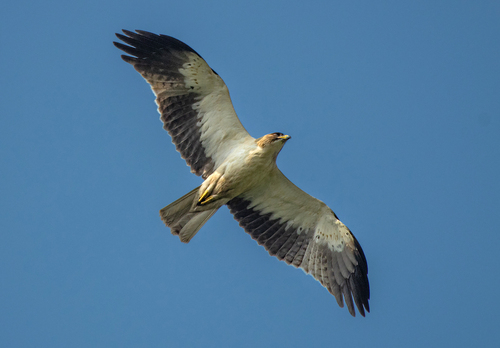 Booted Eagle
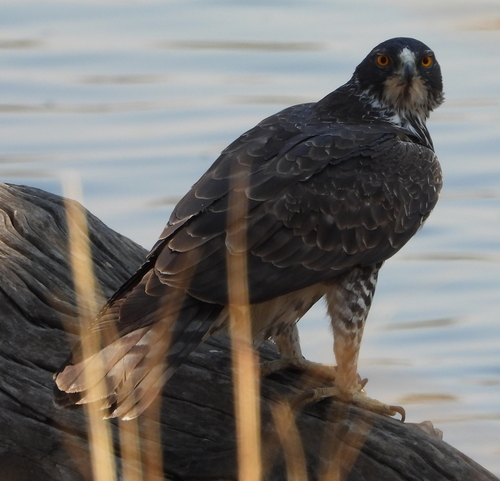 Ayres's Hawk-Eagle
In short
The most reliable field mark to separate Booted Eagle from Ayres's Hawk-Eagle is the underwing pattern in flight: Booted Eagle (all ages) shows contrasting pale 'landing lights' at the base of the primaries, while Ayres's Hawk-Eagle has a more uniformly dark and heavily barred underwing without a pale panel. Juvenile Ayres's Hawk-Eagle is dark above and white below with sparse markings, whereas Booted Eagle juveniles resemble adults of their respective morphs. Both are small eagles with similar size and proportions, but Ayres's Hawk-Eagle often shows a small crest and heavier underpart spotting. Structure and jizz are subtle, so focus on wing pattern and underpart markings for the most reliable separation.
Identification tips
- Underwing pattern in flight (all ages): Booted Eagle shows pale 'landing lights' at the base of the primaries; Ayres's Hawk-Eagle lacks this, showing a uniformly dark, heavily barred underwing. This is the single most reliable field mark.
- Juvenile Ayres's Hawk-Eagle: Dark brown above, white below with sparse dark markings, and a dark crown. As it ages, the underparts become duskier and browner with a rufous cast before moulting to adult plumage. Booted Eagle juveniles resemble adults of their morph (pale or dark), so look for the underwing panel instead.
- Adult upperparts: Booted Eagle pale morph is light grey with darker head and flight feathers; dark morph is mid-brown. Ayres's Hawk-Eagle adults are blackish above, often with a white forehead and supercilium.
- Underpart markings (adults): Ayres's Hawk-Eagle has heavy dark spotting on white underparts, especially on the breast and belly; Booted Eagle is less heavily marked below, especially in pale morphs.
- Tail pattern: Ayres's Hawk-Eagle has an ashy grey tail with a broad black tip and several narrow bars; Booted Eagle's tail is less distinctly barred.
- Crest: Ayres's Hawk-Eagle often shows a small but sometimes pronounced crest, especially when perched or alert. Booted Eagle lacks a crest.
- Leg feathering: Both have feathered legs, but Ayres's Hawk-Eagle's are pure white and conspicuous.
- Facial markings: Ayres's Hawk-Eagle shows a white forehead and supercilium (eyebrow), especially in adults; Booted Eagle lacks this feature.
- Dark morph confusion: Both species can be dark, but Ayres's Hawk-Eagle dark morph is mostly black with white markings, while Booted Eagle dark morph is mid-brown. Use underwing pattern to separate.
- Structure and jizz: Both are compact, small eagles. Ayres's Hawk-Eagle may look slightly longer-tailed and more crested, but this is subtle and unreliable at distance.
- Habitat: Booted Eagle prefers open or semi-open country, especially outside Africa; Ayres's Hawk-Eagle is a woodland specialist. Context can help but is not diagnostic.
- Behavior: Booted Eagle often soars at low heights and hunts by stooping; Ayres's Hawk-Eagle is agile in wooded habitats and may appear more crested when alert.
- Voice: Booted Eagle's call is a shrill 'kli-kli-kli'; Ayres's Hawk-Eagle's voice is not described here, so do not rely on vocalization for separation.
- Sexual dimorphism: Both species show females larger than males, but this does not help separate the two species.
- Pitfalls: Immature Ayres's Hawk-Eagle may be mistaken for pale Booted Eagle, but check for the absence of the pale underwing panel and the presence of a crest or heavy underpart spotting.
Size
Both species are nearly identical in mass (Booted Eagle: ~842 g, Ayres's Hawk-Eagle: ~840 g [wikidata]), and their wingspans overlap (Booted Eagle: 110–132 cm, Ayres's Hawk-Eagle: 106–137 cm [wikipedia]). Ayres's Hawk-Eagle can be slightly longer (44–57 cm vs. Booted Eagle's 40 cm), but this is rarely useful in the field. Both show strong sexual dimorphism, with females noticeably larger than males, but not enough to reliably separate the two species on size alone.
Plumage
-
Juvenile/immature birds in flight: Booted Eagle (all ages) shows pale 'landing lights' at the base of the primaries (inner hand) on the underwing, a key field mark. Ayres's Hawk-Eagle lacks this panel, instead showing a dark, heavily barred underwing throughout, with brown underwing coverts and no obvious pale patch. Juvenile Ayres's Hawk-Eagle is dark brown above, white below with sparse dark markings, and a dark crown; as it matures, it becomes duskier and browner below before moulting into adult plumage.
-
Adults: Booted Eagle comes in two morphs: pale (light grey with darker head and flight feathers) and dark (mid-brown with dark grey flight feathers). Ayres's Hawk-Eagle adults are blackish above, usually with a white forehead and supercilium, and white underparts with heavy dark spotting. The tail of Ayres's Hawk-Eagle is ashy grey with a broad black tip and several narrow bars, while Booted Eagle's tail is less distinctly marked. Both species have well-feathered legs, but Ayres's Hawk-Eagle's are pure white.
-
Melanistic/dark morphs: Both species can show dark morphs, but Ayres's Hawk-Eagle's melanistic birds are mostly black with white markings, while Booted Eagle's dark morph is mid-brown overall.
Behaviour
Booted Eagle is typically seen flying at low heights, often solitary or in pairs, and hunts by stooping from the wing. Ayres's Hawk-Eagle is also a woodland hunter but may appear more crested and is noted for its agile flight in wooded habitats. Both species are active hunters of birds, reptiles, and small mammals, but Ayres's Hawk-Eagle is more strictly associated with woodland hunting behavior.
Habitat
Booted Eagle is mostly migratory, breeding in the Palearctic and southern Asia, with a small, disjunct breeding population in southwestern Africa. It winters in the tropics of Africa and Asia and is often found in open or semi-open country. Ayres's Hawk-Eagle is native to African woodlands and is more strictly associated with wooded habitats. If seen in dense woodland, Ayres's is more likely; Booted Eagle prefers more open terrain, especially outside its African breeding range.
Voice
Booted Eagle gives a shrill 'kli-kli-kli' call. No distinctive vocalization is described for Ayres's Hawk-Eagle in the provided notes, so voice is not a reliable separator in this context.