
Motmot

Brown Crake vs Baillon's Crake

Zapornia akool versus Zapornia pusilla

Play a quiz with Brown Crake and Baillon's Crake
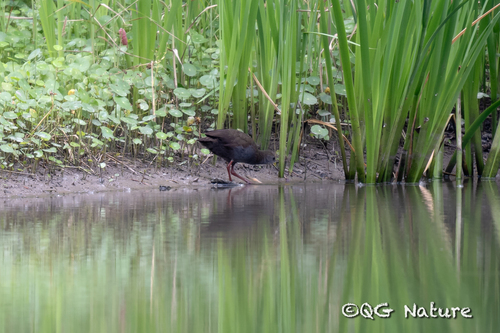
Brown Crake (Zapornia akool) Brown Crake
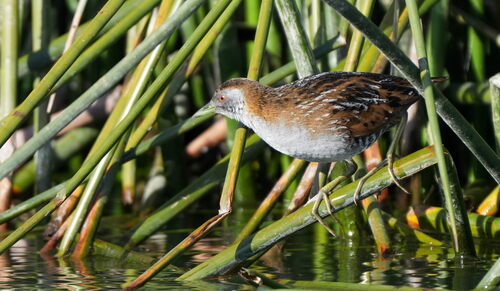
Baillon's Crake (Zapornia pusilla) Baillon's Crake

Media

Loading…

In short

The most reliable field mark to separate Brown Crake from Baillon's Crake is overall plumage tone and underpart pattern: Brown Crake is uniformly brownish above and below, while Baillon's Crake shows blue-grey underparts with strong black-and-white barring on the flanks and undertail. Baillon's Crake is also distinctly smaller and more compact, with a shorter, straight, yellowish or greenish bill, compared to the Brown Crake's larger, heavier structure. Juvenile Baillon's Crakes retain the barred underparts, while Brown Crake remains plain. In flight or when flushed, Baillon's Crake may show more contrast and a smaller, rounder profile. Both are secretive marsh birds, but Baillon's is especially elusive in the breeding season.

Identification tips

  1. Underpart pattern is diagnostic: Baillon's Crake of all ages shows blue-grey underparts with bold black-and-white barring on the flanks and undertail; Brown Crake is plain brown below with no barring or grey wash.
  2. Upperpart tone: Both are brown above, but Baillon's Crake is ochre-brown with occasional black and white streaking, while Brown Crake is more uniformly brown.
  3. Bill structure and color: Baillon's Crake has a short, straight, yellowish or greenish bill (never with a red base); Brown Crake's bill is heavier and less brightly colored.
  4. Size and shape: Baillon's Crake is much smaller and more compact (15–18 cm, ~35g), with proportionally longer toes and a rounder body; Brown Crake is larger and bulkier.
  5. Leg color: Baillon's Crake has olive-green legs, which may be visible if the bird is out in the open; Brown Crake's leg color is not specified, but is unlikely to be as bright.
  6. Flight profile: Baillon's Crake appears compact and rounded in flight, while Brown Crake is bulkier; neither species shows a distinctive upperwing pattern according to the notes.
  7. Juvenile/immature plumage: Immature Baillon's Crake is similar to the adult but with duller, more extensively barred underparts; Brown Crake juveniles remain plain brown below.
  8. Secretive behavior: Both are shy, but Baillon's Crake is especially elusive in the breeding season and more often heard than seen.
  9. Vocalizations: If you hear a rattling, frog-like call, it is Baillon's Crake; Brown Crake's voice is not described, so silence does not confirm its presence.
  10. Habitat context: Both occur in dense marshes, but Baillon's Crake is more strictly tied to dense emergent vegetation; Brown Crake may be seen at more open wetland edges.
  11. Seasonal visibility: Baillon's Crake is easier to see during migration or winter; Brown Crake's visibility does not change as dramatically with season.
  12. No red on bill: If you see any red at the base of the bill, rule out Baillon's Crake.
  13. No barring, no Baillon's: If the flanks and undertail are plain, it's not Baillon's Crake.
  14. Direct comparison: If both species are present, the size and underpart pattern difference is striking in side-by-side views.
  15. When in doubt, focus on underparts and size: These two features are the most consistently reliable for field separation in all seasons and ages.

Size

Baillon's Crake is significantly smaller and lighter than Brown Crake. Baillon's Crake averages about 35 grams in body mass and measures 15–18 cm in length, giving it a noticeably daintier and more compact appearance. Brown Crake is larger and bulkier, though exact measurements are not provided in the sources, and will appear more robust both on the ground and in flight. The difference in size is usually apparent with good views or when the two species are seen in similar habitat.

Plumage

Adult and immature Baillon's Crakes are ochre-brown above, but their underparts are a distinctive light blue-grey, paler on the throat and breast, and heavily barred black and white along the flanks and undertail. These bold bars are present even in immatures, though the underparts are duller and more extensively barred than in adults. In contrast, Brown Crake is uniformly brown above and below, lacking any blue-grey or black-and-white barring on the underparts or flanks at all ages. This plainness is a key separator, especially when viewing birds from the side or rear. Bill color also differs: Baillon's has a short, straight, yellowish or greenish bill without a red base, while Brown Crake's bill is heavier and less brightly colored. No distinctive age-specific upperwing or flight pattern is described for either species, so focus on body and underpart pattern for all ages.

Behaviour

Both species are secretive and prefer to skulk in dense marsh vegetation, but Baillon's Crake is especially elusive during the breeding season, often detected only by its call. It may become more visible during migration or winter. Brown Crake is also shy but may be seen feeding at the edges of water more readily. Both probe in mud or shallow water, but Baillon's Crake's smaller size and long-toed, olive-green legs may be noticeable if seen well. In flight, Baillon's appears more compact and rounded, while Brown Crake is bulkier.

Habitat

Both species are waterbirds of marshes and wetlands, but Brown Crake is found in South Asia, while Baillon's Crake has a broader range across Eurasia, Africa, and Australia. In areas of overlap, both can occur in similar habitats—dense marshes, reedbeds, and vegetated edges of water—but Baillon's Crake may be even more strictly tied to dense emergent vegetation and is less likely to be seen in open areas. Brown Crake may be slightly less restricted, sometimes venturing into more open wetland margins.

Voice

Baillon's Crake is notably vocal, especially in the breeding season, with a rattling call reminiscent of an edible frog or garganey. These calls are often the only clue to its presence, as the bird is highly secretive. There is no vocal description for Brown Crake in the provided notes, so voice is not a reliable separator unless Baillon's Crake's distinctive rattling call is heard.

Submit a better description

Use the same sections as the comparison. Your text is published immediately.

The most reliable field mark to separate Brown Crake from Baillon's Crake is overall plumage tone and underpart pattern: Brown Crake is uniformly brownish above and below, while Baillon's Crake shows blue-grey underparts with strong black-and-white barring on the flanks and undertail. Baillon's Crake is also distinctly smaller and more compact, with a shorter, straight, yellowish or greenish bill, compared to the Brown Crake's larger, heavier structure. Juvenile Baillon's Crakes retain the barred underparts, while Brown Crake remains plain. In flight or when flushed, Baillon's Crake may show more contrast and a smaller, rounder profile. Both are secretive marsh birds, but Baillon's is especially elusive in the breeding season.

  1. Underpart pattern is diagnostic: Baillon's Crake of all ages shows blue-grey underparts with bold black-and-white barring on the flanks and undertail; Brown Crake is plain brown below with no barring or grey wash.
  2. Upperpart tone: Both are brown above, but Baillon's Crake is ochre-brown with occasional black and white streaking, while Brown Crake is more uniformly brown.
  3. Bill structure and color: Baillon's Crake has a short, straight, yellowish or greenish bill (never with a red base); Brown Crake's bill is heavier and less brightly colored.
  4. Size and shape: Baillon's Crake is much smaller and more compact (15–18 cm, ~35g), with proportionally longer toes and a rounder body; Brown Crake is larger and bulkier.
  5. Leg color: Baillon's Crake has olive-green legs, which may be visible if the bird is out in the open; Brown Crake's leg color is not specified, but is unlikely to be as bright.
  6. Flight profile: Baillon's Crake appears compact and rounded in flight, while Brown Crake is bulkier; neither species shows a distinctive upperwing pattern according to the notes.
  7. Juvenile/immature plumage: Immature Baillon's Crake is similar to the adult but with duller, more extensively barred underparts; Brown Crake juveniles remain plain brown below.
  8. Secretive behavior: Both are shy, but Baillon's Crake is especially elusive in the breeding season and more often heard than seen.
  9. Vocalizations: If you hear a rattling, frog-like call, it is Baillon's Crake; Brown Crake's voice is not described, so silence does not confirm its presence.
  10. Habitat context: Both occur in dense marshes, but Baillon's Crake is more strictly tied to dense emergent vegetation; Brown Crake may be seen at more open wetland edges.
  11. Seasonal visibility: Baillon's Crake is easier to see during migration or winter; Brown Crake's visibility does not change as dramatically with season.
  12. No red on bill: If you see any red at the base of the bill, rule out Baillon's Crake.
  13. No barring, no Baillon's: If the flanks and undertail are plain, it's not Baillon's Crake.
  14. Direct comparison: If both species are present, the size and underpart pattern difference is striking in side-by-side views.
  15. When in doubt, focus on underparts and size: These two features are the most consistently reliable for field separation in all seasons and ages.

Baillon's Crake is significantly smaller and lighter than Brown Crake. Baillon's Crake averages about 35 grams in body mass and measures 15–18 cm in length, giving it a noticeably daintier and more compact appearance. Brown Crake is larger and bulkier, though exact measurements are not provided in the sources, and will appear more robust both on the ground and in flight. The difference in size is usually apparent with good views or when the two species are seen in similar habitat.

Adult and immature Baillon's Crakes are ochre-brown above, but their underparts are a distinctive light blue-grey, paler on the throat and breast, and heavily barred black and white along the flanks and undertail. These bold bars are present even in immatures, though the underparts are duller and more extensively barred than in adults. In contrast, Brown Crake is uniformly brown above and below, lacking any blue-grey or black-and-white barring on the underparts or flanks at all ages. This plainness is a key separator, especially when viewing birds from the side or rear. Bill color also differs: Baillon's has a short, straight, yellowish or greenish bill without a red base, while Brown Crake's bill is heavier and less brightly colored. No distinctive age-specific upperwing or flight pattern is described for either species, so focus on body and underpart pattern for all ages.

Both species are secretive and prefer to skulk in dense marsh vegetation, but Baillon's Crake is especially elusive during the breeding season, often detected only by its call. It may become more visible during migration or winter. Brown Crake is also shy but may be seen feeding at the edges of water more readily. Both probe in mud or shallow water, but Baillon's Crake's smaller size and long-toed, olive-green legs may be noticeable if seen well. In flight, Baillon's appears more compact and rounded, while Brown Crake is bulkier.

Both species are waterbirds of marshes and wetlands, but Brown Crake is found in South Asia, while Baillon's Crake has a broader range across Eurasia, Africa, and Australia. In areas of overlap, both can occur in similar habitats—dense marshes, reedbeds, and vegetated edges of water—but Baillon's Crake may be even more strictly tied to dense emergent vegetation and is less likely to be seen in open areas. Brown Crake may be slightly less restricted, sometimes venturing into more open wetland margins.

Baillon's Crake is notably vocal, especially in the breeding season, with a rattling call reminiscent of an edible frog or garganey. These calls are often the only clue to its presence, as the bird is highly secretive. There is no vocal description for Brown Crake in the provided notes, so voice is not a reliable separator unless Baillon's Crake's distinctive rattling call is heard.

Discard your changes?

You have unsaved edits. If you leave now, those changes will be lost.

Brown Crake · Baillon's Crake · My Tricky Birds