
Carrion Crow vs Common Raven
Corvus corone versus Corvus corax
Play a quiz with Carrion Crow and Common Raven
 Carrion Crow
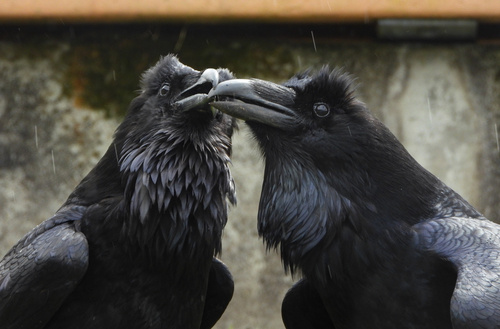 Common Raven
In short
The most reliable way to separate Carrion Crow from Common Raven is by overall structure and size: ravens are much larger, with a massive, heavier bill, a longer, wedge-shaped tail, and a shaggier throat. In flight, ravens show a distinctive wedge-shaped tail and broader wings, while crows have a more squared or slightly rounded tail and proportionally shorter wings. Juvenile crows may show brownish plumage and blue eyes, but juvenile ravens are similar to adults except for a duller sheen and blue-grey iris. Both are all-black, but ravens look bulkier and have a deeper, more resonant call. Careful attention to tail shape, bill size, and flight style is key, especially at a distance.
Identification tips
- Tail shape in flight: Ravens have a long, wedge-shaped tail, most obvious when the bird fans its tail at the end of a glide; crows have a shorter, more squared or gently rounded tail. This is reliable for all ages.
- Bill size and shape: Ravens have a much larger, heavier, and more curved bill than crows. Even at a distance, the bill looks massive and deep, while crows have a slimmer, straighter bill. Works for all ages.
- Throat feathers: Ravens show shaggy, elongated throat feathers ('beard'), especially when calling or in profile; crows have a smooth throat. Best seen when perched or calling.
- Flight style: Ravens often soar and glide on broad wings, with less frequent flapping; crows have steadier, more direct flight with more frequent wingbeats and little gliding. Useful at a distance or in open country.
- Wing shape: Ravens have longer, broader wings with 'fingered' primaries and a heavier look; crows' wings are shorter and less broad. Most useful in good flight views.
- Size: Ravens are much larger and bulkier than crows, but beware of lone birds or poor views—use in combination with other marks.
- Juvenile plumage: Juvenile crows can show brownish-tinged plumage and blue eyes; juvenile ravens are duller black with blue-grey iris, but otherwise similar to adults. Eye color is rarely visible in the field.
- Plumage gloss: Both are glossy black, but crows may show a greener or purpler sheen, while ravens are more uniformly iridescent. Not always reliable.
- Voice: Raven's deep, resonant croak is very different from the crow's guttural 'kraa.' If you hear a truly booming, far-carrying call, it's a raven. Crows are hoarser and less resonant.
- Perched posture: Ravens often look longer-necked, with a heavier bill and shaggier throat; crows are more compact and upright.
- Habitat: If in wild, mountainous, or remote areas, raven is more likely; in dense urban settings, crow is more likely. Not absolute.
- Behavior with other birds: Crows are more likely to be seen with rooks or other corvids; ravens are usually alone or in pairs, except at roosts.
- Group size: Large groups are more likely crows (especially in winter roosts); ravens rarely gather in large flocks except as subadults at roosts.
- Bill color and legs: Both are black, so not useful for separation.
- When in doubt: Focus on tail shape in flight, bill size, and voice—these are the most reliable field marks in most situations.
Size
Common Raven is substantially larger than Carrion Crow. Ravens average about 65–71 cm in length and nearly 950 g in mass, with a wingspan of 116–153 cm. Carrion Crows are much smaller, at 48–52 cm in length, 400–600 g in mass, and a wingspan of 84–100 cm. In the field, this size gap is striking when both are seen together, but can be harder to judge alone or at a distance. Ravens also appear bulkier and heavier-billed, while crows are more compact and lightly built.
Plumage
Juvenile Carrion Crows can be told by their brownish tinge and blue eyes, which darken as they age; juvenile ravens are similar to adults but with a duller black and blue-grey iris. Adult Carrion Crows are uniformly black with a green or purple gloss, while Common Ravens are also all-black but with a more pronounced shaggy throat and longer bristles above the bill. The bases of the neck feathers in ravens are pale brownish-grey, but this is rarely visible in the field. In flight, the tail of the raven is long and wedge-shaped, while the crow's is shorter and more squared or slightly rounded. Both species have black bills, legs, and feet, but the raven's bill is much heavier and more curved.
Behaviour
Carrion Crows are often solitary or seen in pairs, though they may gather in winter roosts. Ravens are typically seen alone or in pairs, but subadults may roost communally. Both species can be found perched in high places, but ravens are more likely to soar for long periods, using their broad wings and stable flight style. Crows have slower, more deliberate wingbeats compared to rooks, but ravens' flight is even more powerful and less labored, often with gliding and soaring. Both species may become tame near humans, but ravens are more likely to be wary and less urban.
Habitat
Both species are adaptable and can be found in a range of habitats, including forests, mountains, and urban areas. Carrion Crows are more common in cities and lowland areas, while Common Ravens are often found in wilder, more open or mountainous regions, though they also occur in cities. Habitat alone is not diagnostic, but ravens are less likely in dense urban cores compared to crows.
Voice
Carrion Crow gives a guttural, slightly vibrant 'kraa' call, usually in short series with pauses, and often bows its head and neck while calling. The Common Raven's voice is deeper, more resonant, and sonorous—a rich 'croak' that carries farther and is more booming than any crow. Raven calls are distinctive and can be a clincher if heard well, but beware of individual variation and distance effects.