
Motmot

Common Cuckoo vs Eurasian Nightjar

Cuculus canorus versus Caprimulgus europaeus

Play a quiz with Common Cuckoo and Eurasian Nightjar
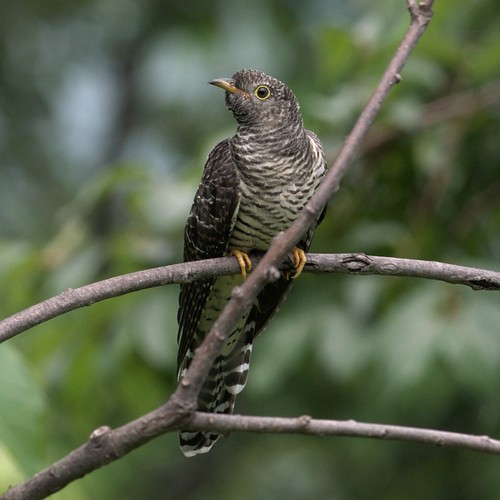
Common Cuckoo (Cuculus canorus) Common Cuckoo
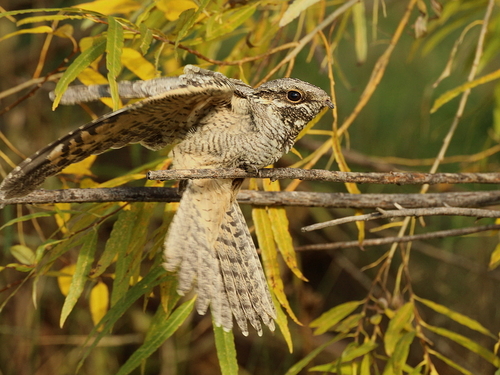
Eurasian Nightjar (Caprimulgus europaeus) Eurasian Nightjar

Media

Loading…

In short

The most reliable field mark to separate Common Cuckoo from Eurasian Nightjar is the overall structure and flight style: cuckoos are long-tailed, slim, and hawk-like with regular, direct wingbeats, while nightjars are short-billed, broad-winged, and have buoyant, fluttery, almost moth-like flight. Juvenile cuckoos show a white nape patch and white-fringed upperwing coverts, never seen in nightjars. Nightjars, especially males, show a distinctive white wing patch and white tail corners in flight, which cuckoos never have. Perched, cuckoos look upright and alert with drooped wings and a long tail, while nightjars are squat, cryptic, and hard to spot, blending into their perch. Voice is also diagnostic: cuckoo males give the classic 'goo-ko' call, while nightjars produce a long, mechanical churring trill at dusk or dawn.

Identification tips

  1. Juvenile Cuckoo White Nape Patch: First-year cuckoos (autumn/spring) show a bold white patch on the nape and white fringes on upperwing coverts—never present in nightjar of any age.
  2. Nightjar White Wing Patch: Adult male nightjars in flight show a bright white patch across three primaries and white tail corners; females lack white but still show broad, rounded wings—cuckoos never show white wing/tail patches.
  3. Flight Style: Cuckoo flies with regular, direct wingbeats, long tail trailing, recalling a small falcon or sparrowhawk. Nightjar flight is buoyant, erratic, and silent, with fluttering, gliding, and moth-like jizz.
  4. Perched Posture: Cuckoo perches upright on exposed branches or wires, often with drooped wings and raised tail. Nightjar sits lengthwise along a branch or on the ground, appearing squat and blending in with bark or leaf litter.
  5. Bill Shape: Cuckoo has a slender, slightly downcurved bill; nightjar has a very short, wide, and flat bill, often hard to see in the field.
  6. Tail Shape: Cuckoo's tail is long and graduated, often fanned or cocked. Nightjar's tail is shorter, with rounded or slightly notched tip; male nightjars have white corners in flight.
  7. Underpart Barring: Cuckoo underparts are sharply and evenly barred, with a clear demarcation from the grey throat. Nightjar underparts are more diffusely barred and spotted, blending into the upperparts.
  8. Rufous Morphs: Both can show rufous tones, but rufous cuckoos (mainly juveniles, rarely adult females) have narrow black bars and creamy-white edges; nightjars are always cryptic, with mottled brown, grey, and buff, never cleanly barred or with white nape.
  9. Eye and Bare Parts: Cuckoo has yellow iris, orbital ring, base of bill, and feet; nightjar's iris is dark brown, bill and feet are brown, and bare parts are not conspicuous.
  10. Voice: Cuckoo male's 'goo-ko' call is diagnostic; nightjar male's long churring trill is completely different. Both may call from perches, but only nightjar sings at dusk/dawn.
  11. Activity Period: Cuckoo is active by day, often seen flying or perching in open. Nightjar is strictly crepuscular/nocturnal, rarely seen except at dusk/dawn or when flushed.
  12. Habitat: Cuckoo found in varied open habitats with host birds; nightjar prefers open woodland, heath, or moorland with bare ground.
  13. Moult Timing: Cuckoo moults partially in summer, fully in winter; nightjar starts body moult after breeding, suspends during migration, and finishes in wintering grounds—rarely diagnostic in the field but may explain odd feather condition.
  14. Confusion Risk: In poor light, a nightjar's flight may seem hawk-like, but the lack of a long tail and presence of white wing/tail patches (in males) are key. Juvenile cuckoo's white nape patch is unique.
  15. Size and Bulk: Cuckoo is larger, heavier, and longer-tailed; nightjar is smaller, lighter, and more compact, with proportionally larger head and shorter tail.

Size

Common Cuckoo is distinctly larger and heavier than Eurasian Nightjar. Cuckoo averages about 32–34 cm in length with a 55–60 cm wingspan and a body mass of 111.5 g (males up to 130 g), while nightjar is smaller at 24.5–28 cm long, wingspan 52–59 cm, and males weighing 51–101 g (females 67–95 g). Cuckoo's body is slimmer but longer-tailed and heavier overall. Nightjar appears more compact and less robust, with a proportionally larger head and shorter tail.

Plumage

Juvenile Common Cuckoos (first autumn and spring) are best identified by a bold white nape patch and white fringes on the upperwing coverts and primaries, plus barred or spotted chestnut-brown upperparts; some may be plain grey. Rufous morph cuckoos (mainly juveniles, rarely adult females) have reddish-brown upperparts with narrow black bars and creamy-white feather edges—never as cryptic as nightjar. Adult cuckoos (male and grey morph female) are slate-grey above with a sharply demarcated grey throat and strongly barred underparts; females may show a pinkish-buff wash and small rufous spots. In contrast, Eurasian Nightjar of all ages is cryptically patterned: greyish-brown with dark streaks, buff spots, and a pale hindneck collar. Males in flight show white patches on three primaries and white tail corners, which females lack. Nightjar underparts are barred and spotted but never as sharply defined as cuckoo's. Nightjar chicks are downy brown and buff, fledglings resemble adult females. Nightjars never show a white nape patch or the clean, sharp barring of cuckoo underparts.

Behaviour

Common Cuckoo is diurnal and often perches openly on wires or exposed branches, sometimes with drooped wings and raised tail, and may wag or pivot its body. In flight, cuckoo is direct, with regular wingbeats, recalling a small hawk or falcon. Eurasian Nightjar is strictly crepuscular and nocturnal, rarely seen in daylight except flushed from the ground. Nightjar flight is buoyant, silent, and erratic, with long glides and fluttering, almost moth-like movements. Perched nightjars are extremely hard to see, sitting lengthwise along branches or on the ground, relying on camouflage.

Habitat

Both species can occur in open country, but Common Cuckoo is a widespread summer migrant to Europe and Asia, often found in a variety of open habitats, including farmland, woodland edges, and reedbeds, wherever host species are present. Eurasian Nightjar prefers open woodland, heath, moorland, and clearings, especially areas with bare ground or sparse vegetation for ground nesting. Nightjars are rarely seen except at dusk or dawn, and are more strictly tied to open, sandy, or heath habitats for breeding.

Voice

Common Cuckoo male gives the unmistakable 'goo-ko' call, usually repeated in groups from an open perch, with the interval and pitch changing through the season. Female cuckoo gives a loud bubbling call. Eurasian Nightjar male sings a long, mechanical churring trill, often for several minutes, from a perch at dusk or dawn; the song can be ventriloquial and hard to locate. Both sexes give short 'cuick' or 'chuck' calls in flight or when alarmed. Nightjar's song is never confused with cuckoo's, but the churring can be mistaken for insects in poor conditions.

Submit a better description

Use the same sections as the comparison. Your text is published immediately.

The most reliable field mark to separate Common Cuckoo from Eurasian Nightjar is the overall structure and flight style: cuckoos are long-tailed, slim, and hawk-like with regular, direct wingbeats, while nightjars are short-billed, broad-winged, and have buoyant, fluttery, almost moth-like flight. Juvenile cuckoos show a white nape patch and white-fringed upperwing coverts, never seen in nightjars. Nightjars, especially males, show a distinctive white wing patch and white tail corners in flight, which cuckoos never have. Perched, cuckoos look upright and alert with drooped wings and a long tail, while nightjars are squat, cryptic, and hard to spot, blending into their perch. Voice is also diagnostic: cuckoo males give the classic 'goo-ko' call, while nightjars produce a long, mechanical churring trill at dusk or dawn.

  1. Juvenile Cuckoo White Nape Patch: First-year cuckoos (autumn/spring) show a bold white patch on the nape and white fringes on upperwing coverts—never present in nightjar of any age.
  2. Nightjar White Wing Patch: Adult male nightjars in flight show a bright white patch across three primaries and white tail corners; females lack white but still show broad, rounded wings—cuckoos never show white wing/tail patches.
  3. Flight Style: Cuckoo flies with regular, direct wingbeats, long tail trailing, recalling a small falcon or sparrowhawk. Nightjar flight is buoyant, erratic, and silent, with fluttering, gliding, and moth-like jizz.
  4. Perched Posture: Cuckoo perches upright on exposed branches or wires, often with drooped wings and raised tail. Nightjar sits lengthwise along a branch or on the ground, appearing squat and blending in with bark or leaf litter.
  5. Bill Shape: Cuckoo has a slender, slightly downcurved bill; nightjar has a very short, wide, and flat bill, often hard to see in the field.
  6. Tail Shape: Cuckoo's tail is long and graduated, often fanned or cocked. Nightjar's tail is shorter, with rounded or slightly notched tip; male nightjars have white corners in flight.
  7. Underpart Barring: Cuckoo underparts are sharply and evenly barred, with a clear demarcation from the grey throat. Nightjar underparts are more diffusely barred and spotted, blending into the upperparts.
  8. Rufous Morphs: Both can show rufous tones, but rufous cuckoos (mainly juveniles, rarely adult females) have narrow black bars and creamy-white edges; nightjars are always cryptic, with mottled brown, grey, and buff, never cleanly barred or with white nape.
  9. Eye and Bare Parts: Cuckoo has yellow iris, orbital ring, base of bill, and feet; nightjar's iris is dark brown, bill and feet are brown, and bare parts are not conspicuous.
  10. Voice: Cuckoo male's 'goo-ko' call is diagnostic; nightjar male's long churring trill is completely different. Both may call from perches, but only nightjar sings at dusk/dawn.
  11. Activity Period: Cuckoo is active by day, often seen flying or perching in open. Nightjar is strictly crepuscular/nocturnal, rarely seen except at dusk/dawn or when flushed.
  12. Habitat: Cuckoo found in varied open habitats with host birds; nightjar prefers open woodland, heath, or moorland with bare ground.
  13. Moult Timing: Cuckoo moults partially in summer, fully in winter; nightjar starts body moult after breeding, suspends during migration, and finishes in wintering grounds—rarely diagnostic in the field but may explain odd feather condition.
  14. Confusion Risk: In poor light, a nightjar's flight may seem hawk-like, but the lack of a long tail and presence of white wing/tail patches (in males) are key. Juvenile cuckoo's white nape patch is unique.
  15. Size and Bulk: Cuckoo is larger, heavier, and longer-tailed; nightjar is smaller, lighter, and more compact, with proportionally larger head and shorter tail.

Common Cuckoo is distinctly larger and heavier than Eurasian Nightjar. Cuckoo averages about 32–34 cm in length with a 55–60 cm wingspan and a body mass of 111.5 g (males up to 130 g), while nightjar is smaller at 24.5–28 cm long, wingspan 52–59 cm, and males weighing 51–101 g (females 67–95 g). Cuckoo's body is slimmer but longer-tailed and heavier overall. Nightjar appears more compact and less robust, with a proportionally larger head and shorter tail.

Juvenile Common Cuckoos (first autumn and spring) are best identified by a bold white nape patch and white fringes on the upperwing coverts and primaries, plus barred or spotted chestnut-brown upperparts; some may be plain grey. Rufous morph cuckoos (mainly juveniles, rarely adult females) have reddish-brown upperparts with narrow black bars and creamy-white feather edges—never as cryptic as nightjar. Adult cuckoos (male and grey morph female) are slate-grey above with a sharply demarcated grey throat and strongly barred underparts; females may show a pinkish-buff wash and small rufous spots. In contrast, Eurasian Nightjar of all ages is cryptically patterned: greyish-brown with dark streaks, buff spots, and a pale hindneck collar. Males in flight show white patches on three primaries and white tail corners, which females lack. Nightjar underparts are barred and spotted but never as sharply defined as cuckoo's. Nightjar chicks are downy brown and buff, fledglings resemble adult females. Nightjars never show a white nape patch or the clean, sharp barring of cuckoo underparts.

Common Cuckoo is diurnal and often perches openly on wires or exposed branches, sometimes with drooped wings and raised tail, and may wag or pivot its body. In flight, cuckoo is direct, with regular wingbeats, recalling a small hawk or falcon. Eurasian Nightjar is strictly crepuscular and nocturnal, rarely seen in daylight except flushed from the ground. Nightjar flight is buoyant, silent, and erratic, with long glides and fluttering, almost moth-like movements. Perched nightjars are extremely hard to see, sitting lengthwise along branches or on the ground, relying on camouflage.

Both species can occur in open country, but Common Cuckoo is a widespread summer migrant to Europe and Asia, often found in a variety of open habitats, including farmland, woodland edges, and reedbeds, wherever host species are present. Eurasian Nightjar prefers open woodland, heath, moorland, and clearings, especially areas with bare ground or sparse vegetation for ground nesting. Nightjars are rarely seen except at dusk or dawn, and are more strictly tied to open, sandy, or heath habitats for breeding.

Common Cuckoo male gives the unmistakable 'goo-ko' call, usually repeated in groups from an open perch, with the interval and pitch changing through the season. Female cuckoo gives a loud bubbling call. Eurasian Nightjar male sings a long, mechanical churring trill, often for several minutes, from a perch at dusk or dawn; the song can be ventriloquial and hard to locate. Both sexes give short 'cuick' or 'chuck' calls in flight or when alarmed. Nightjar's song is never confused with cuckoo's, but the churring can be mistaken for insects in poor conditions.

Discard your changes?

You have unsaved edits. If you leave now, those changes will be lost.

Common Cuckoo · Eurasian Nightjar · My Tricky Birds