
Motmot

Common Kestrel vs Merlin

Falco tinnunculus versus Falco columbarius

Play a quiz with Common Kestrel and Merlin
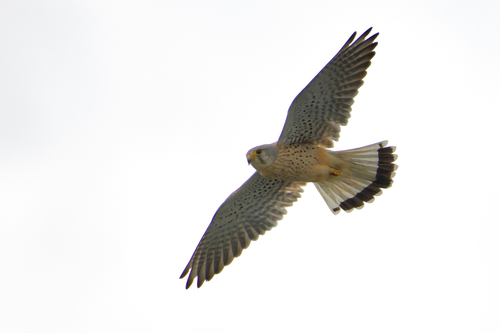
Common Kestrel (Falco tinnunculus) Common Kestrel
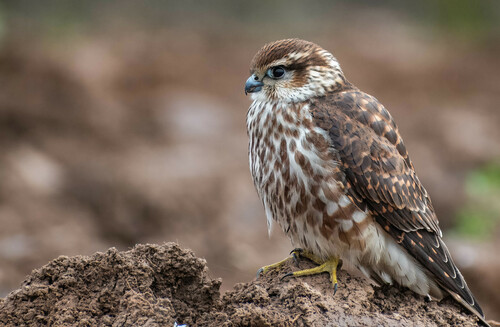
Merlin (Falco columbarius) Merlin

Media

Loading…

In short

The most reliable field mark between Common Kestrel and Merlin is the overall coloration and pattern of the upperparts and tail, especially in flight: Common Kestrel shows a warm chestnut-brown back and upperwings with black spots, while Merlin is more uniformly grayish-brown (males blue-gray, females brown) and lacks the rufous tones. Juvenile and female kestrels are especially prone to confusion with Merlins, but kestrels usually show a longer tail, more distinct facial markings, and a paler, streaked underside. Merlins are more compact, with a heavier, more muscular build and a less contrasting face. In perched birds, note the kestrel's longer tail and more upright stance versus the Merlin's stockier, horizontal posture. In flight, kestrels often hover, while Merlins fly with rapid, direct wingbeats and rarely hover.

Identification tips

  1. Juvenile/female confusion: Juvenile and female Common Kestrels are most often confused with female/immature Merlins. Focus on tail length and pattern: kestrels have a longer, more graduated tail with narrow black bars and a black tip edged white; Merlins have a shorter, squarer tail with broad blackish bands and a black tip with a narrow white edge.
  2. Upperparts color: Kestrels (all ages) show a warm chestnut-brown back and upperwings with black spots; Merlins are more uniform grayish-brown (females/immatures) or blue-gray (adult males) with little or no rufous.
  3. Facial markings: Kestrels have a strong black malar stripe and often a pale cheek, giving a 'moustached' look. Merlin's face is much plainer, with only a faint malar stripe and weak supercilium.
  4. Underparts: Kestrels are buff with narrow blackish streaks (adults) or broader streaks (juveniles); Merlins have buff to orange underparts with heavy, blurry streaking or spotting, never as pale or finely streaked as kestrel.
  5. Bare parts: Kestrels have brighter yellow cere, eye-ring, and feet; Merlins' bare parts are yellow but often less striking, and the iris is always dark in both.
  6. Tail pattern in flight: Both species have a black tail tip with a narrow white edge, but kestrel's tail is longer and more obviously barred; Merlin's tail bands are broader and the tail is shorter and squarer.
  7. Wing shape and flight: Kestrels have longer, narrower wings and a more buoyant, gliding flight; Merlins have shorter, pointed wings and fly with rapid, powerful wingbeats, rarely gliding or hovering.
  8. Hovering: If you see a small falcon hovering for extended periods, it is almost certainly a kestrel. Merlins may briefly pause in the air but do not truly hover.
  9. Perched posture: Kestrels perch upright with a long tail hanging down; Merlins perch more horizontally, appearing stockier and more compact.
  10. Size impression: Kestrels look slender and elongated, especially when perched; Merlins look compact and muscular, with a shorter tail and neck.
  11. Habitat context: In urban or farmland settings, kestrel is much more likely. In open moorland, coastal dunes, or wild grasslands, especially in winter, Merlin becomes more likely.
  12. Sexual dimorphism: Adult male kestrels have a blue-grey cap and tail, unlike any Merlin. Male Merlins are blue-gray above but lack the rufous back and have a plainer face.
  13. Juvenile marks: Juvenile kestrels have paler bare parts and broader underside streaks than adults, but still show the long tail and facial pattern. Juvenile Merlins resemble adult females but are always more uniform above and lack the kestrel's rufous tones.
  14. Flight jizz: Kestrels often soar and hover, with wings held in a shallow V; Merlins fly low and fast, with rapid, level wingbeats and rarely soar or hover.
  15. Pitfalls: In poor light or at distance, female/juvenile kestrels can look surprisingly dark and uniform, but the longer tail and hovering behavior are strong clues. Merlins may appear paler in some subspecies, but never show the warm chestnut tones or strong face pattern of kestrel.

Size

Both species are similar in mass (Common Kestrel ~184g, Merlin ~187g [wikidata]), but the kestrel is generally longer (32–39 cm vs. Merlin's 24–33 cm) and has a broader wingspan (65–82 cm vs. Merlin's 50–73 cm) [wikipedia]. Kestrels appear more slender and elongated, with a proportionally longer tail and wings, while Merlins are noticeably more compact and robust, with shorter wings and tail relative to body size. Females of both species are larger than males, but this does not help much in the field unless birds are side by side.

Plumage

Juvenile and female Common Kestrels have a light chestnut-brown back and upperwings with blackish spots, and a brown tail with black bars and a black tip edged white. Juveniles resemble adult females but have broader underside streaks and paler bare parts. Adult males are more distinctive, with a blue-grey cap and tail, fewer black spots, and a rufous back. By contrast, Merlins (both sexes and immatures) are more uniform above: males are blue-gray, females and immatures are brownish-gray to dark brown. The Merlin's tail is banded with 3–4 wide blackish bars and always ends in a black tip with a narrow white edge, but the tail is shorter and less obviously rufous than kestrel. Merlin underparts are buff to orange with heavy streaking (males) or spotted with brown (females/immatures), but never as pale or as finely streaked as kestrel. The Merlin's face is less strongly marked, with only a faint malar stripe and weak supercilium, while kestrel shows a prominent black malar stripe and brighter yellow bare parts. In flight, kestrels show more contrast and a longer, narrower wing and tail profile; Merlins are more uniform and compact.

Behaviour

Common Kestrels are famous for their hovering hunting style, often seen stationary in the air while searching for prey. Merlins almost never hover; instead, they hunt with fast, direct, low flights, often pursuing small birds in rapid chases. Perched kestrels tend to sit upright with a long tail drooping below the perch, while Merlins perch more horizontally and appear bulkier. Kestrels are more tolerant of urban and open habitats, while Merlins are more often seen in open country, moorland, or coastal areas, especially outside the breeding season.

Habitat

Both species can occur in open habitats, but Common Kestrel is more widespread in farmland, urban areas, and even nesting on buildings. Merlins breed in the northern Holarctic and winter in open country, moorland, coastal dunes, and sometimes urban parks, but are generally less likely to be seen in dense urban areas than kestrels. In the UK and much of Europe, kestrel is the default small falcon in settled areas, while Merlin is more likely in wild, open landscapes, especially in winter.

Submit a better description

Use the same sections as the comparison. Your text is published immediately.

The most reliable field mark between Common Kestrel and Merlin is the overall coloration and pattern of the upperparts and tail, especially in flight: Common Kestrel shows a warm chestnut-brown back and upperwings with black spots, while Merlin is more uniformly grayish-brown (males blue-gray, females brown) and lacks the rufous tones. Juvenile and female kestrels are especially prone to confusion with Merlins, but kestrels usually show a longer tail, more distinct facial markings, and a paler, streaked underside. Merlins are more compact, with a heavier, more muscular build and a less contrasting face. In perched birds, note the kestrel's longer tail and more upright stance versus the Merlin's stockier, horizontal posture. In flight, kestrels often hover, while Merlins fly with rapid, direct wingbeats and rarely hover.

  1. Juvenile/female confusion: Juvenile and female Common Kestrels are most often confused with female/immature Merlins. Focus on tail length and pattern: kestrels have a longer, more graduated tail with narrow black bars and a black tip edged white; Merlins have a shorter, squarer tail with broad blackish bands and a black tip with a narrow white edge.
  2. Upperparts color: Kestrels (all ages) show a warm chestnut-brown back and upperwings with black spots; Merlins are more uniform grayish-brown (females/immatures) or blue-gray (adult males) with little or no rufous.
  3. Facial markings: Kestrels have a strong black malar stripe and often a pale cheek, giving a 'moustached' look. Merlin's face is much plainer, with only a faint malar stripe and weak supercilium.
  4. Underparts: Kestrels are buff with narrow blackish streaks (adults) or broader streaks (juveniles); Merlins have buff to orange underparts with heavy, blurry streaking or spotting, never as pale or finely streaked as kestrel.
  5. Bare parts: Kestrels have brighter yellow cere, eye-ring, and feet; Merlins' bare parts are yellow but often less striking, and the iris is always dark in both.
  6. Tail pattern in flight: Both species have a black tail tip with a narrow white edge, but kestrel's tail is longer and more obviously barred; Merlin's tail bands are broader and the tail is shorter and squarer.
  7. Wing shape and flight: Kestrels have longer, narrower wings and a more buoyant, gliding flight; Merlins have shorter, pointed wings and fly with rapid, powerful wingbeats, rarely gliding or hovering.
  8. Hovering: If you see a small falcon hovering for extended periods, it is almost certainly a kestrel. Merlins may briefly pause in the air but do not truly hover.
  9. Perched posture: Kestrels perch upright with a long tail hanging down; Merlins perch more horizontally, appearing stockier and more compact.
  10. Size impression: Kestrels look slender and elongated, especially when perched; Merlins look compact and muscular, with a shorter tail and neck.
  11. Habitat context: In urban or farmland settings, kestrel is much more likely. In open moorland, coastal dunes, or wild grasslands, especially in winter, Merlin becomes more likely.
  12. Sexual dimorphism: Adult male kestrels have a blue-grey cap and tail, unlike any Merlin. Male Merlins are blue-gray above but lack the rufous back and have a plainer face.
  13. Juvenile marks: Juvenile kestrels have paler bare parts and broader underside streaks than adults, but still show the long tail and facial pattern. Juvenile Merlins resemble adult females but are always more uniform above and lack the kestrel's rufous tones.
  14. Flight jizz: Kestrels often soar and hover, with wings held in a shallow V; Merlins fly low and fast, with rapid, level wingbeats and rarely soar or hover.
  15. Pitfalls: In poor light or at distance, female/juvenile kestrels can look surprisingly dark and uniform, but the longer tail and hovering behavior are strong clues. Merlins may appear paler in some subspecies, but never show the warm chestnut tones or strong face pattern of kestrel.

Both species are similar in mass (Common Kestrel ~184g, Merlin ~187g [wikidata]), but the kestrel is generally longer (32–39 cm vs. Merlin's 24–33 cm) and has a broader wingspan (65–82 cm vs. Merlin's 50–73 cm) [wikipedia]. Kestrels appear more slender and elongated, with a proportionally longer tail and wings, while Merlins are noticeably more compact and robust, with shorter wings and tail relative to body size. Females of both species are larger than males, but this does not help much in the field unless birds are side by side.

Juvenile and female Common Kestrels have a light chestnut-brown back and upperwings with blackish spots, and a brown tail with black bars and a black tip edged white. Juveniles resemble adult females but have broader underside streaks and paler bare parts. Adult males are more distinctive, with a blue-grey cap and tail, fewer black spots, and a rufous back. By contrast, Merlins (both sexes and immatures) are more uniform above: males are blue-gray, females and immatures are brownish-gray to dark brown. The Merlin's tail is banded with 3–4 wide blackish bars and always ends in a black tip with a narrow white edge, but the tail is shorter and less obviously rufous than kestrel. Merlin underparts are buff to orange with heavy streaking (males) or spotted with brown (females/immatures), but never as pale or as finely streaked as kestrel. The Merlin's face is less strongly marked, with only a faint malar stripe and weak supercilium, while kestrel shows a prominent black malar stripe and brighter yellow bare parts. In flight, kestrels show more contrast and a longer, narrower wing and tail profile; Merlins are more uniform and compact.

Common Kestrels are famous for their hovering hunting style, often seen stationary in the air while searching for prey. Merlins almost never hover; instead, they hunt with fast, direct, low flights, often pursuing small birds in rapid chases. Perched kestrels tend to sit upright with a long tail drooping below the perch, while Merlins perch more horizontally and appear bulkier. Kestrels are more tolerant of urban and open habitats, while Merlins are more often seen in open country, moorland, or coastal areas, especially outside the breeding season.

Both species can occur in open habitats, but Common Kestrel is more widespread in farmland, urban areas, and even nesting on buildings. Merlins breed in the northern Holarctic and winter in open country, moorland, coastal dunes, and sometimes urban parks, but are generally less likely to be seen in dense urban areas than kestrels. In the UK and much of Europe, kestrel is the default small falcon in settled areas, while Merlin is more likely in wild, open landscapes, especially in winter.

Discard your changes?

You have unsaved edits. If you leave now, those changes will be lost.

Common Kestrel · Merlin · My Tricky Birds