
Common Linnet vs Common Redpoll
Linaria cannabina versus Acanthis flammea
Play a quiz with Common Linnet and Common Redpoll
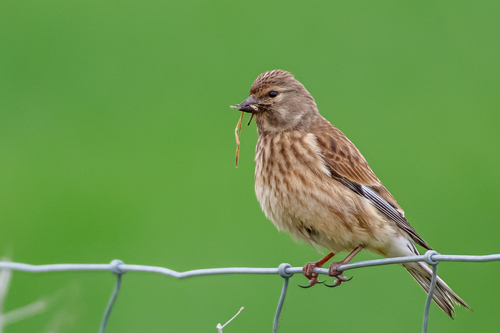 Common Linnet
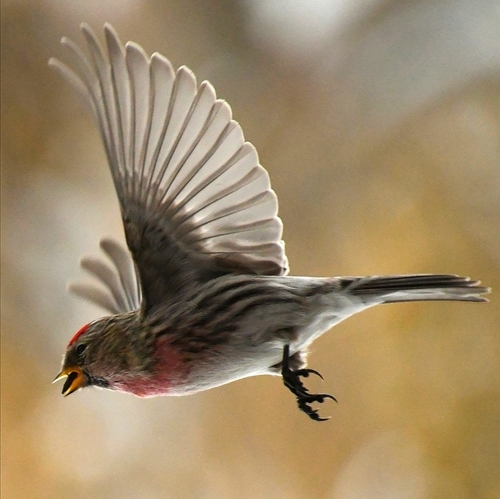 Common Redpoll
In short
The best field mark to separate Common Linnet from Common Redpoll is the presence of a black bib and a bright red forehead patch on the Redpoll, which the Linnet lacks. Linnets are slightly heavier, longer-tailed, and show a more slender, plain-faced look, while Redpolls have a streakier appearance with two pale wingbars and a yellowish bill. Juvenile and female Linnets lack the red tones of adult males, making confusion with Redpolls more likely, but Redpolls always show the red forehead and black bib, even in non-breeding plumages. Both are small finches, but structure, face pattern, and wing markings are key in the field.
Identification tips
- Red forehead patch (Redpoll): All Redpolls, regardless of age or sex, show a bright red patch on the forehead. Linnets never show this feature.
- Black bib (Redpoll): Redpolls have a small, neat black bib under the bill, visible in all plumages. Linnets have plain throats.
- Wingbars (Redpoll): Look for two pale wingbars on Redpolls' dark wings; Linnets lack wingbars and have plain brown wings.
- Bill color: Redpolls have a yellowish bill with a dark tip; Linnet bills are plain grey.
- Face pattern: Redpolls have a more contrasting face with the red forehead, black bib, and pale supercilium; Linnets have a plainer, less marked face.
- Breast color (adult males): Linnet males in summer show a red breast and head-patch, but no black bib or wingbars. Redpoll males may have a pinkish suffusion on the breast, but always with the red forehead and black bib.
- Juvenile/female confusion: Female and juvenile Linnets lack red entirely and have streaked buff breasts, but still lack the black bib and wingbars of Redpolls.
- Upperparts: Both are streaky brown above, but Redpolls are generally colder-toned and more heavily streaked, especially on the rump and flanks.
- Tail shape: Linnets have a longer, more pointed tail; Redpolls' tails are shorter and more notched.
- Structure: Linnets are slimmer and longer-tailed, giving a more elongated look; Redpolls are compact, round-bodied, and short-tailed.
- Flight style: Linnet flocks are more undulating and elongated; Redpoll flocks are tighter and more erratic.
- Feeding behavior: Redpolls often feed high in trees, sometimes hanging upside down; Linnets are more often on the ground or in low vegetation.
- Habitat context: In open farmland and hedgerows, expect Linnet; in birch/alder woods or northern/boreal settings, expect Redpoll.
- Size: Linnets are heavier and slightly larger; Redpolls are smaller and lighter.
- Pitfall: In dull light or at a distance, female/juvenile Linnets can look streaky and brown like Redpolls, but check for the absence of red forehead, black bib, and wingbars to rule out Redpoll.
Size
Common Linnet is heavier (19g vs 12–16g for Redpoll [wikidata, wikipedia]), with a longer, slimmer tail and overall more elongated appearance. Redpolls are slightly shorter in length (11.5–14 cm) and have a more compact, round-bodied look. In the hand or with good views, Linnet feels more slender and less stubby than Redpoll.
Plumage
- Juvenile/Immature/Non-breeding birds: Both can appear streaky brown above and pale below, but Redpolls always show a red forehead patch and a black bib, plus two pale wingbars. Linnet juveniles and females lack any red, have plain faces without a bib, and show streaked buff breasts with white underparts.
- Adult males in breeding plumage: Linnet males have a red head-patch and breast, but no black bib or wingbars; Redpoll males have a red forehead, black bib, and sometimes a pinkish wash on the breast, but always with the bib and wingbars.
- Wing pattern: Redpolls have two distinct pale wingbars on dark wings, visible in all plumages and ages. Linnets lack wingbars, and their wings are plainer brown.
- Bill: Redpolls have a yellowish bill with a dark tip; Linnets have a plain grey bill.
Behaviour
Both species are social and often seen in flocks, especially outside the breeding season. Linnets tend to forage more on the ground or in low vegetation, while Redpolls are more arboreal, often feeding acrobatically in birch or alder trees. Redpolls are more likely to hang upside down while feeding. In flight, Linnet flocks often appear more elongated and undulating, while Redpoll flocks are tighter and more erratic.
Habitat
Linnets prefer open country, farmland, hedgerows, and weedy fields, often in lowland areas. Redpolls are birds of northern and boreal habitats, favoring birch and alder woods, and in winter, they may appear in weedy or shrubby areas but are still closely tied to trees. If you see a streaky finch feeding high in birches or alders, especially in winter, Redpoll is more likely; in open, bushy farmland, Linnet is expected.