
Motmot

Common Nighthawk vs Blue-tailed Emerald

Chordeiles minor versus Chlorostilbon mellisugus

Play a quiz with Common Nighthawk and Blue-tailed Emerald
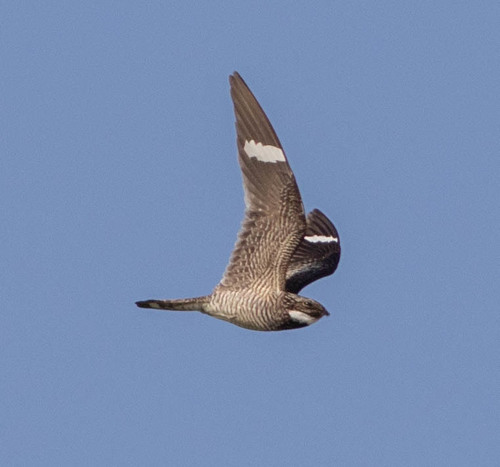
Common Nighthawk (Chordeiles minor) Common Nighthawk
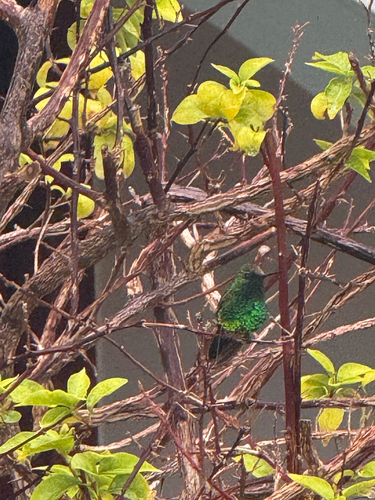
Blue-tailed Emerald (Chlorostilbon mellisugus) Blue-tailed Emerald

Media

Loading…

In short

The most reliable way to separate Common Nighthawk from Blue-tailed Emerald is by overall structure and flight style: nighthawks are long-winged, erratic-flying nightjars with a distinctive white wing patch (smaller in juveniles), while Blue-tailed Emeralds are tiny, compact hummingbirds with a straight bill and metallic green or blue-green plumage. Juvenile nighthawks can be paler and have a smaller white wing patch, but even then, their cryptic, barred pattern and long wings are unlike any hummingbird. The two species differ drastically in size, shape, and behavior, making confusion most likely only in fleeting, silhouetted views or poor light. Use flight style, bill shape, and tail structure as your first checks.

Identification tips

  1. Size is the first check: Common Nighthawk is much larger and bulkier than any hummingbird, including Blue-tailed Emerald. If the bird looks sparrow-sized or larger, it's not an emerald.
  2. Wing pattern in flight: All ages of Common Nighthawk show a white wing patch (smaller in juveniles), visible from below and above in flight. Blue-tailed Emerald never shows a white wing patch.
  3. Bill shape: Nighthawk has a tiny, flat bill with a huge mouth; Blue-tailed Emerald has a short, straight, needle-like black bill. If you see a long, slender bill, it's the emerald.
  4. Tail shape: Nighthawk has a long, notched or slightly forked tail; Blue-tailed Emerald males have a deeply forked steel blue tail, females a blue-black tail with pale tips. However, the nighthawk's tail is proportionally much longer relative to its body.
  5. Plumage color: Nighthawk is cryptically barred gray, brown, and black, never iridescent. Blue-tailed Emerald males are metallic green and blue, females metallic green above and pale below. Any sign of iridescence or metallic sheen rules out nighthawk.
  6. Perching posture: Nighthawk perches horizontally, parallel to the branch or ground; Blue-tailed Emerald perches upright like a typical hummingbird.
  7. Flight style: Nighthawk has buoyant, erratic, moth-like flight, often gliding or soaring. Blue-tailed Emerald flies with rapid wingbeats, hovers at flowers, and never glides.
  8. Activity period: Nighthawk is crepuscular/nocturnal, most active at dusk or dawn. Blue-tailed Emerald is active by day.
  9. Habitat context: Nighthawk favors open areas, rooftops, and clearings; Blue-tailed Emerald is found in gardens, forest edges, and tropical woodlands.
  10. Voice: Listen for the nighthawk's loud 'peent' at dusk; emeralds are quieter, giving soft chips or trills.
  11. Juvenile confusion: Juvenile nighthawks are paler and have a smaller white wing patch, but still show cryptic barring and long wings. No age of Blue-tailed Emerald shows such a pattern.
  12. Facial features: Nighthawk lacks rictal bristles and has a large, flat head with big eyes; Blue-tailed Emerald has a small, rounded head and straight bill.
  13. Feeding behavior: Nighthawk catches insects on the wing; Blue-tailed Emerald feeds at flowers by hovering.
  14. Group behavior: Nighthawk is mostly solitary or in loose groups; Blue-tailed Emerald may visit feeders with other hummingbirds but is usually alone at a flower.
  15. Confusion risk: Only in poor light or distant silhouette could these be confused; use size, wing patch, and flight style as your first checks.

Size

There is an extreme size difference: Common Nighthawk is a medium-sized bird, weighing about 79.3 g and measuring 22–25 cm long with a 51–61 cm wingspan [wikidata, wikipedia]. In contrast, Blue-tailed Emerald is a tiny hummingbird, with males 7.5–9.5 cm long and weighing about 2.7 g, females even smaller [wikipedia]. Even at a distance, the nighthawk is several times larger and bulkier than the hummingbird.

Plumage

Juvenile Common Nighthawks are lighter in color and have a smaller white wing patch than adults; this patch is still present and diagnostic in flight for all ages. Adults show cryptic gray, brown, and black barring with bold white wing patches and a notched tail. Blue-tailed Emerald males are metallic green with a steel blue, deeply forked tail and glittering emerald underparts; females are metallic grass green above with a blue-black tail tipped whitish gray and pale gray underparts. No nighthawk, of any age or sex, shows iridescent or metallic colors, while no Blue-tailed Emerald shows the barred, cryptic pattern or white wing patch of a nighthawk. The nighthawk's plumage is adapted for camouflage, while the emerald's is for display.

Behaviour

Common Nighthawk is most often seen flying at dusk or dawn in buoyant, erratic, moth-like flight, often high overhead or foraging in open areas. It perches horizontally on branches, posts, or the ground, rarely upright. Blue-tailed Emerald is active by day, hovering at flowers or perching upright on twigs; its flight is direct, fast, and hummingbird-typical, with rapid wingbeats and frequent hovering. The nighthawk never hovers like a hummingbird, and the emerald never soars or glides like a nighthawk.

Habitat

Common Nighthawk occurs in open habitats, including urban areas, grasslands, and clearings, across much of the Americas, and is most active at twilight or night. Blue-tailed Emerald is found in tropical and subtropical South America east of the Andes, in gardens, forest edges, and open woodlands, active by day. Their ranges overlap only in northern South America, but their preferred habitats and daily activity periods differ sharply.

Voice

Common Nighthawk is best detected by its distinctive, nasal 'peent' call, especially at dusk or dawn. Blue-tailed Emerald, like most hummingbirds, gives high-pitched, rapid chips or trills, but is generally much quieter and less conspicuous than the nighthawk. The nighthawk's call is loud and carries far, while the emerald's is soft and easily missed.

Submit a better description

Use the same sections as the comparison. Your text is published immediately.

The most reliable way to separate Common Nighthawk from Blue-tailed Emerald is by overall structure and flight style: nighthawks are long-winged, erratic-flying nightjars with a distinctive white wing patch (smaller in juveniles), while Blue-tailed Emeralds are tiny, compact hummingbirds with a straight bill and metallic green or blue-green plumage. Juvenile nighthawks can be paler and have a smaller white wing patch, but even then, their cryptic, barred pattern and long wings are unlike any hummingbird. The two species differ drastically in size, shape, and behavior, making confusion most likely only in fleeting, silhouetted views or poor light. Use flight style, bill shape, and tail structure as your first checks.

  1. Size is the first check: Common Nighthawk is much larger and bulkier than any hummingbird, including Blue-tailed Emerald. If the bird looks sparrow-sized or larger, it's not an emerald.
  2. Wing pattern in flight: All ages of Common Nighthawk show a white wing patch (smaller in juveniles), visible from below and above in flight. Blue-tailed Emerald never shows a white wing patch.
  3. Bill shape: Nighthawk has a tiny, flat bill with a huge mouth; Blue-tailed Emerald has a short, straight, needle-like black bill. If you see a long, slender bill, it's the emerald.
  4. Tail shape: Nighthawk has a long, notched or slightly forked tail; Blue-tailed Emerald males have a deeply forked steel blue tail, females a blue-black tail with pale tips. However, the nighthawk's tail is proportionally much longer relative to its body.
  5. Plumage color: Nighthawk is cryptically barred gray, brown, and black, never iridescent. Blue-tailed Emerald males are metallic green and blue, females metallic green above and pale below. Any sign of iridescence or metallic sheen rules out nighthawk.
  6. Perching posture: Nighthawk perches horizontally, parallel to the branch or ground; Blue-tailed Emerald perches upright like a typical hummingbird.
  7. Flight style: Nighthawk has buoyant, erratic, moth-like flight, often gliding or soaring. Blue-tailed Emerald flies with rapid wingbeats, hovers at flowers, and never glides.
  8. Activity period: Nighthawk is crepuscular/nocturnal, most active at dusk or dawn. Blue-tailed Emerald is active by day.
  9. Habitat context: Nighthawk favors open areas, rooftops, and clearings; Blue-tailed Emerald is found in gardens, forest edges, and tropical woodlands.
  10. Voice: Listen for the nighthawk's loud 'peent' at dusk; emeralds are quieter, giving soft chips or trills.
  11. Juvenile confusion: Juvenile nighthawks are paler and have a smaller white wing patch, but still show cryptic barring and long wings. No age of Blue-tailed Emerald shows such a pattern.
  12. Facial features: Nighthawk lacks rictal bristles and has a large, flat head with big eyes; Blue-tailed Emerald has a small, rounded head and straight bill.
  13. Feeding behavior: Nighthawk catches insects on the wing; Blue-tailed Emerald feeds at flowers by hovering.
  14. Group behavior: Nighthawk is mostly solitary or in loose groups; Blue-tailed Emerald may visit feeders with other hummingbirds but is usually alone at a flower.
  15. Confusion risk: Only in poor light or distant silhouette could these be confused; use size, wing patch, and flight style as your first checks.

There is an extreme size difference: Common Nighthawk is a medium-sized bird, weighing about 79.3 g and measuring 22–25 cm long with a 51–61 cm wingspan [wikidata, wikipedia]. In contrast, Blue-tailed Emerald is a tiny hummingbird, with males 7.5–9.5 cm long and weighing about 2.7 g, females even smaller [wikipedia]. Even at a distance, the nighthawk is several times larger and bulkier than the hummingbird.

Juvenile Common Nighthawks are lighter in color and have a smaller white wing patch than adults; this patch is still present and diagnostic in flight for all ages. Adults show cryptic gray, brown, and black barring with bold white wing patches and a notched tail. Blue-tailed Emerald males are metallic green with a steel blue, deeply forked tail and glittering emerald underparts; females are metallic grass green above with a blue-black tail tipped whitish gray and pale gray underparts. No nighthawk, of any age or sex, shows iridescent or metallic colors, while no Blue-tailed Emerald shows the barred, cryptic pattern or white wing patch of a nighthawk. The nighthawk's plumage is adapted for camouflage, while the emerald's is for display.

Common Nighthawk is most often seen flying at dusk or dawn in buoyant, erratic, moth-like flight, often high overhead or foraging in open areas. It perches horizontally on branches, posts, or the ground, rarely upright. Blue-tailed Emerald is active by day, hovering at flowers or perching upright on twigs; its flight is direct, fast, and hummingbird-typical, with rapid wingbeats and frequent hovering. The nighthawk never hovers like a hummingbird, and the emerald never soars or glides like a nighthawk.

Common Nighthawk occurs in open habitats, including urban areas, grasslands, and clearings, across much of the Americas, and is most active at twilight or night. Blue-tailed Emerald is found in tropical and subtropical South America east of the Andes, in gardens, forest edges, and open woodlands, active by day. Their ranges overlap only in northern South America, but their preferred habitats and daily activity periods differ sharply.

Common Nighthawk is best detected by its distinctive, nasal 'peent' call, especially at dusk or dawn. Blue-tailed Emerald, like most hummingbirds, gives high-pitched, rapid chips or trills, but is generally much quieter and less conspicuous than the nighthawk. The nighthawk's call is loud and carries far, while the emerald's is soft and easily missed.

Discard your changes?

You have unsaved edits. If you leave now, those changes will be lost.

Common Nighthawk · Blue-tailed Emerald · My Tricky Birds