

Common Reed Warbler vs Savi's Warbler
Acrocephalus scirpaceus versus Locustella luscinioides
Play a quiz with Common Reed Warbler and Savi's Warbler
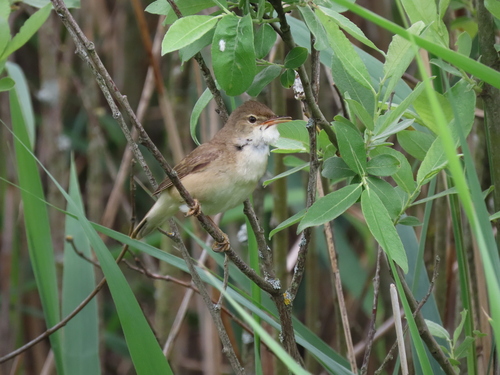 Common Reed Warbler
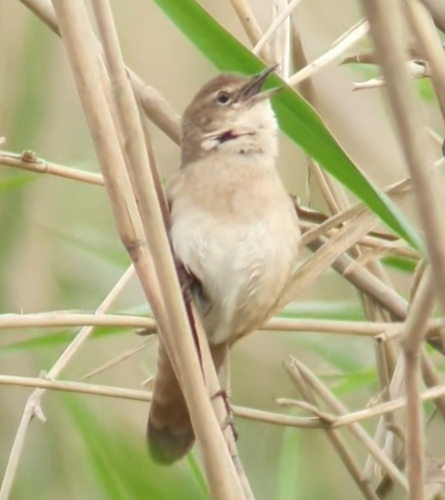 Savi's Warbler
In short
The most reliable field mark between Common Reed Warbler and Savi's Warbler is their overall plumage tone and structure: Common Reed Warbler is a plain, unstreaked brown bird with buff underparts and a strong, pointed bill, while Savi's Warbler is darker, more uniformly reddish-brown above, with a subtle buff eye-stripe and a slenderer bill. Savi's Warbler also tends to appear more secretive, but when singing, it perches high on reed stems and delivers a distinctive, mechanical trill. Juvenile and adult plumages are similar enough that structure and subtle coloration differences are key in the field. Both species can be skulking, but Savi's Warbler is even more elusive except when singing.
Identification tips
- Overall upperpart color: Savi's Warbler is a uniform dark reddish-brown above, sometimes with a greenish tinge, while Common Reed Warbler is a paler, plain brown. This is most useful in good light and at close range.
- Underpart tone: Common Reed Warbler has buff underparts (richer buff in juveniles), while Savi's Warbler shows sandy brown flanks with a whitish-buff chin, throat, and belly. Savi's underparts are generally duller and more uniform.
- Eye-stripe and face: Savi's Warbler has an indistinct buff eye-stripe and dark lores, giving a slightly masked look. Common Reed Warbler lacks a strong supercilium and has a plainer face.
- Bill structure: Common Reed Warbler's bill is strong and pointed; Savi's Warbler's bill is slender and brown. This is subtle but can help at close range.
- Head shape: Common Reed Warbler has a flattened forehead, while Savi's Warbler's head shape is less distinctive.
- Song: Savi's Warbler sings a mechanical, insect-like trill (lower-pitched and less prolonged than Grasshopper Warbler), often preceded by ticking notes. Common Reed Warbler's song is a slow, chattering sequence with whistles and mimicry, never a trill.
- Singing posture: Savi's Warbler sings from high, exposed reed stems with an open beak and visible throat vibration. Common Reed Warbler sings from lower or more concealed perches.
- Behavior: Savi's Warbler is more secretive and rarely seen except when singing; Common Reed Warbler is more likely to be seen moving through reeds or perching low.
- Habitat: Both use reedbeds, but Savi's Warbler is more restricted to dense, extensive stands and is less likely away from optimal habitat. Common Reed Warbler is more widespread and adaptable.
- Size: Savi's Warbler is slightly longer (14 cm vs. 13 cm) but this is rarely useful in the field.
- Leg color: Savi's Warbler has brown legs; Common Reed Warbler's leg color is not specified but is not a key field mark.
- Juvenile confusion: Both species' juveniles are plain and unstreaked above; use structure and overall color as above.
- Flight views: No distinctive wing or tail pattern differences are described for either species; separation in flight relies on structure and coloration.
- Season: Savi's Warbler moults into breeding plumage before returning to breeding grounds, but this is not a strong field mark. Both species are migratory and overlap in timing.
- Sex differences: Both species are sexually monomorphic in plumage; do not rely on sex for identification.
Size
Common Reed Warbler is slightly smaller, averaging 13 cm in length and 12 g in mass [wikidata], while Savi's Warbler is about 14 cm long (mass not specified, but similar or slightly heavier). In the field, this size difference is subtle and rarely diagnostic unless birds are side by side. Both are medium-sized warblers, but Savi's Warbler may appear a touch bulkier and longer-tailed due to its slightly greater length.
Plumage
- Juvenile and immature plumages: No distinctive upperwing or flight marks are described for either species in the provided notes. Both lack streaking above and have plain, unstreaked brown upperparts, but Savi's Warbler is darker and more rufous, while Common Reed Warbler is paler brown.
- Adults: Common Reed Warbler shows an unstreaked, medium brown back and buff underparts, with a flattened forehead and strong, pointed bill. Young birds are richer buff below but otherwise similar. Savi's Warbler is a uniform dark reddish-brown above (sometimes with a greenish tinge), with indistinct buff eye-stripes, dark lores, and sandy brown underparts that are whitish-buff on the chin, throat, and belly. In breeding plumage, Savi's Warbler is slightly paler but still darker and more uniform than Common Reed Warbler. The bill of Savi's is slender and brown, and the legs are also brown. Both sexes are similar in both species.
Behaviour
Both species are typically found in dense reedbeds and can be difficult to see. Common Reed Warbler moves through reeds with agility but is more likely to be seen flitting among stems or perching low. Savi's Warbler is even more secretive, usually staying hidden except when singing, at which point it climbs high on reed stems and sings with an open beak and vibrating throat. Savi's Warbler is less likely than Common Reed Warbler to be seen in the open except during song. Both feed on insects, but Savi's Warbler is noted for occasionally feeding and roosting in small flocks after breeding.
Habitat
Both species breed in reedbeds, marshes, and wetlands with dense vegetation. Savi's Warbler is particularly associated with extensive, dense reedbeds and may also be found in fens or marshy areas with open water, sometimes away from reeds after breeding. Common Reed Warbler is widespread in similar habitats but is generally more abundant and less restricted to the densest reedbeds. Savi's Warbler is more localized and less likely to be encountered outside optimal reedbed habitat.
Voice
Common Reed Warbler's song is a slow, chattering 'jit-jit-jit' with acrocephaline whistles and some mimicry. Savi's Warbler delivers a mechanical, insect-like trill, similar to Grasshopper Warbler but lower-pitched and less prolonged, often starting with a series of low 'ticks' that merge into the trill. Savi's song is usually given from a prominent perch atop reeds, with the bird's throat visibly vibrating. Both sexes sing in Savi's Warbler, while only males sing in Common Reed Warbler.