
Common Swift vs Plain Swift
Apus apus versus Apus unicolor
Play a quiz with Common Swift and Plain Swift
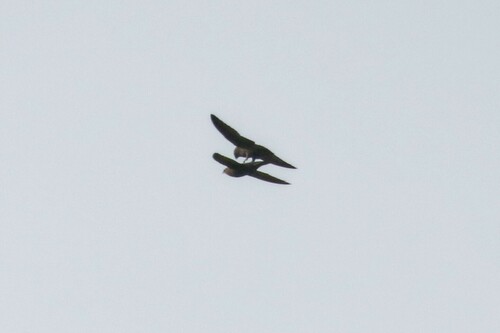 Common Swift
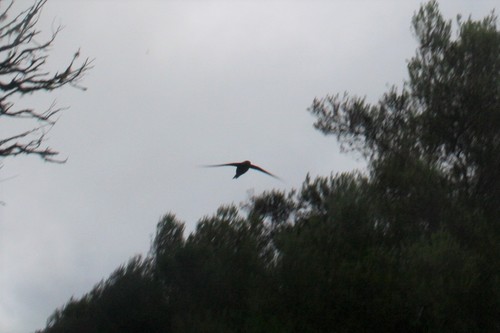 Plain Swift
In short
The most reliable field separation between Common Swift and Plain Swift is the presence of a distinct pale throat patch in Common Swift, which is usually more obvious than the faint or indistinct patch of Plain Swift. Juvenile Common Swifts show a clearly white throat, while Plain Swift's throat is never as bright. Plain Swift is smaller, slimmer, and appears more 'rakish' with longer wings relative to its body, but these differences are subtle and require direct comparison or excellent views. Both species are very dark overall with swept-back wings and a forked tail, so careful attention to throat color, structure, and subtle underpart texture is key.
Identification tips
- Juvenile throat patch: Juvenile Common Swifts have a bright white throat patch, which is never matched by Plain Swift at any age. If you see a clearly white throat on a young swift, it is a Common Swift.
- Adult throat patch: Adult Common Swifts show a small but distinct pale or white chin patch, often visible at close range or in good light. Plain Swift's throat is always less distinct, appearing only faintly paler than the rest of the body and never truly white.
- Overall darkness: Both species are very dark, but Plain Swift is described as even darker and more uniform than Common Swift, which may show slightly browner tones in some lights.
- Underpart texture: Plain Swift may show a faint scaly pattern on the underparts, but this is very hard to see except at close range and should not be relied on in most field situations.
- Structure and jizz: Plain Swift is slimmer, with a more elongated body and longer wings relative to its size, giving a more rakish appearance in flight. Common Swift is bulkier and more compact.
- Tail shape: Both have a short forked tail, but differences are not diagnostic in the field.
- Size: Common Swift is larger and bulkier (16–17 cm) compared to the smaller, slimmer Plain Swift (14–15 cm), but this is only useful with direct comparison or experience.
- Wing shape: Both have long, swept-back, crescent-shaped wings. Plain Swift's wings may appear even more pointed and longer relative to the body, but this is subtle.
- Flight style: Both are fast and agile, but Plain Swift may appear slightly more buoyant or 'rakish' in flight.
- Voice: Both give loud screams; Plain Swift's is possibly higher-pitched and drier, but this is not a reliable field mark unless you know both species well.
- Range and context: Plain Swift is largely restricted to the Canary Islands, Madeira, and parts of coastal Morocco and Portugal. Common Swift is widespread across Europe and into Asia. Use location as a strong clue.
- Habitat: Both species nest on cliffs, buildings, and bridges, but Plain Swift is more likely in Atlantic islands and nearby coasts.
- Season: Both are migratory, but Common Swift's migration is more extensive across Europe and Africa. Plain Swift's migration is more localized to West Africa.
- Pitfalls: At a distance, both species can appear entirely dark with swept-back wings and forked tails. Without a clear view of the throat or a sense of size/structure, separation is extremely difficult.
- What fails: In poor light, at distance, or with brief views, these species are nearly inseparable. Only excellent views of the throat patch or a strong sense of structure and context will allow confident identification.
Size
Common Swift is larger, measuring 16–17 cm in length with a wingspan of 38–40 cm [wikipedia]. Plain Swift is smaller at 14–15 cm long; wingspan is not specified but is proportionally long and slender [wikipedia]. In the field, Plain Swift may appear slimmer and more elongated-winged, but size overlap and lack of direct comparison can make this difficult to judge. Both species are medium-sized swifts, but Common Swift is the bulkier of the two.
Plumage
Juvenile Common Swifts have a distinct white throat patch, which is diagnostic and not matched by Plain Swift at any age. Adult Common Swifts are entirely blackish-brown with a small white or pale grey chin patch, which can be hard to see at a distance. Plain Swift adults are also dark overall but have only an indistinct pale throat patch, never as sharply defined or bright as in Common Swift. Plain Swift may show a slightly scaly texture to the underparts, but this is very hard to see except at close range or in excellent light. Both species have a short forked tail and long swept-back wings, and lack any obvious pale panels or contrasting upperwing marks in any age or season. There are no strong seasonal or sex-based plumage differences in either species.
Behaviour
Both species spend most of their lives on the wing, feeding on insects and rarely perching except to breed. They share a fast, agile, and scythe-winged flight style. Plain Swift is described as more 'rakish' and slimmer in flight, which may translate to a slightly more buoyant or elongated-winged jizz compared to the more robust Common Swift. Both species form screaming parties and are highly aerial, rarely if ever seen on the ground.
Habitat
Common Swift breeds widely across Europe and into Asia, favoring lowlands and areas near water, often nesting in buildings. Plain Swift is much more restricted, breeding mainly on the Canary Islands, Madeira, and parts of coastal Morocco, with recent small colonies in Portugal. Plain Swift is more likely to be seen in these Atlantic islands or nearby coasts, while Common Swift is widespread in continental Europe. Both species may be seen migrating or foraging over similar habitats, but range is a strong clue.
Voice
Both species give loud, piercing screams in flight. The calls are very similar, but Plain Swift's scream is described as possibly higher-pitched and drier than Common Swift's. In practice, vocal differences are subtle and not reliable for separation unless you are very familiar with both species.