
Crested Lark vs Zitting Cisticola
Galerida cristata versus Cisticola juncidis
Play a quiz with Crested Lark and Zitting Cisticola
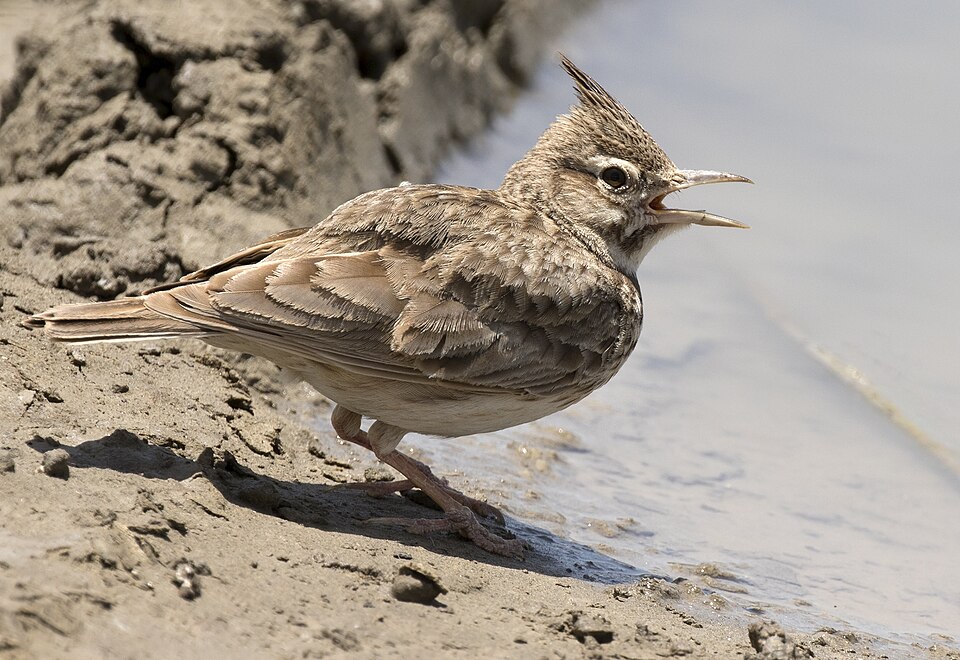 Crested Lark
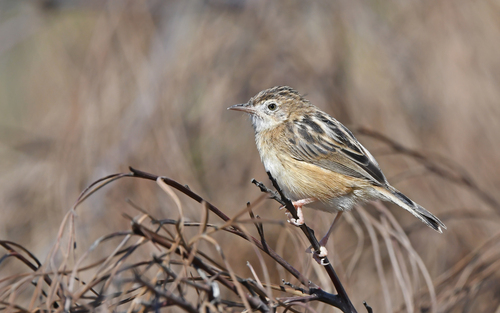 Zitting Cisticola
In short
The most reliable field mark to separate Crested Lark from Zitting Cisticola is the Crested Lark’s obvious pointed crest, which is always visible when perched and often even in flight, while Zitting Cisticola has a plain, rounded head with no crest at all. In flight, Crested Lark shows broad, reddish underwings and a short tail, while Zitting Cisticola is much smaller, with a noticeably longer, fanned tail tipped with white and a rufous rump. Juvenile Crested Larks have more back spots than adults, but even young birds retain the crest and bulkier build. These two species differ strongly in size, structure, and flight style, so confusion is most likely with distant or fast-moving birds in open country.
Identification tips
- Crest: Crested Lark always shows a pointed, erect crest on the head, visible both when perched and often in flight. Zitting Cisticola never has a crest; its head is smoothly rounded. This is the single most reliable separation at any distance.
- Size and Bulk: Crested Lark is much larger and heavier-bodied than Zitting Cisticola. If you see both together, the lark will look nearly twice the size and much chunkier.
- Tail Shape and Length: Crested Lark has a short, square tail with pale outer feathers, while Zitting Cisticola has a long, narrow tail often fanned and tipped with white. In flight, the cisticola’s tail looks noticeably longer and more flexible.
- Rump Color: Zitting Cisticola shows a rufous rump, especially obvious when flying away. Crested Lark’s rump is concolorous with the back and not rufous.
- Underwing Color in Flight: Crested Lark shows broad, reddish underwings in flight; Zitting Cisticola’s underwings are not distinctive and lack this reddish tone.
- Back Pattern (Juveniles): Juvenile Crested Larks have more spots on the back than adults, but still show the crest and overall pale, downy look. Zitting Cisticola juveniles are similar to adults, with streaked brown upperparts but no crest.
- Bill Structure: Crested Lark has a strong, slightly decurved bill, suited to digging and seed eating. Zitting Cisticola has a fine, straight bill typical of insectivorous warblers.
- Flight Style: Crested Lark flies with undulating, bounding movements and often lands on bare ground. Zitting Cisticola performs a zigzagging, bouncing display flight, often over grass, and rarely lands in the open.
- Perched Posture: Crested Lark often stands upright, showing off its crest and robust build. Zitting Cisticola is more likely to perch low in grass, appearing slim and nervous, with tail often cocked or fanned.
- Habitat: Crested Lark is found in open, dry, often bare habitats, while Zitting Cisticola is restricted to grassy or marshy areas. Habitat alone can be a strong clue.
- Vocalization: Crested Lark’s song is a liquid, varied warble, often given from the ground or in level flight. Zitting Cisticola gives a monotonous 'zit-zit-zit' call, especially in display flight. If you hear a repetitive 'zit', think cisticola.
- Sex and Age Differences: Both species are sexually monomorphic in plumage, but juvenile Crested Larks are more spotted above. Zitting Cisticola does not show strong age-related plumage differences relevant for confusion.
- Context: If you see a bird singing high above ground in a bouncing, zigzag flight with a repetitive call, it is almost certainly Zitting Cisticola. If the song is more complex and the bird is on the ground or a low perch, check for the crest for Crested Lark.
- Pitfalls: At long range, a distant Crested Lark with its crest flattened might look less distinctive, but the size, bulk, and underwing color should still separate it from the tiny, slim cisticola. Conversely, a Zitting Cisticola with its tail closed may look shorter-tailed, but the lack of crest and rufous rump remain diagnostic.
- When Marks Fail: In poor light or at extreme distance, rely on structure (crest, size, tail shape) and habitat/context as much as plumage. Voice can be a clincher if the bird is singing or calling.
Size
Crested Lark is substantially larger and bulkier, measuring about 17 cm in length with a wingspan of 29–38 cm and weighing 37–55 g [wikipedia][avonet]. Zitting Cisticola is much smaller and lighter, typically around 10–12 cm long (noted from general sources), with a slim build and a much shorter wingspan and lower mass. In the field, Crested Lark will appear as a medium-sized, chunky passerine, while Zitting Cisticola is a tiny, delicate grassland bird.
Plumage
Juvenile Crested Larks show more spots on the back than adults, but all ages have a pale, downy appearance and a prominent crest. In flight, Crested Lark of all ages shows reddish underwings and a short, square tail with pale outer feathers. Zitting Cisticola, regardless of age, lacks any crest and instead is best recognized by its rufous rump and a long, brown tail with white tips. The cisticola’s tail is often fanned in flight, accentuating the white tips, and the overall plumage is streaked and warm brown above. There is no mention of age-specific upperwing patterns for either species that would be diagnostic in flight, but the combination of crest, underwing color, and tail structure is reliable.
Behaviour
Crested Lark often sings from the ground or from a prominent perch, and when flushed, flies with undulating, bounding flight, showing its reddish underwings and short tail. It is usually seen singly or in loose pairs, sometimes on bare ground or roadsides. Zitting Cisticola is much more active and restless, frequently making short, low flights over grassland with a distinctive zigzagging, bouncing display flight during the breeding season, accompanied by its repetitive 'zit' call. The cisticola’s tail is often fanned and flicked, and it rarely perches in the open for long.
Habitat
Crested Lark prefers open, dry habitats such as wastelands, field edges, and the outskirts of towns, often on bare ground or sparsely vegetated areas. Zitting Cisticola is strongly associated with grasslands, reedbeds, and wet meadows, rarely venturing onto bare ground. If you find the bird in a grassy field or marsh, especially among tall grasses, Zitting Cisticola is much more likely; Crested Lark is more typical of drier, open, and less vegetated ground.
Voice
Crested Lark has a liquid, warbling song, often described as 'whee-whee-wheeoo' or 'twee-tee-too', delivered either from the ground or high in the air. Its song is more complex and musical than that of Zitting Cisticola. Zitting Cisticola gives a monotonous, evenly spaced 'zit-zit-zit' call, especially during its display flight, which is the source of its English name. The cisticola’s call is much simpler, sharper, and more repetitive, and is usually given in flight rather than from a perch.