
Dark-backed Weaver vs Red-headed Quelea
Ploceus bicolor versus Quelea erythrops
Play a quiz with Dark-backed Weaver and Red-headed Quelea
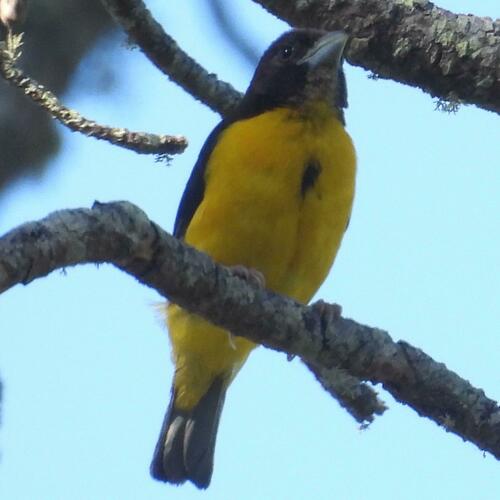 Dark-backed Weaver
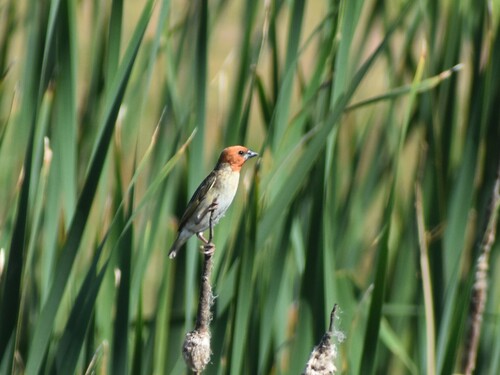 Red-headed Quelea
In short
The most reliable field mark to separate Dark-backed Weaver from Red-headed Quelea is the presence of a bright red or rufous head and face in adult Red-headed Quelea, which is never shown by Dark-backed Weaver. Both species are weavers and may overlap in some regions, but their plumage, especially on the head, is distinct in adults. Structural differences are subtle, so focus on plumage, particularly head color. Immature and non-breeding birds may be trickier, but the absence of any red on the head in Dark-backed Weaver remains a key point.
Identification tips
- Red or rufous head/face (adult Red-headed Quelea): If you see a bird with a bright red or rufous head, especially in breeding season, it is a Red-headed Quelea. Dark-backed Weaver never shows this feature.
- No red on head (any age Dark-backed Weaver): Any bird lacking red or rufous on the head could be either species, but if the back is distinctly dark and the habitat is forested, favor Dark-backed Weaver.
- Juvenile/immature confusion: Young Red-headed Quelea lack the full red head but may show a hint of rufous on the face; Dark-backed Weaver juveniles remain plain and never develop red tones.
- Back color: Dark-backed Weaver, as the name suggests, shows a darker back compared to the generally paler, more uniform upperparts of Red-headed Quelea.
- Habitat context: In dense forest, lean toward Dark-backed Weaver; in open country, Red-headed Quelea is far more likely.
- Social behavior: Both species are gregarious, but Red-headed Quelea often forms very large flocks in open areas, while Dark-backed Weaver is more likely to be in pairs or small groups in forest.
- Bill structure: No reliable difference is noted in the available sources; both have typical weaver bills.
- Sexual dimorphism: Only male Red-headed Quelea in breeding plumage show the bright red head; females and non-breeding males are duller but may retain some rufous.
- Range and abundance: Red-headed Quelea is widespread and common in suitable habitat; Dark-backed Weaver is much more local and scarce.
- Plumage pitfalls: Do not rely on subtle differences in wing or tail pattern, as these are not described as diagnostic for either species.
- Mixed flocks: If seen in a mixed weaver flock in open country, Red-headed Quelea is the default; check for red heads to confirm.
- Perched vs. in flight: No specific flight marks are described, so identification is best made when birds are perched and head color is visible.
- Seasonal variation: Red-headed Quelea males are most striking in breeding season; at other times, plumage differences are less obvious but still present.
- Voice: No diagnostic vocal differences are available in the sources provided.
- Fallback: If in doubt and no red is visible on the head, use habitat and back color as secondary clues.
Size
Both species are small weavers, and available data suggest their body mass is similar (Red-headed Quelea: 19.4g [wikidata]). No direct measurement is available for Dark-backed Weaver, but there is no evidence of a significant size difference in the field. Size alone is not a reliable separator between these two.
Plumage
Adult Red-headed Quelea males in breeding plumage are unmistakable for their bright red or rufous head and face, which is the origin of their name and a unique feature among these two species. Females and non-breeding birds may appear duller but often retain some reddish or rufous tones on the face. Dark-backed Weaver, by contrast, never shows red on the head; it has a darker back and a more uniform, subdued coloration overall. Juvenile and immature birds of both species can be more challenging, as young queleas lack the full red head, but even then, any hint of rufous on the face favors Red-headed Quelea. There is no mention of distinctive upperwing or flight pattern marks for either species in the sources, so focus remains on head and general body coloration.
Behaviour
Both species are typical weavers and may be seen foraging in groups or building nests, but no diagnostic behavioral differences are noted in the available sources. Both are likely to be active and social, often seen in mixed flocks with other weavers.
Habitat
Red-headed Quelea is widespread across sub-Saharan Africa and occupies a wide range of open habitats, including savannas, grasslands, and cultivated areas. Dark-backed Weaver is much more sparsely distributed and is typically associated with forested habitats. If seen in dense forest, Dark-backed Weaver is more likely; in open country or agricultural land, Red-headed Quelea is the default.