
Golden Eagle vs Bonelli's Eagle
Aquila chrysaetos versus Aquila fasciata
Play a quiz with Golden Eagle and Bonelli's Eagle
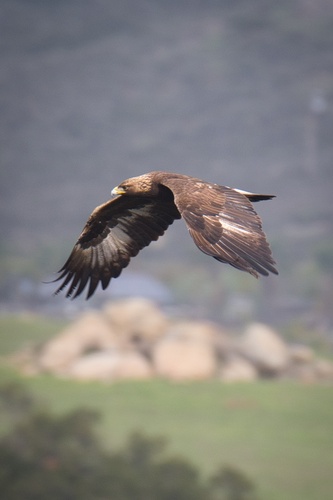 Golden Eagle
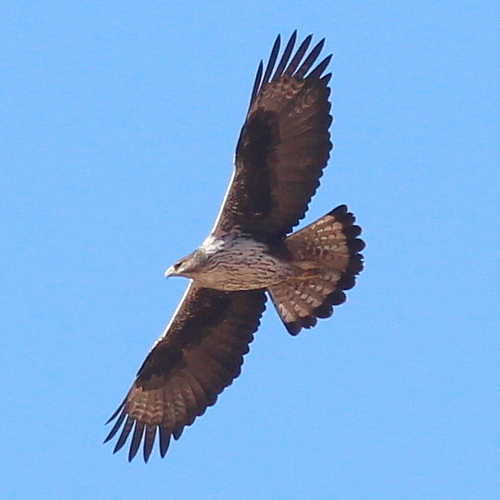 Bonelli's Eagle
In short
The most reliable field mark between Golden Eagle and Bonelli's Eagle is size: Golden Eagle is nearly twice as heavy and much larger in all proportions, making confusion unlikely when seen together or with good scale. For immatures in flight, juvenile Golden Eagles show bold white patches at the base of the primaries and tail, while juvenile Bonelli's Eagles are paler below but lack these large white wing and tail patches. Structurally, Golden Eagle is bulkier with a longer tail and broader wings, while Bonelli's Eagle is more slender and often shows a white mantle patch in adults. Both species are brown eagles, but careful attention to wing pattern, structure, and size will separate them in almost all field situations.
Identification tips
- Size is the first check: Golden Eagle is nearly twice as heavy and much larger in all proportions. If the bird looks truly massive, especially in comparison to other raptors, Golden Eagle is likely.
- Juvenile wing and tail pattern: Juvenile Golden Eagles show large, sharply defined white patches at the base of the primaries and a broad white band at the base of the tail, both visible in flight. Juvenile Bonelli's Eagles never show such extensive white; their wings and tail are more evenly brown and barred.
- Adult mantle patch: Adult Bonelli's Eagles often have a white patch on the mantle (upper back), which is never present in Golden Eagle. If you see a white patch on the back of a perched or flying adult, it's Bonelli's.
- Nape color: Golden Eagle adults have a golden to rufous nape (back of the neck), contrasting with the rest of the dark brown plumage. Bonelli's Eagle has a dark brown head with a paler, streaky neck but lacks the golden nape.
- Tail pattern: Adult Golden Eagle's tail is long, dark brown, and lacks barring, while Bonelli's Eagle's tail is grey with thin bars, a broad black subterminal band, and a white tip. Juvenile Bonelli's tail is more clearly barred than the adult's, but never with a bold white base.
- Underparts: Bonelli's Eagle adults are cream below with dark streaks, especially on the breast and flanks; Golden Eagles are more uniformly dark brown below, sometimes with a slightly paler area but never cream-based with streaks.
- Flight silhouette: Golden Eagle is bulkier with broader wings and a longer tail, often flying with a pronounced dihedral (upturned wings). Bonelli's Eagle is more slender, with slightly pinched-in wings and a relatively broad, square-ended tail.
- Head projection: In flight, Bonelli's Eagle shows a well-projecting head and a compact body; Golden Eagle's head is less prominent relative to the body bulk.
- Wing molt variability: Bonelli's Eagle wings can appear variable in shape due to molt, sometimes longer and narrower, but never as massive as Golden Eagle.
- Behavior in flight: Golden Eagle soars with slow, powerful, steady wingbeats; Bonelli's Eagle has looser, shallower beats and is often seen flying in pairs.
- Habitat context: Golden Eagle is more likely in northern, open, or high-altitude areas; Bonelli's Eagle prefers rocky, Mediterranean, or hilly landscapes.
- Sexual dimorphism: Female Bonelli's Eagles are darker and more heavily marked below than males, but this is subtle and not a reliable separation from Golden Eagle.
- Aging: Bonelli's Eagle takes 4–5 years to reach adult plumage, so intermediate birds may show a mix of features, but will never have the bold white wing/tail patches of juvenile Golden Eagle.
- Perched birds: Size, mantle patch (Bonelli's), and nape color (Golden) are best clues. Bill size is not a strong separator between these two.
- When in doubt: Focus on size, juvenile wing/tail pattern, and adult mantle/nape color for the most reliable separation.
Size
Golden Eagle is much larger and heavier, with an average body mass of 4383 g compared to Bonelli's Eagle's 2190 g. In the field, Golden Eagle appears bulkier, with broader wings and a longer tail. Even a large female Bonelli's Eagle is dwarfed by a Golden Eagle. When perched, the size difference is striking, and in flight, Golden Eagle's wingspan and body bulk are unmistakable. Bonelli's Eagle, while large for a raptor, is noticeably more slender and compact.
Plumage
-
Juvenile/immature birds in flight: Juvenile Golden Eagles show large, crisp white patches at the base of the primaries (forming a 'window') and a broad white band at the base of the tail, both sharply contrasting with the otherwise dark plumage. These white areas are extensive and well-defined, fading as the bird matures. In contrast, juvenile Bonelli's Eagles are paler brown above with some pale edges, but do not show large white patches on the wings or tail; their underparts are warm buff to rufous with minimal black streaks, and the tail is more evenly barred with a thin white tip but no bold white base.
-
Adults: Golden Eagle adults are uniformly dark brown with a golden to rufous nape, lacking any white on the mantle or back. Bonelli's Eagle adults are dark brown above with a variable white mantle patch (never present in Golden Eagle), a grey tail with thin bars and a broad black subterminal band, and a cream base color below with dark streaks, especially on the breast and flanks. The adult Bonelli's Eagle's head is dark brown with a paler, streaky neck and white throat, while Golden Eagle's nape is golden but the rest of the head is dark.
-
Aging: Bonelli's Eagle takes 4–5 years to reach adult plumage, gradually increasing streaking below and developing the adult tail pattern. Golden Eagle's white wing and tail patches are most prominent in juveniles and fade with age.
Behaviour
Golden Eagles soar with broad, slightly upturned wings (dihedral) and powerful, steady flight. They are more likely to be seen alone or in pairs, often soaring at great heights. Bonelli's Eagles also soar but more often on flat or only slightly raised wings, with a tendency for powerful but looser, shallower wingbeats. Bonelli's Eagles frequently fly in pairs and may appear more agile and quick in flight. When gliding, Bonelli's Eagle wings are slightly pinched at the body and can look variable in shape due to molt. Golden Eagle's flight is slower and heavier, matching its bulkier build.
Habitat
Both species occur in open or mountainous habitats, but Golden Eagle has a much broader range across the Northern Hemisphere and is found in a wider variety of open country, including tundra, steppe, and high mountains. Bonelli's Eagle is more restricted to southern Europe, North Africa, and parts of Asia, favoring rocky hills, cliffs, and Mediterranean-type landscapes. Overlap is limited, and context can help: Golden Eagle is more likely in northern or high-altitude regions, while Bonelli's Eagle prefers warmer, rocky, and Mediterranean habitats.