
Greater Spotted Eagle vs Imperial Eagle
Clanga clanga versus Aquila heliaca
Play a quiz with Greater Spotted Eagle and Imperial Eagle
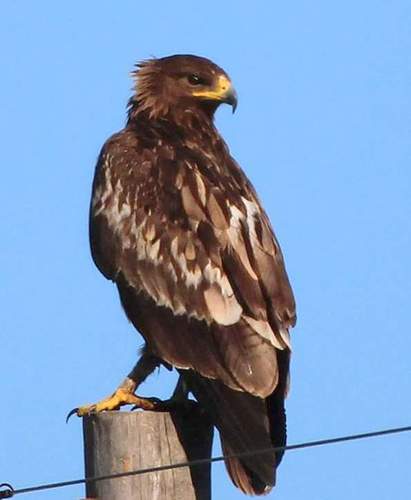 Greater Spotted Eagle
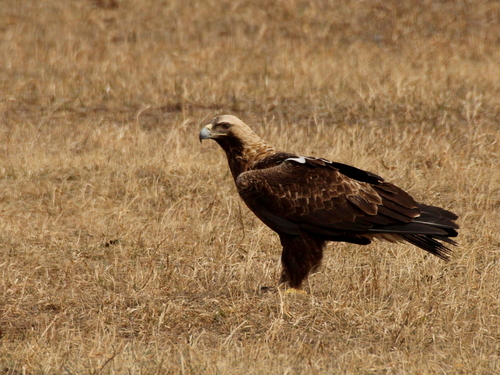 Imperial Eagle
In short
The most reliable field mark for separating Greater Spotted Eagle from Imperial Eagle, especially in flight, is the underwing and body pattern in juveniles and immatures: juvenile Imperial Eagles show a unique combination of pale tawny-buff ground color with brown streaking and a striking contrast between pale rear body and dark flight feathers, while juvenile Greater Spotted Eagles are overall darker, with heavier spotting and barring, and lack the pale nape and shawl. Structurally, Greater Spotted Eagles are more compact with broader, shorter wings and a smaller head, compared to the longer-necked, longer-winged, and more powerful-looking Imperial Eagle. Adults are more challenging, but Greater Spotted Eagles remain darker and more uniform, lacking the white shoulder spots and paler under-tail of Imperial. Size overlaps, but Imperial Eagle averages heavier. Most confusion arises with immature birds in flight, so focus on wing and body contrast, head/neck proportions, and covert patterns.
Identification tips
- Juvenile underwing/body contrast: Juvenile Imperial Eagles show a striking contrast between a pale, tawny-buff rear body and dark flight feathers, with brown streaking on the body. Juvenile Greater Spotted Eagles are overall darker, more uniformly brown, with heavier spotting and barring, and lack this sharp contrast. This is the most reliable mark in flight for immatures.
- Pale nape and shawl: Juvenile and immature Imperial Eagles often show a paler shawl or nape area, which is absent or only faintly present (never ochre/orange) in Greater Spotted Eagles of any age.
- Upperwing coverts: Juvenile Greater Spotted Eagles have uniform, dark upperwing coverts, while Imperial Eagles (especially adults) show white spots on the wing mantle. Fulvescens morph Greater Spotted Eagles may appear pale but retain dark coverts and mantle.
- Covert band and barring: Older immature Greater Spotted Eagles show a more prominent greater covert band below and denser barring on flight feathers than Imperial Eagles of similar age.
- Facial and head structure: Imperial Eagles have a larger, more protruding head and longer neck, giving a more 'imperial' profile both perched and in flight. Greater Spotted Eagles have a smaller head and shorter neck, making the head look relatively small against broad wings.
- Wing shape in flight: Greater Spotted Eagles have broader, shorter wings and a more compact frame, while Imperial Eagles have longer, more rectangular wings and a longer tail. This is especially noticeable in direct comparison or with experience.
- Tail shape: Imperial Eagles have a longer, more wedge-shaped tail, while Greater Spotted Eagles have a shorter, more rounded tail.
- Adult plumage: Adult Imperial Eagles are dark but show white shoulder spots and a greyish under-tail, which Greater Spotted Eagles lack. Adult Greater Spotted Eagles are uniformly dark, with no white spots or pale nape.
- Underwing pattern (adults): Both can show underwing contrast, but Imperial Eagles have a more patterned underwing with white spots, while Greater Spotted Eagles are more uniform.
- Size impression: Imperial Eagles are generally heavier and more powerful, but size overlaps. Use structure and plumage first.
- Perched jizz: Imperial Eagles appear more upright and long-necked when perched; Greater Spotted Eagles are more compact and hunched.
- Habitat context: In wetlands and marshes, Greater Spotted Eagle is more likely; in open steppe or agricultural land, Imperial Eagle is more likely, though both can overlap in winter.
- Fulvescens morph pitfall: Pale morph Greater Spotted Eagles can resemble juvenile Imperial Eagles but lack brown streaks below and have darker coverts and mantle.
- Hybrid confusion: Hybrids between Greater and Lesser Spotted Eagles can complicate ID, but Imperial Eagle is not known to hybridize with these species.
- In-hand measurements: Bill height/width, extent of white spots (juvenile), and length of middle toe can separate Greater Spotted from Lesser, but not from Imperial in the field.
Size
Imperial Eagle is generally the heavier and more powerful species, with an average body mass of 3215 g [wikidata]. Greater Spotted Eagle females can approach the size of smaller Imperial Eagles, but there is broad overlap and some male Greater Spotted Eagles are scarcely larger than male Lesser Spotted Eagles. Structurally, Imperial Eagle appears longer-necked, with a proportionately larger head and longer wings and tail, while Greater Spotted Eagle is more compact, with broader, shorter wings and a smaller head. In the field, size alone is unreliable due to overlap, but Imperial Eagle often looks bulkier and more imposing, especially when perched.
Plumage
-
Juvenile/Immature: Juvenile Imperial Eagles are distinctive with a tawny-buff base color, brownish streaking, and a strong contrast between a dark mantle/chest band and very pale rear body, plus a blackish tail and remiges with pale primary wedges. Juvenile Greater Spotted Eagles are overall darker, with strong spotting and barring, uniform dark upperwing coverts, and typically lack a pale nape patch (if present, only slightly paler than the rest of the plumage and never ochre/orange). Greater Spotted Eagle juveniles have more extensive and denser barring on flight feathers and less contrast between body and wing.
-
Subadult/Immature: Subadult Imperial Eagles may be confused with older immature Greater Spotted Eagles, but the latter are less contrasting, lack a pale shawl, and show a more prominent covert band below and denser barring on flight feathers. Fulvescens morph Greater Spotted Eagles can be as pale as Imperial juveniles but lack brown streaks below and have much darker wing coverts and mantle.
-
Adult: Adult Imperial Eagles are dark but show white spots on the wing mantle and a greyish under-tail, which Greater Spotted Eagles lack. Adult Greater Spotted Eagles are uniformly dark, with no white shoulder spots, no pale nape, and a more uniform underwing. Imperial Eagles have a slightly more brownish hue below and a more protruding head/neck profile.
Behaviour
Both species are large, soaring eagles and can be seen gliding or circling on thermals. Imperial Eagles tend to look more powerful and dominant, especially in wintering areas where they may outcompete other raptors. Greater Spotted Eagles are more compact in flight and may appear less imposing. Both perch in open areas, but Imperial Eagles may appear more upright due to their longer neck and larger head.
Habitat
Both species are migratory and overlap in wintering grounds in parts of South Asia and the Middle East. Imperial Eagle breeds in open woodlands, steppe, and agricultural areas across southeastern Europe and Central Asia, while Greater Spotted Eagle favors wetlands, marshes, and forest edges. In winter, both may be found in similar open habitats, but Greater Spotted Eagle is more closely associated with wetland environments.