
Grey Nightjar vs Eurasian Nightjar
Caprimulgus jotaka versus Caprimulgus europaeus
Play a quiz with Grey Nightjar and Eurasian Nightjar
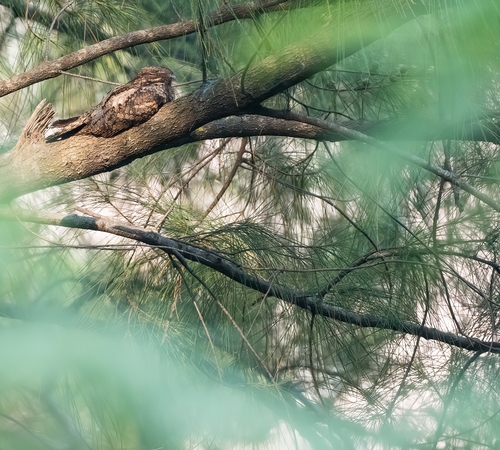 Grey Nightjar
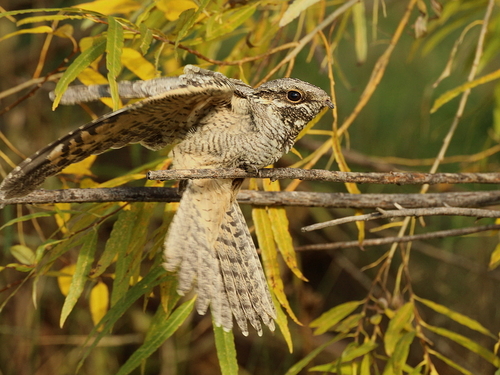 Eurasian Nightjar
In short
The most reliable field mark between Grey Nightjar and Eurasian Nightjar is the pattern of white in the wings and tail of adult males in flight: male Eurasian Nightjars show bold white patches on the primaries and outer tail feathers, while male Grey Nightjars have a single white patch on the first primary and white bars on the next three, plus a white subterminal patch on the outer tail feathers. Females and immatures of both species lack these white marks, making separation much trickier and requiring close attention to fine plumage details and structure. Both species are cryptically patterned and can be extremely difficult to distinguish when perched, especially in low light. Geographic context can help, but their ranges overlap in parts of East Asia. Focus on wing and tail pattern in flight, then on subtle plumage and structural differences if the sex or age is unclear.
Identification tips
- Adult male in flight: wing and tail white pattern – Eurasian Nightjar shows a broad white patch across three primaries and white tips to the two outer tail feathers; Grey Nightjar male has a single white patch on the first primary, white bars on the next three, and a white subterminal patch on the outer tail feathers. This is the best field mark for adult males.
- Female and immature in flight – Both lack white in the wings and tail, making separation much more difficult. Focus on subtle differences in upperwing pattern and tail barring, but expect high uncertainty.
- Crown and nape pattern (perched) – Grey Nightjar has a prominent black central stripe on the crown and more intricate vermiculated grey and brown patterning; Eurasian Nightjar is more uniformly greyish-brown with dark streaking and a pale buff hindneck collar.
- Facial markings – Eurasian Nightjar shows a white moustachial line and a pale buff hindneck collar, which are less prominent or absent in Grey Nightjar.
- Scapulars – Grey Nightjar scapulars are black with brownish-yellow spots and often have brownish-yellow patches on the outer webs; Eurasian Nightjar scapulars are less contrasting.
- Tail pattern – Grey Nightjar's central tail feathers have 6–7 black wavy bands and (in males) a prominent white subterminal patch on the outer feathers; Eurasian Nightjar's tail is less boldly banded and only males have white tips on the outer two feathers.
- Underparts – Grey Nightjar is paler below with dense dark brown horizontal stripes; Eurasian Nightjar is greyer with brown barring and buff spots.
- Throat patch – Both species have a white throat patch, but it is larger and brighter in male Grey Nightjar; in females, the patch is smaller and browner in Grey Nightjar and less distinct in Eurasian Nightjar.
- Flight style – Both species have buoyant, silent flight, but Grey Nightjar may show more circular or erratic patterns when foraging.
- Perching posture – Both perch lengthwise along branches, making them hard to spot; posture is not a reliable separator.
- Geographic context – In Japan, Korea, and much of Southeast Asia, only Grey Nightjar is expected; in Europe and western Russia, only Eurasian Nightjar. In eastern China and the Himalayas, both may occur; do not rely on range alone in these areas.
- Vocalizations – Eurasian Nightjar's long churring trill is distinctive; Grey Nightjar's song is not described here, so use with caution unless familiar with both.
- Sex differences – Only males of both species show white in the wings and tail; females and immatures lack these marks, so do not misidentify a female Eurasian Nightjar as a Grey Nightjar based on absence of white.
- Moult timing – Eurasian Nightjar adults moult body feathers after breeding and replace flight feathers on wintering grounds; this may affect appearance late in the season, but is not a reliable field mark.
- Juvenile confusion – Juveniles and immatures of both species are extremely similar and may not be safely separated in the field without close views or vocalizations.
Size
Eurasian Nightjar is slightly larger overall, with a length of 24.5–28 cm and a wingspan of 52–59 cm [wikipedia]. Grey Nightjar is described as medium-sized but direct measurements are not provided in the sources; it is generally similar in size to Eurasian Nightjar, perhaps marginally smaller. Both species have a large head, long tail, and relatively long wings for a nightjar, so size alone is not a reliable separator in the field.
Plumage
Juvenile and immature birds of both species are very similar, with cryptic brown and grey vermiculated upperparts and barred underparts. For adults in flight, male Eurasian Nightjar shows a broad white patch across three primaries and white tips to the two outer tail feathers; females lack these white marks. Male Grey Nightjar shows a white circular patch on the first primary and white bars on the second to fourth primaries, plus a white subterminal patch on the outer tail feathers. Female Grey Nightjar has a smaller, browner-tinged white throat patch, and lacks white spots in the flight feathers and tail. Eurasian Nightjar adults have a pale buff hindneck collar and a white moustachial line, which are less prominent or absent in Grey Nightjar. The upperparts of Grey Nightjar are more intricately vermiculated with a prominent black central crown stripe, and the scapulars have black with brownish-yellow spots. Both species have dark, barred tails, but Grey Nightjar's tail has 6–7 black wavy bands and more prominent white subterminal patches (male only). Underparts of Grey Nightjar are paler and more densely barred than Eurasian Nightjar, which tends to have more buff spots and a greyer tone.
Behaviour
Both species are nocturnal or crepuscular and forage for insects in flight, using slow, buoyant wingbeats and occasional glides. Grey Nightjar often flies in circular patterns, sometimes erratically when chasing prey, and is described as silent in flight. Eurasian Nightjar's flight is buoyant and noiseless due to soft plumage. Both species perch lengthwise along branches during the day, blending in with their surroundings. There are no strong behavioral differences in foraging or roosting that are diagnostic in the field.
Habitat
Grey Nightjar breeds from southeastern Russia through China, Korea, Japan, northern Indochina, and along the Himalayas, wintering south to Java. Eurasian Nightjar breeds across most of Europe and the Palearctic to Mongolia and NW China. Their ranges overlap in parts of East Asia, but Eurasian Nightjar is absent from Japan and much of Southeast Asia. Both prefer open woodland, forest edges, and clearings, so habitat is not a strong separator except at the extremes of their ranges.
Voice
Eurasian Nightjar males sing a sustained churring trill, often for several minutes, with occasional pitch or speed changes, and may end with a bubbling trill and wing-clapping. The song is ventriloquial and can be heard at great distances. Grey Nightjar's call is not described in the provided sources, but the split from Jungle Nightjar was partly based on vocal differences. In areas of overlap, song is a key separator, but without a description of Grey Nightjar's song here, this is not a reliable field mark unless the observer is familiar with both.