
Imperial Eagle vs Bonelli's Eagle
Aquila heliaca versus Aquila fasciata
Play a quiz with Imperial Eagle and Bonelli's Eagle
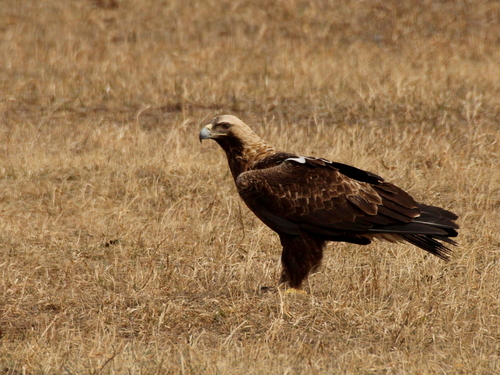 Imperial Eagle
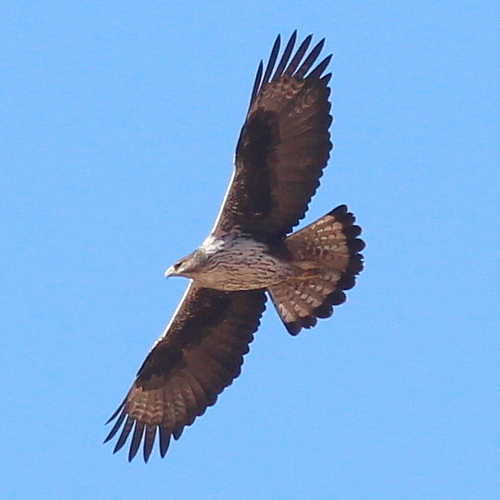 Bonelli's Eagle
In short
Juvenile Imperial Eagles are best separated from Bonelli's Eagles by their unique tawny-buff plumage with strong brown streaking below and strikingly pale primary wedges in flight, a combination not seen in Bonelli's at any age. Adults are reliably told apart by the Imperial's much darker overall plumage, white spots on the wing mantle, and greyer undertail, while Bonelli's shows a paler, streaked underside and a distinctive white mantle patch. Structurally, Imperial Eagle is noticeably larger and bulkier, with a longer neck and proportionately bigger head, but Bonelli's Eagle has a longer, squarer tail and slightly pinched-in wings in flight. Both species can be confused at a distance, especially immatures, but careful attention to these plumage and shape details will resolve most field encounters.
Identification tips
- Juvenile Imperial Eagle shows unique tawny-buff plumage with strong brown streaking below and a pale primary wedge in flight—Bonelli's juveniles are never as streaked or as buffy, and lack the pale wedge.
- Adult Imperial Eagle is very dark overall, with white spots on the wing mantle and a greyish undertail; Bonelli's adults are paler below, with a cream base and variable blackish streaks, and a white mantle patch that can be extensive.
- Bonelli's Eagle (all ages) shows a longer, squarer tail with thin white tip and a broad blackish subterminal band, while Imperial's tail is shorter and more rounded, with a greyer tone in adults.
- Bonelli's has broad pale margins on the median wing coverts (adults), making the upperwing look lighter brown overall, while Imperial's upperwing is much darker with more restricted pale areas.
- Juvenile Bonelli's is medium brown above with paler edges and a rusty-brown head, lacking the strong contrast and streaking of juvenile Imperial.
- Bonelli's underparts (all ages) are never as heavily streaked as juvenile Imperial, and the streaking is usually confined to the breast and flanks; Imperial's juvenile streaking is bold and extensive.
- Imperial Eagle is much bulkier and heavier (average 3215g vs 2190g), with a longer neck and larger head; Bonelli's is more slender and compact.
- In flight, Bonelli's wings are broad and long but can appear pinched at the body and slightly tapered at the tips, while Imperial's wings are broader and less pinched, adding to its powerful look.
- Bonelli's Eagle often flies in pairs and uses shallow, loose wingbeats, gliding on flat wings with carpals pressed forward; Imperial's flight is heavier and more ponderous.
- Imperial's white spots are on the wing mantle (shoulder), while Bonelli's white patch is on the mantle and can extend to the upper back—location and extent of white are helpful at close range.
- Bonelli's tail is more clearly barred in juveniles, with a thin white tip; Imperial's juvenile tail is blackish and less distinctly barred.
- Bonelli's adult head is dark brown with a paler, streaky neck and white throat; Imperial's head is darker and less patterned.
- Aging Bonelli's: Immatures become patchier below with heavier streaking as they age, but never match the tawny, streaked look of juvenile Imperial.
- Habitat: Imperial prefers open steppe/plains, Bonelli's is more often in rocky, hilly, or wooded terrain—useful but not definitive.
- If in doubt, focus on the combination of size, underpart streaking (especially in juveniles), and the presence/location of white on the upperwing and mantle.
Size
Imperial Eagle is significantly heavier (average adult mass 3215g vs Bonelli's 2190g [wikidata]), and appears bulkier and more powerful overall. The Imperial also has a longer neck and larger head, contributing to a more imposing silhouette, especially when perched. Bonelli's Eagle, while still a large raptor, is more slender and compact, with a relatively longer tail and slightly narrower wings. In direct comparison, Bonelli's Eagle will look noticeably smaller and less robust, though large female Bonelli's may approach small male Imperials in size.
Plumage
Juvenile/immature birds are the most frequent source of confusion:
- Juvenile Imperial Eagle: Unique tawny-buff ground color with strong brownish streaking below, dark mantle and chest band, very pale rear body, blackish tail and remiges, and strikingly pale primary wedges in flight. No other Aquila, including Bonelli's, shows this combination. The pale primary wedge is especially distinctive in flight for young birds.
-
Juvenile Bonelli's Eagle: Medium brown above with paler edges, sometimes a creamy patch on the back (not mantle), rusty-brown head, and light rufous to warm buff below with minimal black streaks (mostly on chest sides). The tail is more clearly barred than adults, with a thin white tip. Underparts lack the strong brown streaking of Imperial, and the flight feathers do not show the pale wedge.
-
Adult Imperial Eagle: Very dark overall, with white spots on the wing mantle and a greyish undertail. The white on the shoulder is more restricted than in Spanish Imperial Eagle. Underparts are darker than Bonelli's, with a more uniform look.
-
Adult Bonelli's Eagle: Dark brown above with broad pale margins on median coverts, irregular white patch on the mantle (can be large), grey tail with thin bars and broad blackish subterminal band, and a cream base color below with variable blackish streaks (heaviest on breast/flanks). The white mantle patch and paler, streaked underparts are key contrasts to Imperial.
-
Aging: Bonelli's takes 4–5 years to reach adult plumage, with immatures showing increasingly patchy underparts and a thicker subterminal tail band, but never the strong streaked tawny look of juvenile Imperial.
Behaviour
Imperial Eagles tend to dominate in areas where both occur, being more powerful and often the top raptor in their wintering grounds. Bonelli's Eagle is more likely to be seen flying in pairs, and its flight style includes powerful but shallow wingbeats, often gliding on flat wings with slightly forward-pressed carpals. Bonelli's soars less frequently and tends to have a more agile, less ponderous flight than the heavier Imperial. Both species perch conspicuously, but Imperial's larger size and longer neck are apparent when at rest.
Habitat
Imperial Eagle breeds across southeastern Europe and central Asia, wintering in NE Africa, the Middle East, and South/East Asia. Bonelli's Eagle is more Mediterranean in distribution, with a preference for rocky hills, open woodlands, and scrub, often in more arid or broken terrain. Overlap is possible in wintering areas, but Imperial is more likely in open steppe or plains, while Bonelli's is tied to rugged, hilly landscapes. Habitat alone is not diagnostic, but can support an ID when combined with plumage and structure.