
Jack Snipe vs Common Snipe
Lymnocryptes minimus versus Gallinago gallinago
Play a quiz with Jack Snipe and Common Snipe
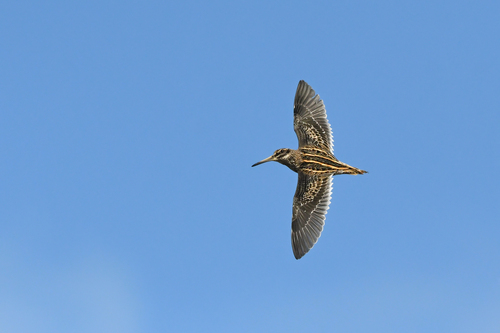 Jack Snipe
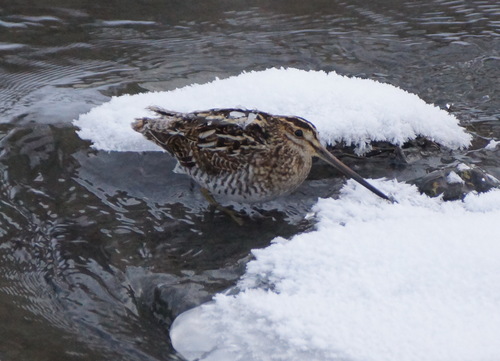 Common Snipe
In short
The most reliable field mark for separating Jack Snipe from Common Snipe is the head pattern: Jack Snipe lacks a central crown stripe and instead shows two pale lateral crown stripes separated from the supercilium by a dark area, while Common Snipe has a bold pale central crown stripe. In flight, Jack Snipe shows bright yellowish back stripes and is noticeably smaller and more compact, with a shorter bill. Jack Snipe also has a distinctive bobbing behavior when feeding or alert, which Common Snipe never shows. Both species are well camouflaged and can be hard to flush, but their structure, head pattern, and flight style are key for confident identification.
Identification tips
- Head pattern is key: Jack Snipe lacks a pale central crown stripe; instead, look for two pale lateral crown stripes separated from the supercilium by a dark area. Common Snipe always has a bold pale central crown stripe. This mark is reliable in all ages and seasons.
- Bill length: Jack Snipe’s bill is noticeably shorter and stubbier, never as long as Common Snipe’s very long, straight bill. Use this in both perched and feeding birds.
- Body size and shape: Jack Snipe is much smaller, more compact, and rounder-bodied, with a shorter neck and tail. Common Snipe appears longer, slimmer, and more elongated.
- Back stripes in flight: Jack Snipe shows bright yellowish stripes on the back, especially visible in flight. Common Snipe’s back stripes are paler and less contrasting.
- Bobbing behavior: Only Jack Snipe bobs up and down repeatedly when feeding or alert. If you see a snipe bouncing like it’s on springs, it’s a Jack Snipe.
- Flight style and flush distance: Jack Snipe sits extremely tight and flushes only when nearly stepped on, flying low and dropping quickly back into cover, usually silently. Common Snipe flushes earlier, calls loudly ('scape, scape'), and flies off in a zig-zagging, erratic pattern.
- Wing shape: Jack Snipe’s wings are narrower and more pointed; Common Snipe’s are broader in proportion to body size.
- Underparts: Both are pale below, but Jack Snipe is often more cleanly marked, with less barring or spotting than Common Snipe.
- Facial stripes: Both have a dark eye-stripe, but only Common Snipe has a pale stripe above and below the eye and a central crown stripe.
- Tail and rump: Not detailed in the sources, so not reliable for separation here.
- Vocalization: If you hear a sharp call on flushing, it’s Common Snipe. Jack Snipe is silent in winter and when flushed.
- Display sounds: In breeding areas, Jack Snipe’s display is a mechanical sound like a galloping horse; Common Snipe’s is a 'drumming' or 'winnowing' sound from the tail feathers. These are not usually heard on migration or in winter.
- Habitat overlap: Both can occur together in marshy ground, but Jack Snipe is less common and more likely in dense, wet cover.
- Season and sex: No strong seasonal or sex-based plumage differences relevant for separation in the field.
- When in doubt: Focus on head pattern, bill length, and bobbing behavior for the most reliable separation in all seasons and ages.
Size
Jack Snipe is significantly smaller and lighter than Common Snipe. Jack Snipe averages about 50 g in body mass, with a length of 18–25 cm and a wingspan of 30–41 cm. In contrast, Common Snipe is much heavier (average 120 g), longer (25–27 cm), and broader-winged (44–47 cm). The difference in bill length is also striking: Jack Snipe has a relatively short bill, while Common Snipe’s bill is very long (5.5–7 cm), often appearing almost as long as the head and neck combined. In the field, Jack Snipe looks compact and stubby, while Common Snipe is lankier and more elongated.
Plumage
No age-specific upperwing or flight marks are described for either species, but adults and immatures can be separated by head and back pattern. Jack Snipe lacks a pale central crown stripe; instead, it has two pale lateral crown stripes with a dark area between them and the supercilium. Common Snipe always shows a bold pale central crown stripe, with a dark line through the eye and pale supercilium above and below. Both species are brown and heavily mottled above with straw-yellow or yellowish stripes on the back, but Jack Snipe’s back stripes are brighter yellow and stand out in flight. Underparts are pale in both, but Jack Snipe is more cleanly marked below. The wings of both are pointed, but Jack Snipe’s are narrower. In flight, Jack Snipe’s yellow back stripes are diagnostic if seen well. There are no detailed notes on juvenile or immature-specific upperwing patterns for either species in the sources provided.
Behaviour
Jack Snipe is famous for its continuous bobbing or bouncing motion when feeding or alert, a unique behavior among snipes. It is also extremely secretive, often sitting tight until almost stepped on, then flying only a short distance before dropping back into cover silently. Common Snipe, while also shy and well-camouflaged, does not bob and is more likely to flush at a greater distance, often giving a sharp call and flying off in a zig-zag pattern. In display, Jack Snipe males perform a silent aerial display, while Common Snipe males perform a high, circling 'winnowing' or 'drumming' display, producing a distinctive sound with their tail feathers.
Habitat
Both species breed in similar wet habitats: marshes, bogs, tundra, and wet meadows with short vegetation. Jack Snipe is more likely to be found in dense, marshy cover and is generally more secretive, while Common Snipe can be found in a wider range of wetland habitats and is more widespread. Both are migratory in much of their range and can overlap in wintering areas, but Jack Snipe is less numerous and more localized.
Voice
Jack Snipe is silent in winter and does not call when flushed. During the breeding season, the male gives a distinctive display sound described as like a galloping horse, but this is not heard outside the breeding grounds. Common Snipe, in contrast, gives a sharp 'scape, scape' call when flushed and is famous for its 'winnowing' or 'drumming' display, produced by vibrating its tail feathers during display flights. This sound is unique and can be heard during the breeding season.