
Jack Snipe vs Great Snipe
Lymnocryptes minimus versus Gallinago media
Play a quiz with Jack Snipe and Great Snipe
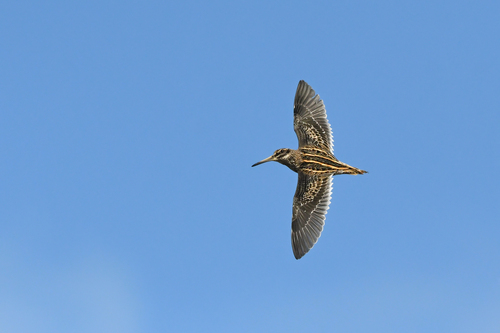 Jack Snipe
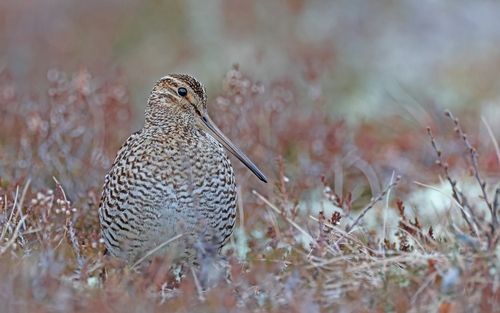 Great Snipe
In short
The most reliable field mark to separate Jack Snipe from Great Snipe is the Jack Snipe’s distinctive head pattern: it lacks a central crown-stripe and instead shows two pale lateral crown-stripes, while Great Snipe has a more typical snipe head pattern. In flight, Jack Snipe flashes narrow, pointed wings with yellowish back stripes, while Great Snipe shows broader wings with a pale wingbar and conspicuous white outer tail in display. Jack Snipe is much smaller and more compact, with a shorter bill and a unique bobbing behavior when feeding or alarmed. Both are secretive, but Jack Snipe flushes only at close range and drops quickly, while Great Snipe flies further and more powerfully when disturbed.
Identification tips
- Head pattern: Jack Snipe lacks a central crown-stripe and instead has two pale lateral crown-stripes separated from the supercilium by a dark area; Great Snipe has a central crown-stripe typical of Gallinago snipes. This is diagnostic at all ages if the head is seen well.
- Flight pattern: Jack Snipe shows narrow, pointed wings and yellowish stripes along the back in flight, with no pale wingbar. Great Snipe has broader wings with a clear pale wingbar and, in display, a fanned tail with conspicuous white outer feathers. Use these marks for all ages.
- Size and structure: Jack Snipe is much smaller, more compact, and has a shorter bill than Great Snipe. Great Snipe appears bulkier, especially in flight, and has a relatively longer bill (though still shorter than Common Snipe’s).
- Bill length: Jack Snipe’s bill is noticeably shorter and stubbier; Great Snipe’s is longer and more snipe-like, but not as long as Common Snipe’s.
- Underparts: Jack Snipe is pale below; Great Snipe is barred underneath. This is best seen on perched birds or in good light.
- Tail pattern: Jack Snipe’s tail is short and inconspicuous; Great Snipe’s tail is broader, with white sides that are conspicuous in flight and especially during display.
- Behavior when flushed: Jack Snipe flushes only at very close range, flies low and silently for a short distance, then drops quickly back into cover. Great Snipe flushes more readily, flies straight and strongly for a longer distance, and may show white tail sides in flight.
- Bobbing behavior: Jack Snipe bobs up and down almost constantly when feeding or alarmed; Great Snipe does not bob.
- Wing shape: Jack Snipe’s wings are narrow and pointed; Great Snipe’s are broader and less pointed, contributing to its bulkier jizz in flight.
- Habitat preference: Jack Snipe prefers wetter, boggier ground; Great Snipe can use slightly drier meadows and marshes.
- Vocalizations: Not usually helpful in non-breeding season. In breeding season, Jack Snipe’s display is a mechanical 'galloping horse' sound; Great Snipe’s lekking calls are varied rattles and clicks.
- Supercilium: Both have a dark eye-stripe, but Jack Snipe’s supercilium is separated from the lateral crown-stripes by a dark area, enhancing the unique head pattern.
- Display behavior: Great Snipe males display at leks, standing erect and fanning their tails; Jack Snipe’s display is an aerial flight with mechanical sound.
- Confusion risk: In poor views or brief flight flushes, size and flight style are most reliable. If the bird bobs when feeding, it is Jack Snipe. If it shows a broad white tail in flight, it is Great Snipe.
- Pitfalls: Both are secretive and well camouflaged; lone birds in dense cover can be hard to judge for size. Always try for a clear view of the head pattern and note behavior when flushed.
Size
Jack Snipe is significantly smaller and lighter (body mass ~50 g, length 18–25 cm, wingspan 30–41 cm) than Great Snipe (length 26–30 cm, wingspan 43–50 cm). Great Snipe appears bulkier and heavier in the field, with a much more robust body, especially in flight. Bill length is shorter in both compared to Common Snipe, but Great Snipe’s bill is still proportionally longer than Jack Snipe’s. These size differences are usually obvious if both species are seen side by side, but less so with lone birds in dense cover.
Plumage
For all ages, Jack Snipe lacks a central crown-stripe, instead showing two pale lateral stripes on the crown, separated from the supercilium by a dark area; Great Snipe has a more conventional snipe head pattern with a central crown-stripe. In flight, Jack Snipe shows narrow, pointed wings with yellowish stripes along the back, and no pale wingbar; Great Snipe has broader wings with a clear pale wingbar and, in display, a fanned tail with conspicuous white outer feathers. Underparts: Jack Snipe is pale below, Great Snipe is barred. Both have a dark eye-stripe. Tail: Jack Snipe’s tail is short and not showy; Great Snipe’s tail is broader, with white sides visible in flight and display. These contrasts hold for adults and immatures; no age-specific upperwing marks are described for either species, so the head and flight patterns are most useful.
Behaviour
Jack Snipe is famous for its continuous bobbing or bouncing movement when feeding or alarmed, a behavior not shared by Great Snipe. When flushed, Jack Snipe usually flies only a short distance before dropping back into cover, often silently and low to the ground. Great Snipe, by contrast, flushes more readily, flies strongly and directly for a considerable distance, and may show its white tail in display. Jack Snipe is extremely secretive and reluctant to flush, often only at very close range; Great Snipe can be difficult to see but is less likely to rely on squatting.
Habitat
Both species breed in wet meadows and marshes with short vegetation, but Jack Snipe favors wetter, boggier ground and is more often found in marshes and bogs, while Great Snipe can use slightly drier habitats. In non-breeding season, Jack Snipe is a rare vagrant in many areas and can be hard to find, while Great Snipe winters in tropical Africa. Both are well camouflaged and secretive in their chosen habitats.
Voice
Jack Snipe is silent in winter and rarely heard except during the male’s aerial display in breeding season (a sound like a galloping horse). Great Snipe’s voice is a faint 'yeah', but more importantly, males at the lek produce a variety of rattles, clicks, buzzes, and whistles that can be heard at great distances. Vocalizations are rarely useful for separating these species outside the breeding season, as both are generally silent when flushed.