

King Eider vs Common Eider
Somateria spectabilis versus Somateria mollissima
Play a quiz with King Eider and Common Eider
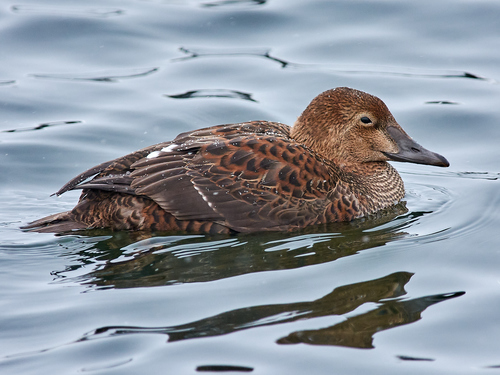 King Eider
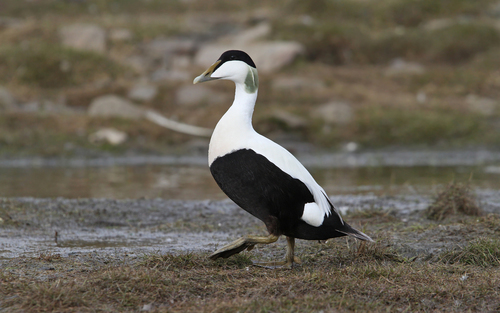 Common Eider
In short
The most reliable field mark between King Eider and Common Eider is the male's head and bill pattern: King Eider males in breeding plumage show a striking multicolored head with a large orange-yellow knob above the bill, while Common Eider males have a more subdued green nape and lack the bill knob. Females and immatures are more challenging, but King Eider females show a distinctive buffy spot at the bill base and a downward-curving buffy eye-stripe, while Common Eider females are plainer-faced. In flight, both species look similar, especially as immatures, but King Eider juveniles and young males can show white on the breast and rump as they age. Structure is also helpful: Common Eider is bulkier with a longer, more wedge-shaped bill. Size overlaps but Common Eider averages heavier. Context and flock composition can help, but careful attention to head and bill shape and plumage is key.
Identification tips
- Adult male head and bill (breeding): King Eider males have a large orange-yellow bill knob and a multicolored head (bluish-grey, pale green cheek, buff-tinged breast); Common Eider males lack the knob and have a green nape with a more wedge-shaped bill. This is the single most reliable mark in spring.
- Female face pattern: Female King Eider shows a buffy spot at the base of the bill and a buffy eye ring that curves downward behind the eye; Common Eider female is plainer-faced, with a longer, wedge-shaped bill and no strong facial pattern.
- Bill shape (all ages): Common Eider has a long, wedge-shaped bill that extends up the forehead, giving a sloping profile; King Eider's bill is shorter, more triangular, and the base is more distinct from the forehead (especially in males with the knob).
- Body size and bulk: Common Eider is bulkier and heavier on average, but there is overlap. Use only in combination with other marks.
- Male upperparts (breeding): King Eider males have black bodies with a buff-tinged white breast; Common Eider males have a black and white pattern with a clean white back and black belly.
- Female upperparts: Both are brown, but King Eider females have blackish chevrons on the flanks and upperparts, and fine black streaks on the head and neck; Common Eider females are more uniformly brown.
- Juvenile/immature males (late autumn onwards): Young male King Eiders begin to show white on the breast and rump as they moult into adult plumage, a process taking up to three years. This can be a subtle but helpful mark in mixed flocks.
- Leg and foot color: Female King Eider has greenish-grey legs and feet; Common Eider's leg color is not specified here, but is often greyish or olive.
- Flock structure: Common Eiders often form very large, dense flocks in winter; King Eiders are more often seen in smaller groups or mixed in with Common Eiders.
- Habitat and range: In temperate coastal waters, especially outside the high Arctic, Common Eider is much more likely. King Eider is more strictly northern and less likely in southern wintering areas.
- Vocalizations: If heard, Common Eider males give a distinctive "ah-ooo" call; King Eider's calls are not described here.
- Bill color (female): Female King Eider's bill is black or grey, sometimes with a buffy base; Common Eider females often have a duller, more uniform bill.
- Cheek color (male): King Eider males have a pale green cheek patch; Common Eider males have a white cheek with a green nape.
- Tertial "spurs" (male King Eider): Some King Eider males show curved tertials forming "spurs" along the back, absent in Common Eider.
- Hybrid caution: Rare hybrids between these species can show intermediate features; always check multiple marks, especially in unusual individuals.
Size
Common Eider is the larger and heavier of the two, with an average adult mass of about 2066.5 g compared to King Eider's 1617 g [wikidata]. Both are large sea ducks, but Common Eider is notably bulkier and has a slightly longer body and wingspan (Common Eider: 50–71 cm length, 80–110 cm wingspan; King Eider: 50–70 cm length, 86–102 cm wingspan [wikipedia]). In mixed flocks, Common Eider often stands out as the largest duck present, but individual overlap means size alone is not diagnostic.
Plumage
For adult males in breeding plumage, King Eider is unmistakable: black body, pale bluish-grey head and nape, pale green cheek, buff-tinged white breast, and a large orange-yellow bill knob. Common Eider males are black and white with a green nape, lacking the bill knob and multicolored head. Female King Eiders are warm brown with black chevrons on the flanks and upperparts, a buffy spot at the bill base, and a buffy eye ring extending into a downward-curving stripe; their bill is black or grey. Female Common Eiders are also brown but have a more uniform face and a longer, wedge-shaped bill. Juvenile King Eiders are greyish brown and late in their first autumn, young males begin to show white on the breast and rump, gradually acquiring adult plumage over three years. Common Eider juveniles are brown and lack the distinctive facial markings of King Eider females. In flight, both species show similar wing patterns, but the presence of white on the breast and rump in young male King Eiders (late first autumn onwards) can be a subtle clue.
Behaviour
Both species are marine ducks, diving for mollusks and crustaceans. Common Eider is noted for forming very large, dense flocks on coastal waters, especially in winter. King Eider is more likely to be seen in smaller groups, particularly outside the breeding season. Both species dive for food, but Common Eider is often seen feeding on mussels and crabs, sometimes swallowing mussels whole. Behavior is not a strong separator, but flock size and density can give a hint.
Habitat
Both species breed along Arctic and subarctic coasts and winter in coastal marine habitats. Common Eider has a broader winter range, extending farther south into temperate coastal waters and sometimes forming huge flocks. King Eider is more strictly high-latitude, especially in winter, and less likely to be found far south. In Europe and North America, Common Eider is generally more abundant and widespread, especially outside the high Arctic.
Voice
Common Eider males have a distinctive, almost human-like "ah-ooo" display call, while females give hoarse quacks. King Eider vocalizations are not described in the provided notes, so voice is not reliably diagnostic based on this information.