
King Eider vs Harlequin Duck
Somateria spectabilis versus Histrionicus histrionicus
Play a quiz with King Eider and Harlequin Duck
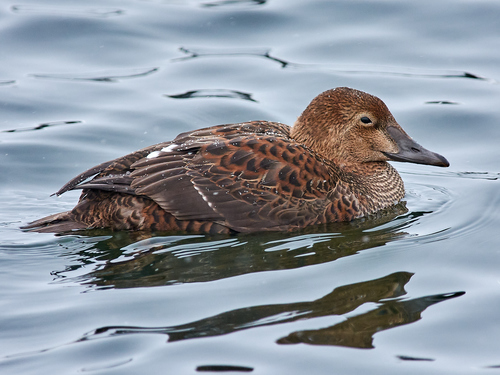 King Eider
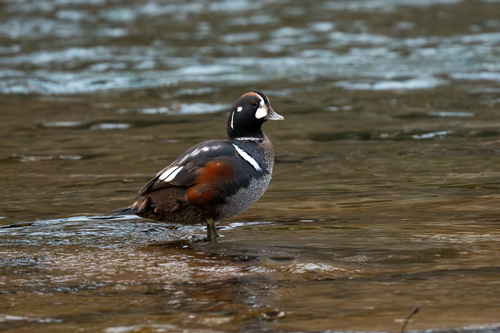 Harlequin Duck
In short
The most reliable field mark to separate King Eider from Harlequin Duck is size and structure: King Eider is a much larger, heavier-bodied duck with a thick neck and a distinctive bill shape, while Harlequin Duck is notably smaller, more compact, and has a finer bill. Adult male King Eiders are unmistakable in breeding plumage with their multicolored heads and large orange bill knob, but confusion can arise with females and immatures of both species, especially at a distance or in poor light. Juvenile and female King Eiders are warm brown with chevrons and subtle facial markings, while female Harlequins are brownish-grey with three crisp white facial spots. In flight, King Eider appears bulkier and longer-winged, while Harlequin Duck is more agile and compact. Both species may occur together in coastal northern waters, but their jizz and field marks remain distinct with careful observation.
Identification tips
- Size and bulk: King Eider is much larger and heavier than Harlequin Duck. If you see a sea duck that looks goose-sized among smaller ducks, suspect King Eider.
- Bill shape and color (adult males): Male King Eider has a huge orange-yellow knob on the bill, very obvious even at a distance. Harlequin Duck's bill is always small, blue-grey, and lacks any knob.
- Head pattern (adult males): King Eider males have a pale blue-grey head, green cheek, and black line separating the red bill from the face. Harlequin males have a dark slate blue head with a bold white crescent in front of the eye, a white spot behind the eye, and a chestnut patch on the side of the head.
- Female/immature face pattern: Female King Eider shows a buffy spot at the bill base and a buffy eye ring that curves downward; otherwise, the face is plain brown. Female Harlequin Duck has three distinct white facial spots: behind the eye, from eye to bill, and above the eye—these are crisp and stand out at a distance.
- Body pattern (females/immatures): King Eider females and immatures are warm brown with black chevrons on flanks and upperparts. Harlequin females are brownish-grey, lack chevrons, and look plainer except for the facial spots.
- Wing pattern in flight: King Eider has broad, rounded wings and may show a white secondary panel, but this is not always visible. Harlequin Duck has a metallic blue speculum and white inner secondaries that may show as white patches over the back when perched.
- Tail shape: King Eider's tail is short and rounded; Harlequin's is longer and pointed, especially noticeable in flight or when preening.
- Jizz in flight: King Eider appears heavy, with slow, deep wingbeats and a direct, ponderous flight. Harlequin Duck is quick, agile, and twists rapidly, often low over water.
- Habitat context: King Eider is usually farther offshore or in large, open bays. Harlequin Duck is found in rocky surf zones or fast-flowing streams, often close to shore.
- Group size: King Eider often forms large, loose flocks; Harlequin Duck is more often in small groups or pairs.
- Bill color (females/immatures): Female King Eider has a dark (black or grey) bill, while female Harlequin Duck has a blue-grey bill, but this can be subtle at distance.
- Leg color: King Eider has greenish-grey legs and feet; Harlequin Duck's leg color is less distinctive in the field.
- Seasonal confusion: Young male King Eiders in their first autumn can show white on the breast and rump but remain mostly dark for up to three years—do not expect full adult male plumage in young birds.
- Plumage molt timing: Harlequin males have an alternate (breeding) plumage in winter, so bright males can be seen in winter flocks. King Eider males take three years to reach full adult plumage.
- When in doubt: Focus on overall size, bill shape, and facial pattern—these are the most reliable marks at all ages and seasons.
Size
King Eider is a true heavyweight among sea ducks, with an average adult body mass of 1617g, and lengths ranging from 50–70 cm. It is much larger and bulkier than Harlequin Duck, which is a small sea duck (precise mass not given here, but always much lighter and shorter). King Eider has a thick neck, large head, and heavy, deep bill with a prominent knob in males. Harlequin Duck is compact, with a short neck, small rounded head, and a fine, blue-grey bill. Even at a distance, King Eider's size and bulk are apparent, especially when seen alongside other ducks.
Plumage
Juvenile and female King Eiders are overall warm brown with blackish chevrons on the flanks and upperparts, a buffy spot at the bill base, and a buffy eye ring that extends into a downward curving stripe. Their head and neck are only slightly paler, and the bill is dark. Young males in their first autumn start to show white on the breast and rump, but remain mostly dark for up to three years. In contrast, female Harlequin Ducks are brownish-grey, lacking the chevron pattern, and show three crisp white facial spots: a round spot behind the eye, a larger patch from the eye to the bill, and a small spot above the eye. Adult male King Eiders in breeding plumage are unmistakable: black body, white breast, pale blue-grey head with green cheek patch, and a huge orange-yellow bill knob. Adult male Harlequin Ducks are also colorful but in a completely different way: dark slate blue overall with chestnut sides, bold white crescent and spots on the head, and a black crown stripe. In flight, King Eider shows a broad, rounded wing with a strong white secondary panel (not always diagnostic at distance), while Harlequin Duck has a metallic blue speculum and white inner secondaries that form white marks over the back when perched. Tail shape also differs: King Eider's tail is short and rounded, while Harlequin's is longer and pointed.
Behaviour
King Eider is typically seen in large, loose flocks on open sea, often diving for food in deeper water. They are more ponderous and slower in flight, with deep wingbeats and a heavy, direct flight style. Harlequin Duck is much more agile, often seen in small groups or pairs, and prefers turbulent, rocky coasts or fast-flowing streams. They dive and swim in white water, often bobbing and twisting in the surf, and their flight is rapid, low, and twisting, reflecting their smaller size and agility.
Habitat
Both species are sea ducks but differ in their preferred habitats. King Eider favors open, cold marine waters at high latitudes, often far offshore or in large estuaries, and breeds on Arctic tundra near coasts. Harlequin Duck prefers fast-moving streams and rocky coastal shorelines, especially areas with pounding surf or white water. While both may be seen along northern coasts in winter, Harlequin Duck is more likely to be close to shore and in turbulent water, while King Eider is usually farther out or in sheltered bays.