
Lesser Redpoll vs Common Crossbill
Acanthis cabaret versus Loxia curvirostra
Play a quiz with Lesser Redpoll and Common Crossbill
 Lesser Redpoll
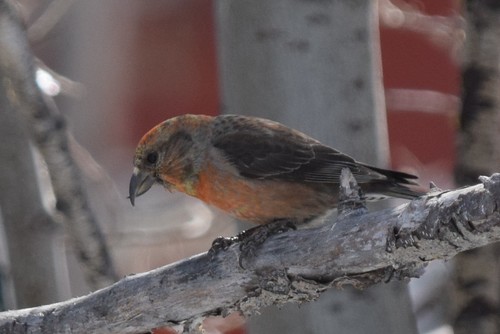 Common Crossbill
In short
The most reliable field mark to separate Lesser Redpoll from Common Crossbill is the bill: crossbills have unique, obviously crossed mandibles, while redpolls have a small, straight, conical finch bill. In flight or perched, Lesser Redpolls show pale wing bars and a red forehead, while Common Crossbills lack wing bars and have a more uniform, dark wing. Juvenile and female redpolls can be streaky and brownish, but never show the heavy, deep body or the distinctive bill shape of a crossbill. Both species can appear in mixed flocks in coniferous habitats, but their structure and feeding behavior are very different.
Identification tips
- Bill shape is the most definitive mark: Common Crossbill has a large, heavy bill with tips that cross over each other—unique among finches. Lesser Redpoll has a small, straight, pointed finch bill. This is diagnostic at all ages and distances where the bill can be seen.
- Wing bars vs. plain wings: Lesser Redpoll always shows two pale wing bars on each wing, visible both perched and in flight, at all ages. Common Crossbill never shows wing bars; its wings are uniformly dark brownish-black.
- Red forehead patch: Lesser Redpoll (adults and many juveniles) shows a bright red patch on the forehead, which is never present on crossbills. Absence of this patch does not rule out redpoll (especially in young birds or females), but its presence is a strong pointer.
- Overall size and structure: Crossbill is much bulkier, with a large head and deep chest, and a heavier, more powerful jizz. Redpoll is small, slim, and delicate, with a finer, more pointed head profile.
- Plumage tones: Lesser Redpoll is brownish-grey with heavy dark streaks above and below; adult males may show pinkish-red on the breast, but females and juveniles are streaky and lack strong color. Crossbill males are red or orange overall, females greenish or yellow, and juveniles are duller but less streaked below than redpolls.
- Rump pattern: Lesser Redpoll has a streaked rump; crossbill's rump is more uniform and lacks strong streaking.
- Feeding behavior: Redpolls feed acrobatically on small seeds, often hanging from catkins; crossbills use their crossed bills to extract seeds from conifer cones, often holding cones with their feet.
- Flight style: Redpolls are light and fluttery in flight, sometimes giving a bouncing impression; crossbills are heavier, with a more direct, purposeful flight.
- Habitat context: If seen in birch or alder woodland, especially feeding on catkins, redpoll is more likely. If in dense coniferous forest, especially feeding on cones, crossbill is more likely.
- Juvenile confusion: Juvenile redpolls are streaky and show wing bars; juvenile crossbills are streaky but lack wing bars and have the distinctive bill.
- Sexual dimorphism: Both species show some sexual color variation, but only crossbill males are extensively red or orange all over; redpoll males have limited red restricted to forehead and breast.
- Leg color: Redpoll has brown legs; leg color is not a strong mark for crossbill but is not diagnostic.
- Vocalizations: Not covered in detail here, but crossbills have distinctive 'chip' or 'jip' calls, while redpolls give a rapid, twittering flight call. Use voice as a supporting mark if known.
- Seasonal context: Both species can be irruptive and appear outside typical range, so do not rely solely on season or location.
- Mixed flocks: Both species can join mixed finch flocks in winter, so always check bill and wing pattern carefully, especially in large groups.
Size
Lesser Redpoll is a much smaller finch, measuring 11.5–14 cm in length and weighing 12–16 g [wikipedia], with a wingspan of 19–22 cm. Common Crossbill is noticeably larger and bulkier, with a much heavier head and bill, though precise measurements are not provided here. In the field, the crossbill's size and robust build are obvious when seen alongside redpolls or other small finches.
Plumage
For all ages, Lesser Redpoll shows two pale wing bars and a bright red forehead patch (adults and many juveniles), with brownish-grey, heavily streaked upperparts and a streaked rump. Males often have a pinkish-red suffusion on the breast, while females and juveniles are more subdued. The rump is streaked, not plain. Common Crossbill, by contrast, has entirely dark brownish-black wings with no wing bars at any age, and lacks any red on the forehead. Adult males are red or orange overall, females greenish or yellow, and juveniles are greyish-green and streaked, but none show wing bars or red foreheads. The crossbill's plumage is more uniform and less streaked below than redpoll, especially in adults. Juvenile redpolls and crossbills can both be streaky, but the presence of wing bars and the redpoll's finer streaking are distinctive. The crossbill's bill is always diagnostic.
Behaviour
Lesser Redpolls are agile, active feeders, often hanging acrobatically from birch or alder catkins, and may forage in small, loose flocks. They are often seen feeding high in trees but will also come to the ground. Common Crossbills are more methodical and robust in their feeding, using their crossed bills to pry open conifer cones, often holding cones with their feet. Crossbills are usually found in tight, noisy flocks, and their feeding behavior is more deliberate and less acrobatic than redpolls. In flight, crossbills appear heavier and more direct, while redpolls are lighter and more fluttery.
Habitat
Lesser Redpolls are most often found in birch and alder woodland, scrub, and sometimes gardens, especially in winter. They are less strictly tied to conifers. Common Crossbills are closely associated with coniferous forests and plantations, especially where there is a good crop of cones. While both species can occur together in mixed woodlands, crossbills are rarely found far from conifer stands, whereas redpolls are more flexible in habitat choice.