
Long-billed Dowitcher vs Great Snipe
Limnodromus scolopaceus versus Gallinago media
Play a quiz with Long-billed Dowitcher and Great Snipe
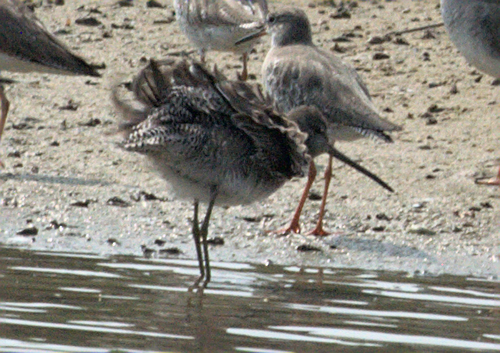 Long-billed Dowitcher
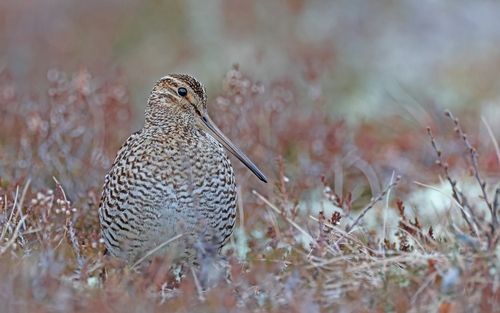 Great Snipe
In short
The most reliable field mark between Long-billed Dowitcher and Great Snipe is the presence of a large, bright white upper rump and back visible in flight on the dowitcher, versus the great snipe’s brown-centered tail with white sides and a pale wingbar. Juvenile dowitchers also show distinctive dull, plain tertials compared to the more patterned upperparts of great snipe. Structurally, dowitchers have a much longer, straighter bill and a slimmer, less bulky build, while great snipe appear more robust and woodcock-like in flight. In non-breeding plumage, both can look drab and similar, but differences in bill length, rump/tail pattern, and flight jizz remain useful. Calls and habitat preferences can also help, especially in ambiguous plumages.
Identification tips
- Juvenile tertials: Juvenile Long-billed Dowitchers have plain, dark gray tertials with narrow buff edges and almost no internal markings; Great Snipe juveniles and adults have more patterned, mottled upperparts. This is a key mark in autumn.
- White rump in flight: Long-billed Dowitcher shows a large, bright white rump extending up the back in flight, unlike Great Snipe, which has a brown-centered tail with white sides but no white rump.
- Tail pattern: Dowitcher tail is barred black and white (black bars wider); Great Snipe tail is brown in the center with conspicuous white sides, especially when fanned during display.
- Pale wingbar: Great Snipe shows a broad, pale wingbar in flight; dowitcher lacks this feature.
- Bill length and shape: Dowitcher has a very long, straight bill (about twice head length, 62–72 mm), while Great Snipe's bill is shorter (6–7 cm), stouter, and less straight.
- Body shape and jizz: Dowitcher is slim, elongated, and less bulky; Great Snipe is robust, heavy-bodied, and woodcock-like, especially obvious in flight.
- Facial pattern: Both have a dark eye-stripe, but dowitcher has a whitish supercilium and dark loral stripe extending past the eye; Great Snipe’s facial stripes are bolder and more contrasting.
- Underpart color and barring: Breeding dowitchers are rufous below with black barring and white flanks; Great Snipe are heavily barred underneath, never rufous.
- Non-breeding plumage: Both become drab, but dowitcher’s breast is gray fading to a white belly, while snipe retain barred flanks and a more mottled look.
- Leg color: Dowitcher legs are yellowish olive-green; leg color is not described for Great Snipe, so use with caution.
- Feeding behavior: Dowitchers feed in open water with rapid, repeated probing; Great Snipe forage in dense vegetation or mud, often hidden.
- Flight style: Great Snipe flushes and flies straight for long distances, dropping quickly; dowitcher flight is more direct, less erratic.
- Display: Great Snipe males display at leks with puffed chests and fanned tails, making mechanical sounds; dowitcher males chase females in flight.
- Habitat: Dowitchers are found in open, shallow freshwater habitats; Great Snipe in dense, grassy marshes and wet meadows.
- Voice: If heard, dowitcher’s flight call is diagnostic; Great Snipe’s display includes rattles, clicks, and a faint 'yeah' call.
Size
Long-billed Dowitcher is a medium-sized shorebird with a body mass around 104 g [wikidata], while Great Snipe is slightly larger and noticeably bulkier than Common Snipe, but exact mass is not provided. In the field, Great Snipe looks more robust and heavy-bodied, especially in flight, with a shorter bill relative to head length. Dowitcher is slimmer and more elongated, with a bill about twice the head length, giving a more streamlined impression.
Plumage
Juvenile/immature plumage is key: juvenile Long-billed Dowitchers have dark gray tertials with narrow buff edges and almost no internal markings, making the tertials look plain and dull. Their upperparts are fringed chestnut, and the breast is uniformly gray, fading into a paler rufous lower belly. In contrast, Great Snipe juveniles (and adults) have strongly patterned, mottled brown upperparts and a boldly barred underside, with a dark eye-stripe and a broad pale wingbar visible in flight. In flight, adult dowitchers show a striking white rump extending up the back, and a tail barred black and white (black bars wider than white). Great Snipe, in flight, shows a brown-centered tail with white sides (conspicuous when fanned) and a pale wingbar, but lacks the large white rump. In breeding plumage, dowitchers are rufous below with black barring and a dark crown, while Great Snipe remain heavily barred underneath and mottled above. In non-breeding plumage, both become drabber gray-brown, but dowitchers retain a contrasting white belly and a supercilium, while snipe keep their bold facial stripes and barred flanks.
Behaviour
Long-billed Dowitchers feed with a rapid 'sewing machine' motion, probing in shallow water, often in groups. They are more likely to be seen in open, freshwater habitats, sometimes wading deeply. Great Snipe are secretive, foraging in dense vegetation or soft mud, usually alone or in loose groups, and are more likely to flush suddenly and fly straight for a long distance before dropping. In display, Great Snipe males gather at leks, puffing chests and fanning tails, sometimes leaping and making a variety of mechanical sounds. Dowitcher displays involve aerial chases.
Habitat
Long-billed Dowitchers favor open, freshwater habitats—marshes, ponds, and shallow wetlands, especially in North America. Great Snipe breed in marshes and wet meadows with short vegetation across northern Eurasia, and are more likely to be found in dense cover or drier, grassy wetlands than dowitchers. Dowitchers are rarely found in the dense, grassy habitats preferred by Great Snipe, and vice versa.
Voice
Dowitchers are best separated from similar species by their flight call, especially in winter, but the actual call is not described here. Great Snipe has a faint 'yeah' call and, during display, produces a mix of rattles, clicks, buzzes, and whistles that can be heard over long distances. If you hear mechanical or xylophone-like display sounds, Great Snipe is likely. If you can distinguish the typical dowitcher flight call, that is diagnostic, especially in non-breeding plumage.