
Ochre-flanked Tapaculo vs Magellanic Tapaculo
Eugralla paradoxa versus Scytalopus magellanicus
Play a quiz with Ochre-flanked Tapaculo and Magellanic Tapaculo
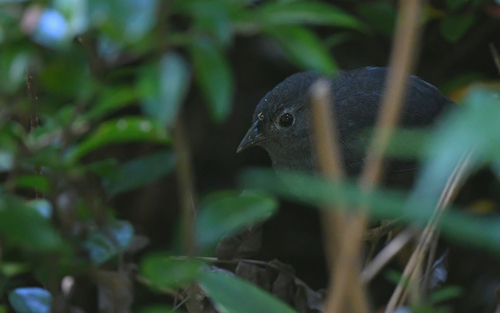 Ochre-flanked Tapaculo
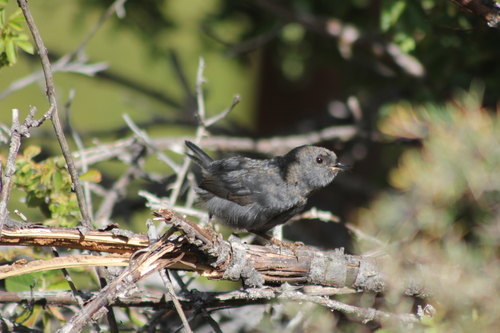 Magellanic Tapaculo
In short
The most reliable field mark between Ochre-flanked Tapaculo and Magellanic Tapaculo is size: Ochre-flanked is nearly three times heavier and noticeably longer. For plumage, Ochre-flanked adults show distinctive ochre/tawny flanks and clay-brown lower underparts, while Magellanic is overall dark grey with only a chestnut tinge to the flanks and undertail. Juveniles of both are barred, but Ochre-flanked juveniles are cinnamon/rufous-barred over dusky grey, whereas Magellanic juveniles are brown with dark barring and lack any white crown patch. Structure also helps: Ochre-flanked has a unique 'Roman nose' profile, while Magellanic is more wren-like with a short, cocked tail. Use these features in combination, especially when glimpsing birds in dense cover.
Identification tips
- Size is the most immediate clue: Ochre-flanked Tapaculo is nearly three times heavier and significantly longer than Magellanic Tapaculo. If the bird looks chunky or notably large for a tapaculo, lean toward Ochre-flanked.
- Juvenile plumage: Juvenile Ochre-flanked is barred cinnamon/rufous over dusky grey, while juvenile Magellanic is brown with dark barring and lacks any white on the crown. If you see a barred juvenile, check for overall color tone—warm cinnamon/rufous bars point to Ochre-flanked.
- Adult flank color: Ochre-flanked adults have rich ochre/tawny brown flanks and clay-brown lower underparts, sharply contrasting with the otherwise gray plumage. Magellanic adults are dark grey overall, with only a faint chestnut tinge on the flanks and undertail.
- Crown patch: Some Magellanic Tapaculos show a silvery-white patch on the crown (mainly adults), which Ochre-flanked never shows. Absence of this mark is not diagnostic, but its presence confirms Magellanic.
- Facial profile: Ochre-flanked Tapaculo has a unique 'Roman nose' profile—its forehead and bill form a straight, sloping line, unlike the more rounded, wren-like head of Magellanic.
- Tail structure and carriage: Magellanic Tapaculo has a very short tail, often held cocked upright. Ochre-flanked's tail is short but not as extremely so, and is usually held more horizontally.
- Bill and legs: Magellanic has a slender, black bill and pinkish, fairly long legs. These features are less distinctive in Ochre-flanked, but the overall impression is of a heavier, more robust bird.
- Behavior: Magellanic Tapaculo is more active and wren-like, often flicking its tail and hopping in dense cover. Ochre-flanked appears bulkier and moves more deliberately.
- Habitat context: If in south-central Chile or adjacent Argentina in dense temperate forest, Ochre-flanked is more likely. In more open or southern habitats, especially further south, Magellanic is more likely, but range overlap means this is only a supporting clue.
- Vocalizations: If you hear a loud, staccato, repetitive song, it is likely Magellanic Tapaculo. Lack of song information for Ochre-flanked means silence is not diagnostic.
- Underpart contrast: Ochre-flanked shows a clear transition from gray chest to clay-brown belly and vent, with tawny flanks. Magellanic is more uniform, with only a chestnut tinge to the flanks and undertail.
- White on crown: Presence of a silvery-white crown patch is a clincher for Magellanic, but absence does not rule it out.
- Pitfalls with juveniles: Both species' juveniles are barred, but the color and tone of the barring differ—look for cinnamon/rufous (Ochre-flanked) versus brown/dark (Magellanic).
- Sex differences: No sex-specific plumage differences are described for either species, so use the above marks for all individuals.
- When in doubt: Prioritize size and flank color, then check for the 'Roman nose' profile and tail structure. If you see a white crown patch, it's Magellanic. If the bird is notably large and ochre-flanked, it's Ochre-flanked.
Size
Ochre-flanked Tapaculo is much larger and heavier, with a typical body mass of 34.5 g and length around 14.5 cm. Magellanic Tapaculo is much smaller, weighing about 12 g and measuring 10–12 cm in length. This size difference is usually obvious in the field if you get a good look, particularly if both species are known from the same area. Ochre-flanked appears bulkier and more robust, while Magellanic is compact and dainty.
Plumage
Juvenile Ochre-flanked Tapaculo is barred throughout with cinnamon to rufous over dusky grey, while juvenile Magellanic Tapaculo is brown with dark barring and lacks any white on the crown. For adults, Ochre-flanked is dark gray above with paler gray underparts, but the abdomen and vent are clay brown and the flanks are a rich tawny brown—these ochre/tawny tones are diagnostic. Magellanic Tapaculo adults are dark grey overall, with only a chestnut tinge on the flanks, undertail, and wings; some individuals show a silvery-white crown patch, which Ochre-flanked never has. Both species have short tails, but Magellanic's is especially short and often held erect.
Behaviour
Both species are skulking and secretive, typical of tapaculos, but Magellanic Tapaculo often appears more wren-like in its movements, with frequent tail-cocking and a tendency to hop about low in dense cover. Ochre-flanked Tapaculo may appear bulkier and less active, with a more horizontal posture and a distinctive facial profile. Both are difficult to see well, but the larger size and heavier build of Ochre-flanked can be apparent if seen side-by-side or with a good view.
Habitat
Both species occur in southern South America, but Ochre-flanked Tapaculo is found in south-central Chile and adjacent western Argentina, while Magellanic Tapaculo ranges further south. Their habitats overlap in some areas, but Ochre-flanked is more associated with temperate forests and dense undergrowth, while Magellanic can be found in a wider range of southern habitats, including more open or shrubby areas. In overlapping zones, context may help but is not diagnostic on its own.
Voice
Only Magellanic Tapaculo's song is described: it is loud, staccato, and repetitive. No vocal description is provided for Ochre-flanked Tapaculo, so voice is not a reliable separator based on current notes.
Ochre-flanked Tapaculo · Magellanic Tapaculo · My Tricky Birds