
Red-footed Falcon vs Eleonora's Falcon
Falco vespertinus versus Falco eleonorae
Play a quiz with Red-footed Falcon and Eleonora's Falcon
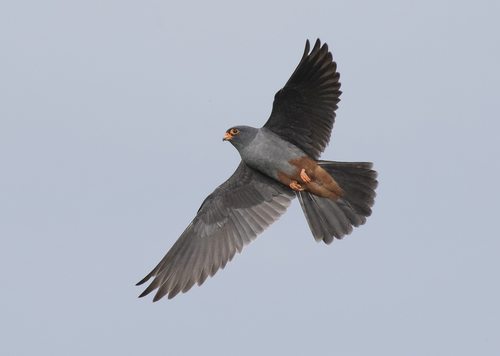 Red-footed Falcon
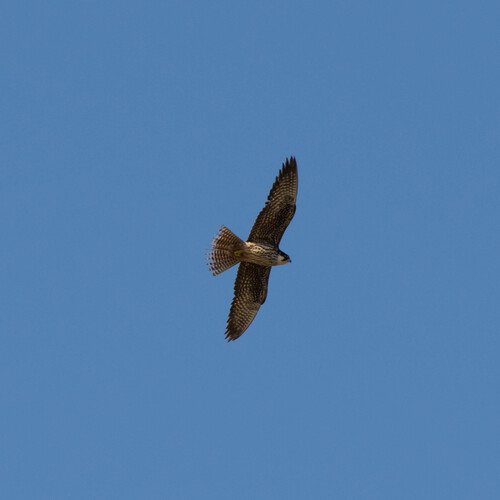 Eleonora's Falcon
In short
The most reliable field mark between Red-footed Falcon and Eleonora's Falcon is the underwing pattern, especially in juveniles and light-morph Eleonora's: Red-footed Falcon (all ages) shows uniformly pale grey underwings (males) or lacks strong contrast (females, juveniles), while Eleonora's Falcon (light morph and juveniles) shows a sharp contrast between dark underwing coverts and paler flight feathers. Size and structure also help: Eleonora's is much larger and longer-winged. Adult male Red-footed Falcons are blue-grey with red legs and undertail, unique among these two, while Eleonora's (dark morph) is all sooty brown. Juvenile and female Red-footed Falcons can be confused with light-morph Eleonora's, but the face pattern and underwing contrast remain key. Habitat and season can help: Red-footed breeds inland in eastern Europe/Asia, Eleonora's breeds on Mediterranean islands and cliffs.
Identification tips
- Underwing pattern in flight (all ages): Red-footed Falcon (male, female, juvenile) shows uniform or subtly marked underwings; Eleonora's Falcon (light morph and juvenile) shows a bold contrast between dark underwing coverts and pale flight feathers. This is the single best field mark, especially for immatures.
- Adult male plumage: Red-footed Falcon males are blue-grey all over with a red undertail and legs, and a uniform grey underwing. Eleonora's (dark morph) males are all sooty brown with blackish underwings, never blue-grey.
- Adult female/juvenile face pattern: Red-footed Falcon females and juveniles have a white face with a distinct black eye stripe and moustache, giving a 'masked' look. Eleonora's lacks this bold facial pattern, especially in light morphs.
- Body size and shape: Eleonora's Falcon is much larger, longer-winged, and longer-tailed than Red-footed. If you see two birds together, the difference is obvious, but alone, look for a more powerful, rangy jizz in Eleonora's.
- Tail length and shape: Eleonora's has a longer tail relative to body size, often appearing more 'streamered' in flight. Red-footed is more compact.
- Plumage morphs (Eleonora's only): Eleonora's Falcon comes in dark and light morphs. Dark morph is all sooty brown (never shown by Red-footed); light morph can be confused with juvenile/female Red-footed but always check the underwing contrast.
- Leg and undertail color (adult males): Red-footed Falcon males have conspicuous red legs and undertail coverts; Eleonora's never does.
- Habitat during breeding: Red-footed breeds in inland open country, often near human settlements; Eleonora's breeds on sea cliffs and islands. Context can help, but beware migrants.
- Seasonal timing: Eleonora's breeds late (late summer/early autumn) to coincide with bird migration; Red-footed breeds earlier in spring/summer.
- Group behavior: Red-footed Falcons may be seen in loose groups or colonies, especially near nest sites or during migration. Eleonora's is colonial but usually seen singly or in small numbers away from colonies.
- Feeding behavior: Red-footed often hunts insects in flight or from perches over fields; Eleonora's specializes in catching small birds on the wing, especially during migration.
- Vocalizations: Eleonora's gives a 'kek-kek-kek' call, but this is not diagnostic against Red-footed in most field situations.
- Juvenile confusion: If you see a pale-bellied, streaky falcon with a bold face mask and uniform underwings, it's a juvenile Red-footed. If the underwing is sharply two-toned and the face is less marked, it's a young Eleonora's.
- Pitfalls: Light-morph Eleonora's and female/juvenile Red-footed are the main confusion pair; always check underwing pattern and face for separation.
- When in doubt: If you cannot see the underwing well, use a combination of size, habitat, and face pattern, but beware overlap in non-breeding areas or on migration.
Size
Eleonora's Falcon is substantially larger and heavier than Red-footed Falcon: average mass is about 334 g for Eleonora's, versus 158.5 g for Red-footed [wikidata]. Eleonora's is also longer (36–42 cm vs 28–34 cm) and has a much broader wingspan (87–104 cm vs 65–75 cm) [wikipedia]. In the field, Eleonora's will look longer-winged, longer-tailed, and generally more powerful, while Red-footed is noticeably more compact and dainty.
Plumage
- Juvenile/immature birds (highest priority):
- Red-footed Falcon juveniles are brown above and buff below with dark streaks, and their face pattern resembles the female (white face with black eye stripe and moustaches). Their underwings lack strong contrast, appearing fairly uniform.
- Eleonora's Falcon juveniles (and light morph adults) have pale buff underparts but crucially show a strong contrast on the underwing: dark underwing coverts stand out against paler flight feathers. This 'two-tone' underwing is diagnostic in flight. The face is less strongly marked than Red-footed, lacking the bold moustache.
- Adult males:
- Red-footed Falcon males are all blue-grey with a red undertail and legs, and uniformly grey underwings.
- Eleonora's Falcon males (dark morph) are entirely sooty brown with black underwing coverts; light morphs are paler below but still show the underwing contrast.
- Adult females:
- Red-footed Falcon females have a grey back and wings, orange head and underparts, and a white face with black eye stripe and moustaches.
- Eleonora's Falcon females are similar to males in their respective morphs, with the same underwing contrast in light morph.
The key difference is the underwing: Red-footed never shows the sharp two-tone underwing of Eleonora's.
Behaviour
Both species are agile aerial hunters, but Eleonora's Falcon is especially known for its long, steady wingbeats and habit of cruising along coastal cliffs, watching for migrating birds. Red-footed Falcons are more likely to be seen hunting insects or small prey over open grasslands or agricultural areas, sometimes in loose groups. Eleonora's is more likely to be seen in late summer or early autumn, coinciding with bird migration, while Red-footed is present earlier in the season. Eleonora's is also unique in imprisoning live prey for later feeding, but this is not visible in the field.
Habitat
Red-footed Falcon breeds in eastern Europe and Asia, favoring open grasslands and agricultural areas, often nesting in colonies (sometimes in artificial nest boxes) within or near human settlements. Eleonora's Falcon breeds almost exclusively on Mediterranean islands and coastal cliffs, especially off Greece, and is rarely found inland during breeding. In migration, Eleonora's can be seen over land but is still strongly associated with coastal or island habitats. If you see a falcon in a steppe or inland grassland, Red-footed is much more likely; on a Mediterranean island or sea cliff, Eleonora's is the default.
Voice
Eleonora's Falcon gives a typical falcon 'kek-kek-kek' call. No distinctive vocalization is noted for Red-footed Falcon in these sources, and voice is not a reliable separator between these two in the field.