
Red Knot vs Sanderling
Calidris canutus versus Calidris alba
Play a quiz with Red Knot and Sanderling
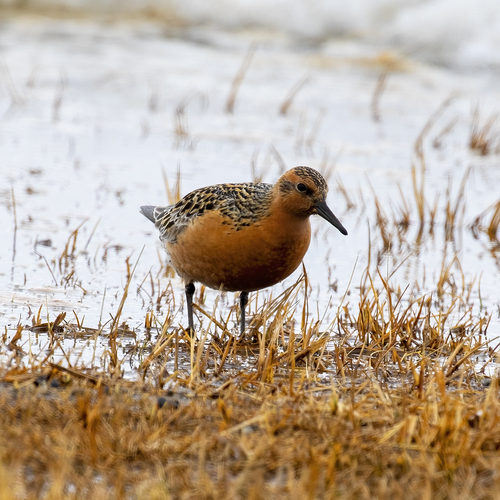 Red Knot
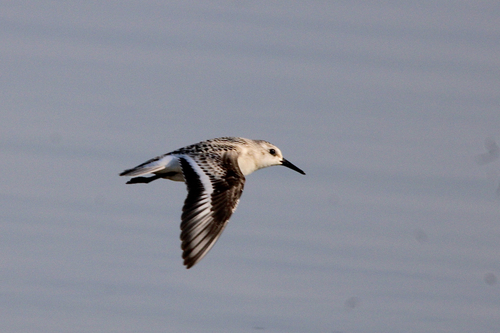 Sanderling
In short
The most reliable field mark to separate Red Knot from Sanderling is size and structure: Red Knot is distinctly larger and bulkier, with a thicker body, shorter legs, and a proportionally longer, slightly tapering bill, while Sanderling is smaller, rounder, and has a stubbier bill. In flight, both show a strong white wingbar, but Red Knot has a grey rump and tail, whereas Sanderling's tail is white and its upperparts are paler overall. Juvenile Red Knots show brown coverts with submarginal lines, a feature not seen in Sanderling. On the ground, Sanderlings are often seen running with a rapid, 'bicycling' leg motion on sandy beaches, while Red Knots move more deliberately and appear 'low-slung' due to their short legs. Both species can appear pale in winter, but Red Knot is always larger and never as white as Sanderling.
Identification tips
- Size is the quickest check: Red Knot is much larger and bulkier than Sanderling, especially obvious in direct comparison or mixed flocks. If the bird looks as big as a Dunlin or larger, consider Red Knot.
- Bill shape and length: Red Knot has a medium-length, slightly tapering dark bill about as long as its head; Sanderling's bill is shorter, stubbier, and thicker at the base. This is most useful at close range.
- Leg color and length: Both have dark legs, but Red Knot's are shorter and give it a 'low-slung' look when feeding, while Sanderling's legs are proportionally longer for its body size, aiding its rapid running.
- Flight pattern and wingbar: Both show a strong white wingbar in flight, but Red Knot has a grey rump and tail, while Sanderling's rump and tail are white. This is a key mark when birds flush.
- Juvenile plumage: Juvenile Red Knots show brown coverts with submarginal lines, a pattern not seen in Sanderling juveniles, which are paler and lack strong covert markings.
- Breeding plumage: Red Knot in breeding plumage is heavily mottled grey above with a rich cinnamon face, throat, and breast, often extending onto the belly. Sanderling in breeding plumage is rufous and patterned above but never as extensively red below.
- Winter plumage: Both species become pale, but Sanderling is much whiter overall, especially on the head and underparts, often appearing almost ghostly white, while Red Knot remains pale grey.
- Foraging behavior: Sanderling is famous for its rapid, 'bicycling' run along the wave edge, chasing receding surf. Red Knot moves more slowly and methodically, often probing deeper mud or sand.
- Habitat preference: In winter, Sanderling is almost always on sandy beaches, especially at the surf line. Red Knot is more often found on mudflats, estuaries, or sometimes sandy beaches but rarely in the surf zone.
- Flock structure: Sanderlings form tight, active flocks, often running in unison. Red Knots may form large flocks but move more slowly and are less synchronized.
- Voice: Red Knot gives a low 'knutt' or 'knuup-knuup' in flight; Sanderling's calls are not detailed here but are generally higher-pitched and less distinctive.
- Sex differences: Female Red Knots are slightly paler and have a less distinct eye-line than males, but this is subtle and not reliable in the field.
- Pitfalls: In poor light or at a distance, pale winter Red Knots can look like Sanderlings, but check for size, bill shape, and especially the color of the rump and tail in flight.
- Age-related confusion: Juvenile Red Knots' brown covert pattern is unique among these two; Sanderling juveniles are plainer and paler.
- Context: If you see a pale sandpiper running with the waves, it's almost certainly a Sanderling. If it's feeding more slowly on a mudflat or estuary, check for Red Knot, especially if it looks large and chunky.
Size
Red Knot is substantially larger than Sanderling: Red Knot averages 137g in body mass [wikidata], with a length of 23–26 cm and a wingspan of 47–53 cm [wikipedia]. Sanderling is noticeably smaller and stouter, similar in size to a Dunlin, and appears more compact and round-bodied. In mixed flocks or side-by-side, the size difference is obvious, with Red Knot standing taller and bulkier.
Plumage
Juvenile Red Knots have distinctive brown coverts with submarginal lines, while juvenile Sanderlings lack this pattern and are generally paler above. In flight, both species show a strong white wingbar, but Red Knot's rump and tail are grey, contrasting with the white rump and tail of Sanderling. In winter, Red Knot is uniformly pale grey above and below, while Sanderling becomes very white, especially on the underparts and head, often appearing much cleaner and brighter than Red Knot. In breeding plumage, Red Knot is mottled grey above with a rich cinnamon face, throat, and breast, whereas Sanderling in breeding plumage is more rufous and patterned above but never as extensively red below as Red Knot. Female Red Knots are slightly paler and have a less distinct eye-line than males, but this is subtle and not a primary field mark.
Behaviour
Sanderlings are highly gregarious in winter, often forming large, tight flocks on sandy beaches and running back and forth with the waves, using a rapid, 'bicycling' leg motion. Red Knots are also gregarious but move more deliberately, often feeding in slightly deeper water or mudflats and appearing lower to the ground due to their shorter legs. Sanderlings are more likely to be seen actively chasing the surf, while Red Knots tend to probe methodically.
Habitat
Both species breed in Arctic tundra, but their wintering habitats differ. Sanderlings strongly prefer sandy beaches and are rarely found far from the surf zone, while Red Knots are more often found on tidal mudflats, estuaries, and sometimes sandy beaches, but are less tied to the surf edge. If you see a pale sandpiper running with the waves on a sandy beach, it is more likely to be a Sanderling; on mudflats or estuaries, especially in mixed flocks, check carefully for Red Knot.
Voice
Red Knot is generally quiet when feeding singly, but in flight flocks gives a low monosyllabic 'knutt' or a disyllabic 'knuup-knuup' during migration. Sanderling's calls are not described in the provided notes, but both species are not especially vocal outside of migration or display. Red Knot's display song is a fluty 'poor-me', but this is only heard on the breeding grounds.