
Red-necked Stint vs Sanderling
Calidris ruficollis versus Calidris alba
Play a quiz with Red-necked Stint and Sanderling
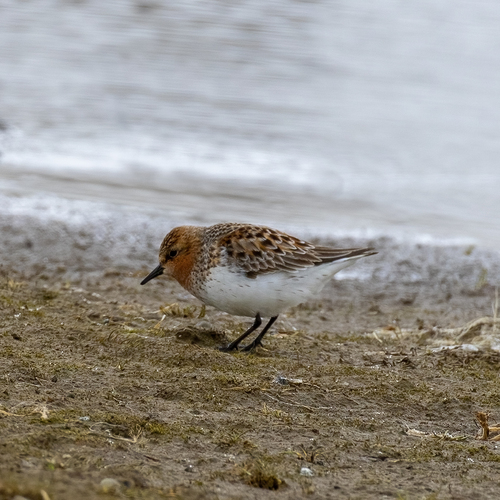 Red-necked Stint
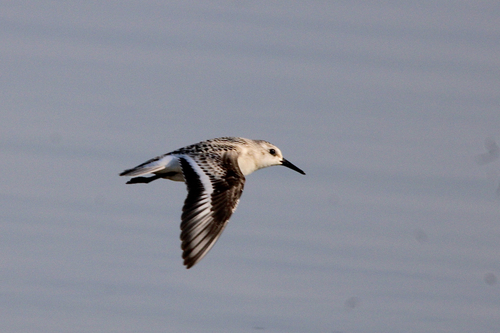 Sanderling
In short
The most reliable field mark to separate Red-necked Stint from Sanderling is size and structure: Red-necked Stint is distinctly smaller, more delicate, with a fine, thin bill and quick, darting movements, while Sanderling is noticeably larger, chunkier, with a stouter bill and a unique, 'bicycling' running action. In flight, Sanderling shows a strong white wingbar, which Red-necked Stint lacks. Both species have black legs and bills, but Sanderling lacks a hind toe (not visible in the field), and has a thicker bill. Juvenile and non-breeding plumages can be confusing, but Sanderling's size, shape, and wing pattern remain reliable. Focus on overall jizz, bill structure, and, if seen in flight, the presence or absence of a bold white wingbar.
Identification tips
- Size and bulk: Sanderling is much larger and bulkier than Red-necked Stint. In mixed flocks, Sanderling stands out as a big, pale sandpiper, while Red-necked Stint is tiny and neat. This is reliable at all ages and seasons.
- Bill structure: Red-necked Stint has a fine, thin, and straight bill, while Sanderling's bill is thicker and stouter. This is best seen at close range but can be judged in good light with binoculars.
- Leg color: Both species have black legs, so this is not helpful for separation.
- Wing pattern in flight: Sanderling of all ages shows a strong, broad white wingbar in flight; Red-necked Stint lacks this, showing a plainer wing. This is one of the best field marks if the birds flush or fly.
- Primary projection: Red-necked Stint has a longer primary projection relative to its body size, giving a more attenuated look at rest. Sanderling appears more compact and less attenuated.
- Plumage (breeding): Red-necked Stint in breeding plumage shows a bright rufous-orange breast and a white 'V' on the back, which Sanderling never shows. Sanderling is more gray and white, lacking rufous tones.
- Plumage (juvenile): Juvenile Red-necked Stint has a more contrasting mantle with weaker white lines down the back; Sanderling juveniles are generally paler and less patterned, but this is subtle and not always diagnostic.
- Plumage (non-breeding): Both species become plainer, but Sanderling is paler overall, often nearly white below and pale gray above, while Red-necked Stint remains small and neat, with less contrast.
- Behavior: Sanderling's 'bicycling' running action along the surf line is unique and diagnostic. Red-necked Stint moves quickly but does not show this distinctive gait.
- Habitat: In winter, Sanderling is almost always on open sandy beaches, often in the wave zone. Red-necked Stint prefers mudflats, estuaries, and coastal wetlands. If you see a small stint on a sandy beach, check carefully for Sanderling's other marks.
- Group associations: Red-necked Stint often flocks with other small Calidris waders, while Sanderling is often in single-species flocks or with larger shorebirds.
- Voice: Red-necked Stint gives a hoarse 'stit' call, but Sanderling's call is not described here, so use with caution.
- Feet: Sanderling lacks a hind toe, but this is not visible in the field and is not a practical separator.
- Jizz: Red-necked Stint appears delicate, fine-billed, and quick; Sanderling is robust, thick-billed, and purposeful in its running.
- Pitfalls: Be cautious with lone birds, especially in non-breeding plumage. Use a combination of size, structure, wing pattern in flight, and behavior for the most reliable identification.
Size
Red-necked Stint is among the smallest waders, with a body mass around 26 g and a length of 13–17 cm. Sanderling is substantially larger and stouter, with a size similar to Dunlin, and a much bulkier appearance compared to the dainty Red-necked Stint. Even at a distance or in mixed flocks, Sanderling stands out as a larger, more robust bird, while Red-necked Stint appears tiny and fine-billed.
Plumage
- Juvenile/First-winter: Red-necked Stint juveniles show a more contrasting mantle pattern with weaker white lines down the back, while Sanderling juveniles are not described in detail here but are generally paler and less patterned above. In flight, Sanderling of all ages shows a strong white wingbar, a key feature absent in Red-necked Stint.
- Adult breeding: Red-necked Stint adults have an unstreaked orange (rufous) breast bordered below with dark markings and a white 'V' on the back; Sanderling adults in breeding plumage are not described in detail here, but are generally more gray and white, lacking the rufous tones.
- Non-breeding/winter: Both species become plainer, but Sanderling remains paler overall, often appearing almost white below and pale gray above, while Red-necked Stint is shorter-legged and longer-winged than Little Stint, and remains small and neat. Sanderling's white wingbar in flight is always a clincher.
Behaviour
Red-necked Stint is highly gregarious and often flocks with other small Calidris waders, moving rapidly with quick, darting actions. Sanderling is also gregarious, especially in winter, but its behavior is distinctive: it runs along the beach with a unique 'bicycling' leg motion, frequently stopping to pick food, and is often found chasing the retreating surf on sandy beaches. This running style is a strong behavioral clue.
Habitat
Red-necked Stint breeds in northeast Russia and winters along the coastlines of Southeast Asia and Australasia, typically found on mudflats and coastal wetlands. Sanderling breeds in the High Arctic and winters on sandy beaches worldwide, including South America, Africa, and Australia. In the non-breeding season, Sanderling strongly prefers open sandy beaches, while Red-necked Stint is more likely on mudflats or estuarine habitats. Overlap can occur in migration, but Sanderling is much more tied to sandy shorelines.
Voice
Red-necked Stint gives a hoarse 'stit' call. Sanderling's call is not described in the provided notes, so voice is not a strong separator here.