
Rook vs Carrion Crow
Corvus frugilegus versus Corvus corone
Play a quiz with Rook and Carrion Crow
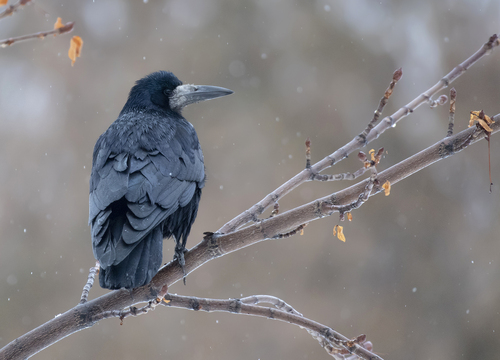 Rook
 Carrion Crow
In short
The most reliable field mark to separate Rook from Carrion Crow is the Rook's bare, whitish facial skin at the base of the bill, visible in all adult Rooks but never present in Carrion Crow. Juvenile Rooks, however, lack this bare patch and can closely resemble Carrion Crows, so age must be considered. In flight, Rooks show proportionally longer, narrower wings and a shaggier, laxer look to the leg feathering, while Carrion Crows appear stockier and more compact. Plumage gloss differs subtly: Rook is more blue or purple, Carrion Crow more greenish. Social behavior and voice also help: Rooks are often in noisy flocks, Carrion Crows are usually solitary or in pairs and have a deeper, croakier call.
Identification tips
- Bare facial skin (adults only): Adult Rooks always show a pale, featherless patch around the bill base and in front of the eye. This is never present in Carrion Crow. In poor light, this patch can be hard to see, but in good light or at close range it is diagnostic.
- Juvenile confusion: Juvenile Rooks lack the bare facial skin and can look almost identical to Carrion Crows. Look for a thinner, more pointed beak in young Rooks, and brownish-black tones on the hind neck, back, and underparts. Juvenile Carrion Crows have blue eyes and brownish plumage, but these features fade with age.
- Bill structure: Rook's bill looks longer and more pointed, partly due to the bare skin at the base, while Carrion Crow's bill is shorter, deeper, and all black. This difference is most obvious in adults.
- Head and leg feathering: Rook has denser, silkier head and neck feathers, and shaggier, laxer feathering around the legs, giving a somewhat scruffy look. Carrion Crow's plumage is sleeker and more even.
- Plumage gloss: Rook shows a blue or bluish-purple sheen in sunlight; Carrion Crow's gloss is more greenish or purplish, with green predominating. This is subtle and best seen in bright light.
- Wing shape in flight: Rook's wings are proportionally longer and narrower, giving a more buoyant, less labored flight. Carrion Crow's wings are broader and the flight is slower and more deliberate.
- Jizz and posture: Rooks often look slimmer, with a domed head and long bill, while Carrion Crows appear chunkier and more compact.
- Social behavior: Flocks of noisy, gregarious black corvids in open country are likely Rooks. Solitary or paired birds, especially in urban or woodland settings, are more likely Carrion Crows.
- Vocalizations: Listen for the Rook's higher, nasal 'kaaa' versus the Carrion Crow's deeper, croakier 'kraa'. Calls can carry far and are often the best clue when visibility is poor.
- Habitat context: In city parks and urban areas, Carrion Crow is much more likely. In rural fields, especially near rookery colonies, Rook predominates.
- Mixed flocks: Both species can occur together, especially in winter. Look closely at each individual, as social context alone is not always reliable.
- Perched vs. flight views: The facial skin and bill shape are easiest to see when perched. In flight, focus on wing proportions and flocking behavior.
- No distinctive upperwing pattern: Neither species has a unique juvenile or immature upperwing pattern, so rely on structure and bare facial skin for separation.
- Sex and season: No significant sexual dimorphism or strong seasonal plumage differences in either species; age and molt are more important for ID.
- Potential pitfalls: Beware of juvenile Rooks, which can be nearly indistinguishable from Carrion Crows at a distance. Use multiple features and, if in doubt, note the context and behavior for clues.
Size
Both species are similar in size and can overlap, but Carrion Crow is typically slightly heavier (400–600 g) compared to the Rook (average 453.5 g [wikidata]). Rook measures 44–46 cm in length with an 81–99 cm wingspan, while Carrion Crow is 48–52 cm long with an 84–100 cm wingspan. In the field, these differences are subtle and not usually diagnostic unless birds are side by side, but Carrion Crow tends to look bulkier and more robust, while Rook appears a bit slimmer and longer-winged.
Plumage
For adults, the single most distinctive plumage feature is the Rook's bare, whitish skin around the bill base and in front of the eye, which is never shown by Carrion Crow. Adult Rooks also have denser, silkier feathers on the head, neck, and shoulders, and their leg feathering appears shaggier. The Rook's plumage gloss is blue or bluish-purple in sunlight, while Carrion Crow has a greener or purpler sheen, with the green gloss being more pronounced. Juvenile Rooks lack the bare facial patch and show a thinner beak and brownish-black tones on the hind neck, back, and underparts, making them very similar to juvenile Carrion Crows, which have brownish plumage and blue eyes (the latter darkening with age). In flight, adult Rooks show proportionally longer and narrower wings than Carrion Crow, but there are no distinctive age-specific upperwing patterns described for either species.
Behaviour
Rooks are highly gregarious, often seen in large flocks, especially at roosts and feeding sites, and are more likely to nest colonially. Carrion Crows are mostly solitary or in pairs, though they may join mixed flocks in winter. Rooks often feed in open fields, while Carrion Crows are more versatile, frequently seen alone or in small groups, and can be quite bold around humans. Both species may overlap in feeding areas, so flocking alone is not always diagnostic.
Habitat
Both species are widespread across the Palearctic, but Rooks are more closely associated with open countryside, farmland, and rural areas, often nesting in colonies in tall trees. Carrion Crows are more adaptable, found in a range of habitats including cities, woodlands, and mountains, as well as farmland. In urban areas, Carrion Crow is more likely, while large noisy colonies in rural settings suggest Rook.
Voice
Rook calls are higher-pitched and more nasal (a sharp 'kaaa'), while Carrion Crow has a deeper, guttural, croaking 'kraa' that is more vibrant and resonant. Carrion Crows often call in short series, bowing with each note. Voice is a useful field clue, especially when birds are not seen well.