
Rough-legged Buzzard vs Long-legged Buzzard
Buteo lagopus versus Buteo rufinus
Play a quiz with Rough-legged Buzzard and Long-legged Buzzard
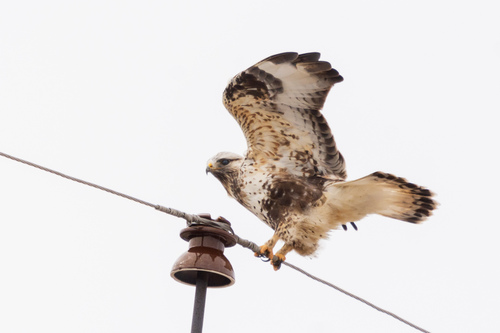 Rough-legged Buzzard
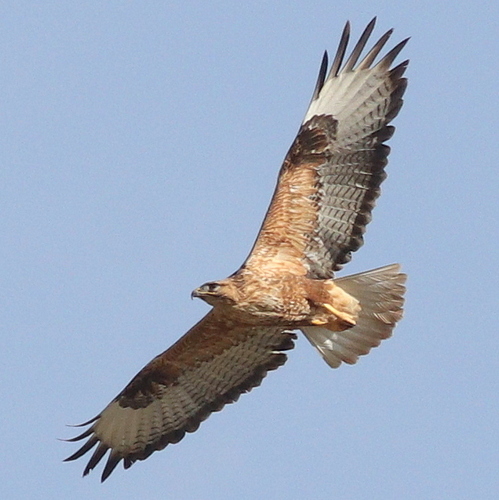 Long-legged Buzzard
In short
The best field mark to separate Rough-legged Buzzard from Long-legged Buzzard is the presence of a bold, square dark carpal (wrist) patch on the underwing of Rough-legged (especially in light-morph juveniles and adults), which Long-legged Buzzard never shows. Juvenile and adult Rough-leggeds also have a distinctive white tail with a single or several dark subterminal bands, while Long-legged shows a more rufous or greyish tail, often with multiple faint bars. Structurally, Rough-legged is longer-winged and more eagle-like in flight, with wings that often reach or extend past the tail when perched, while Long-legged is bulkier with a proportionally larger bill and longer legs. Both species are variable in plumage, but habitat and behavior also help: Rough-legged is a winter visitor from the Arctic, often seen hovering, while Long-legged is a resident or migrant of open, warmer country and rarely hovers.
Identification tips
- Dark carpal (wrist) patch: Rough-legged Buzzard (all ages, especially light morphs) shows a bold, square dark patch at the 'wrist' of the underwing, visible in flight; Long-legged Buzzard never shows this mark.
- Tail pattern: Rough-legged has a mostly white tail with one or more crisp dark subterminal bands (all ages); Long-legged has a rufous, sandy, or greyish tail, often with faint, irregular bars or a broader subterminal band, but never as clear-cut as Rough-legged.
- Underwing contrast: Rough-legged's underwing is white with strong dark markings at the carpal and sometimes along the trailing edge; Long-legged's underwing is more uniform, lacking the bold carpal patch, and may show a pale panel but not the same contrast.
- Plumage variability: Both species are variable, but Rough-legged is more likely to show heavy speckling and a broad brown chest-band; Long-legged (pale morph) has a plain, pale head and breast with fine streaks, and a sandy or rufous mantle.
- Leg feathering: Rough-legged has feathered tarsi (legs), giving a 'trousered' look; Long-legged also has long legs but is less obviously feathered (not always visible in the field).
- Wing and tail structure: In flight, Rough-legged appears longer-winged and more eagle-like, with wings reaching or extending past the tail when perched; Long-legged is bulkier, with a larger bill and longer legs, and wings that do not reach beyond the tail.
- Bill size: Long-legged Buzzard has a noticeably larger, heavier bill on a smallish head; Rough-legged's bill is smaller and more delicate.
- Flight style: Rough-legged often hovers while hunting, a rare behavior for a Buteo; Long-legged does not hover and is more likely to be seen soaring or perched.
- Perching behavior: Long-legged often perches upright and prominently on rocks, crags, or artificial structures; Rough-legged is more likely to be seen in open country, often on the ground or low perches.
- Juvenile upperwing coverts: Juvenile Long-leggeds have neat, pale edges to the greater and median coverts above, but this is subtle and not as distinctive as Rough-legged's underwing pattern.
- Head pattern: Long-legged (pale morph) has a plain, pale head with a dark eye-stripe and a more solidly dark nape; Rough-legged is more speckled and lacks the same head contrast.
- Eye color: Juvenile Long-leggeds have pale grey to greyish-yellow eyes, turning brown with age; Rough-legged's eye color is less distinctive in the field.
- Habitat and season: Rough-legged is a winter visitor from the Arctic, found in open, flat country; Long-legged is a resident or migrant of dry, rocky, or steppe habitats in warmer regions.
- Dark morphs: Both species can be very dark, but Rough-legged dark morphs still show the carpal patch and white tail base with a dark band, while Long-legged dark morphs are more uniformly dark with a grey or brown-grey tail.
- When in doubt: Focus on the underwing pattern (carpal patch), tail pattern, and flight style (hovering) for the most reliable separation, especially in juveniles and birds in flight.
Size
Rough-legged Buzzard averages about 925.8 g in body mass [wikidata], with females larger than males. Both species are among the larger Buteos, but the Long-legged Buzzard is described as large and sturdy, with a relatively large bill and long legs. In the field, size alone is unreliable, but Rough-legged tends to look longer-winged and more elegant, while Long-legged appears bulkier and heavier-billed. When perched, Rough-legged's wings often reach or slightly extend beyond the tail, unlike Long-legged.
Plumage
Juvenile and adult Rough-legged Buzzards (light morphs) show a striking white underwing with a bold, square dark carpal patch ('wrist'), and a mostly white tail with one or more dark subterminal bands. This underwing pattern is present in all ages and is a key separation point. Long-legged Buzzard, regardless of age or morph, lacks the dark carpal patch and instead shows a more uniform underwing, sometimes with a pale panel but never the strong contrast of Rough-legged. Juvenile Long-leggeds have a pale head and breast with streaks, and a tail that is pale with irregular faint brown bars, sometimes with a broader subterminal band, but not the crisp white-and-black of Rough-legged. Adult Long-leggeds (pale morph) have a rufous or sandy tail, often plain or with faint banding, and a pale, streaked head, while Rough-legged adults retain the white tail with dark band(s) and the carpal patch. Dark morphs of both species are rare and can be confusing, but the carpal patch and tail pattern remain useful. Juvenile Long-leggeds show paler upperwing coverts with neat edges, but this is subtle compared to the bold patterns of Rough-legged.
Behaviour
Rough-legged Buzzard is notable for its habit of hovering in place while hunting, a behavior rare among large Buteos and not shown by Long-legged. Long-legged Buzzard is more sluggish, often perching upright and prominently on rocks, crags, or artificial structures, and is also seen walking or waddling on the ground. In flight, Rough-legged appears more eagle-like and buoyant, while Long-legged is broader-bodied and less agile. Both species can soar, but the hovering of Rough-legged is distinctive.
Habitat
Rough-legged Buzzard breeds in Arctic and subarctic tundra and is seen in temperate open country only in winter, often in flat, open areas with little tree cover. Long-legged Buzzard is a resident or migrant of open, warmer regions across Eurasia and North Africa, favoring dry steppe, semi-desert, and rocky hills, sometimes near cultivation. Overlap is limited to migration and wintering grounds, but context can help: Rough-legged is unlikely in warm, arid, or rocky habitats, while Long-legged is rare in cold, northern, or wet lowland areas.
Rough-legged Buzzard · Long-legged Buzzard · My Tricky Birds