

Rusty-tailed Flycatcher vs Taiga Flycatcher
Ficedula ruficauda versus Ficedula albicilla
Play a quiz with Rusty-tailed Flycatcher and Taiga Flycatcher
 Rusty-tailed Flycatcher
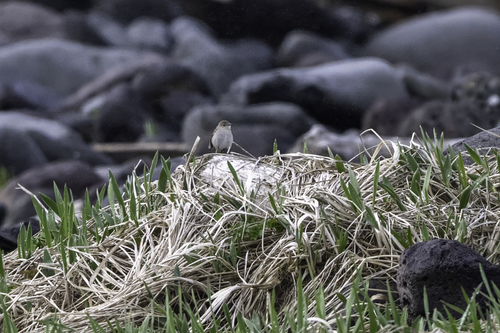 Taiga Flycatcher
In short
The most reliable field mark between Rusty-tailed Flycatcher and Taiga Flycatcher is the tail and uppertail pattern, especially in females and non-breeding birds. Taiga Flycatcher shows a distinctly blackish tail with contrasting white edges, while Rusty-tailed Flycatcher has a more uniformly rusty or rufous tail without strong white contrasts. Males in breeding plumage are separable by throat color: Taiga Flycatcher males show a clear orange-red throat patch, which Rusty-tailed lacks. Both are small, brownish flycatchers with similar structure, so careful attention to tail color, wing pattern, and (for males) throat color is essential, especially outside the breeding season when both can appear drab. Immature and female birds are the most frequent source of confusion.
Identification tips
- Tail pattern is the most reliable field mark in all seasons and ages: Taiga Flycatcher shows a blackish tail with crisp white outer edges, particularly obvious when the tail is spread or flicked; Rusty-tailed Flycatcher has a more uniform rusty or rufous tail with little or no white.
- Breeding male Taiga Flycatcher has a bright orange-red throat patch (sometimes called 'red-throated flycatcher'), which is absent in Rusty-tailed Flycatcher. Rusty-tailed males are plain-throated.
- Female and non-breeding Taiga Flycatcher: Look for brown upperparts, buffish breast, white underparts, and the key black-and-white tail. Rusty-tailed females are overall warmer brown with a rusty tail, lacking the black-and-white contrast.
- Both sexes of Rusty-tailed Flycatcher are similar: There is little sexual dimorphism; both are plain brown with a rusty tail.
- No distinctive upperwing or flight pattern marks are documented for either species, so do not rely on wing bars or panels.
- Structure and size are not reliable: Both are small, compact flycatchers with similar proportions.
- Ear covert and neck color in males: Breeding male Taiga Flycatcher shows blue-tinged grey on ear coverts and neck sides; Rusty-tailed lacks this.
- Underpart color is subtle: Taiga Flycatcher has a buffish breast and white belly; Rusty-tailed is plainer below, but this is variable and not always reliable.
- Habitat overlap: In winter, both can occur in similar habitats in South Asia, so do not use habitat as a primary separator.
- Behavior: Both perch upright and sally for insects; tail flicking in Taiga may help reveal the white tail edges.
- Voice is not described in the provided sources, so do not rely on calls or song for separation.
- Range: Outside the Indian subcontinent, Rusty-tailed is rare; in Central Asia, Rusty-tailed is more likely, but Taiga is widespread in migration and winter.
- Molecular/genus differences are not field-diagnostic.
- When in doubt, focus on the tail pattern and, for males, throat color.
- Juvenile and immature birds: No unique upperwing or flight marks are described for either species; tail pattern remains the best clue.
Size
Both species are small flycatchers of similar size and proportions. Rusty-tailed Flycatcher averages about 13.3 g in mass and is around 14 cm in length [wikidata][wikipedia]. No direct mass is available for Taiga Flycatcher, but field experience and references suggest it is very close in size. Structural differences are minimal and not reliably diagnostic in the field.
Plumage
Juvenile and female Taiga Flycatchers are best separated from Rusty-tailed Flycatchers by the tail: Taiga Flycatcher has a blackish tail with prominent white outer edges (especially visible when fanned or flicked), while Rusty-tailed Flycatcher shows a more uniform rusty or rufous tail with little or no white contrast. In males, breeding Taiga Flycatcher is distinctive with a bright orange-red throat patch and blue-tinged grey on the ear coverts and neck sides; Rusty-tailed males lack these features and are plainer. Both sexes of Rusty-tailed Flycatcher are similar, with no strong sexual dimorphism in plumage. Taiga Flycatcher females and non-breeding males have brown upperparts and a buffish breast with mostly white underparts, but the tail pattern remains the key difference. Rusty-tailed Flycatcher is overall warm brown above with a rusty tail, lacking the sharp tail contrast of Taiga. No distinctive upperwing pattern or age-specific wing marks are documented for either species.
Behaviour
Both species behave like typical Ficedula flycatchers, perching upright and sallying for insects. No strong behavioral differences are noted in the sources. Both may flick their tails, which can help reveal the tail pattern in Taiga Flycatcher. Flight style and jizz are similar and not reliably separable.
Habitat
Rusty-tailed Flycatcher is found mainly in the northern Indian subcontinent, parts of southwest India, and Central Asia, often in open forests and wooded areas. Taiga Flycatcher breeds in northern Eurasian taiga forests and winters widely across South and Southeast Asia, including India. In winter, both can occur in overlapping habitats such as gardens, parks, and wooded edges, so habitat alone is not a safe separator where ranges overlap.
Rusty-tailed Flycatcher · Taiga Flycatcher · My Tricky Birds