

Sanderling vs Dunlin
Calidris alba versus Calidris alpina
Play a quiz with Sanderling and Dunlin
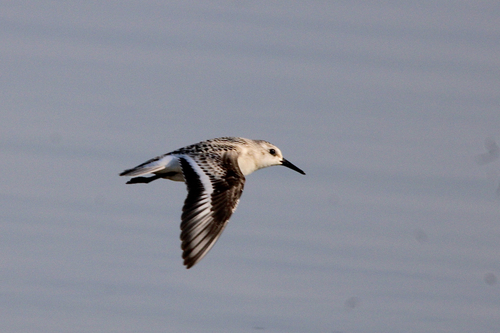 Sanderling
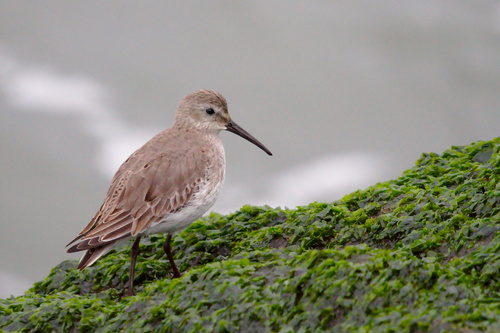 Dunlin
In short
The most reliable field mark between Sanderling and Dunlin is the presence of a strong white wingbar in flight on Sanderling of all ages, compared to the Dunlin's narrower wingbar. Sanderling also lacks a hind toe, has a shorter, straight black bill, and black legs, while Dunlin shows a slightly decurved black bill and black legs. In breeding plumage, Dunlin is unique among small waders for its bold black belly patch, which Sanderling never shows. In nonbreeding and juvenile plumages, Sanderling is paler and cleaner below, while Dunlin tends to show more streaking or smudging on the flanks or belly. Both species are gregarious in winter, but Sanderling prefers sandy beaches, whereas Dunlin is more typical of mudflats.
Identification tips
- White wingbar in flight: Sanderling of all ages shows a strong, broad white wingbar, much more prominent than the Dunlin's narrow wingbar. This is best seen when birds flush or fly past.
- Bill shape and length: Sanderling has a short, straight black bill; Dunlin's bill is longer and noticeably decurved, especially in females. This is reliable at close range but can be subtle at a distance.
- Leg color: Both species have black legs, so this is not useful for separation.
- Hind toe: Sanderling lacks a hind toe, while Dunlin has one. This is rarely visible except in photos or very close views, but can be diagnostic.
- Breeding plumage: Only Dunlin shows a bold black belly patch in breeding plumage (spring/summer). Sanderling never shows a black belly.
- Nonbreeding (winter) plumage: Sanderling is pale grey above and clean white below, with little or no streaking. Dunlin is greyer above and usually shows some dark marks or smudges on the flanks or belly.
- Juvenile plumage: Juvenile Dunlin have brown upperparts with two faint whitish 'V's on the back and often some blackish marks on the belly. Juvenile Sanderling is paler and lacks these marks.
- Feeding behavior: Sanderling runs rapidly along the beach, often following the waves; Dunlin feeds with a steadier, probing action, more often on mudflats.
- Habitat: Sanderling is strongly associated with sandy beaches; Dunlin is more typical of mudflats and estuaries but can occur on sand.
- Structure: Sanderling appears chunkier and stouter, with a thicker neck and body; Dunlin is longer and slimmer, with a longer bill.
- Flock composition: Large, tight flocks on open sand are more likely to be Sanderling; mixed flocks on mudflats often contain more Dunlin.
- Voice: Dunlin's 'chreep' call is distinctive, but voice is not the best separator in most field situations.
- Pitfalls: In poor light or at a distance, both can appear similar in size and general shape; focus on the wingbar in flight and bill shape at rest.
- Sex and age variation: Female Dunlin have longer bills than males, which can overlap with Sanderling, but the decurved shape remains a good clue. Juvenile and winter birds are most often confused; use wingbar and underpart markings for these ages.
- When in doubt: If the bird is on a sandy beach, very pale, and shows a strong white wingbar in flight, it is almost certainly a Sanderling. If it has a black belly patch (in breeding season) or is feeding with a steady probing action on a mudflat, it is likely a Dunlin.
Size
Both species are similar in size, but Sanderling is slightly smaller and stouter. Sanderling is about the same size as a Dunlin, but appears chunkier with a thicker neck and body. Dunlin is a bit longer (16–20 cm length, 38–43 cm wingspan, 34–77 g weight) and has a slightly longer wingspan than Sanderling, but the difference is subtle and not always reliable in the field. Structure and proportions are more useful than absolute size.
Plumage
- Juvenile and nonbreeding (winter) plumage: Sanderling is very pale overall, with clean white underparts and pale grey upperparts, and shows a strong white wingbar in flight. Dunlin in winter is greyer above and white below, but usually shows some dark marks on the flanks or belly. Juvenile Dunlin have brown upperparts with two faint whitish 'V's on the back, and often some blackish marks on the belly; Sanderling juveniles are much paler and lack these marks.
- Breeding plumage: Dunlin is unmistakable with a bold black belly patch and more rufous tones above; Sanderling is more mottled and lacks any black belly.
- Flight: Sanderling's white wingbar is broader and more striking than Dunlin's narrow wingbar. Both species show white in the wing, but Sanderling's is more obvious. Sanderling also lacks a hind toe, which can be seen in good photos or close views of the feet.
- Bill and legs: Sanderling has a short, straight black bill and black legs; Dunlin's bill is longer, slightly decurved, and also black, with black legs.
Behaviour
Sanderling is famous for its 'bicycling' running action along sandy beaches, often chasing the waves back and forth and stopping abruptly to pick food. Dunlin feeds with a more methodical 'sewing machine' action, probing steadily in mud or sand. Both are highly gregarious in winter and can form large flocks, but Sanderling flocks are more likely to be seen on open sandy beaches, while Dunlin prefers mudflats and estuaries.
Habitat
Sanderling is most often found on sandy beaches, especially in winter and migration, and is less common on mudflats or rocky shores. Dunlin is more typical of coastal mudflats, estuaries, and sometimes sandy beaches, but is less strictly tied to sand than Sanderling. Both species can overlap in habitat, but Sanderling is rarely seen away from open sand, while Dunlin is more flexible.
Voice
Dunlin gives a typical sandpiper 'chreep' call and a harsh trill in display. Sanderling's calls are less distinctive and not emphasized in the sources. Voice is not a primary field mark for separating these two in most situations.