
Semicollared Flycatcher vs Collared Flycatcher
Ficedula semitorquata versus Ficedula albicollis
Play a quiz with Semicollared Flycatcher and Collared Flycatcher
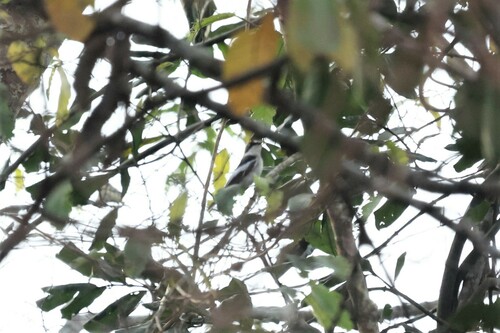 Semicollared Flycatcher
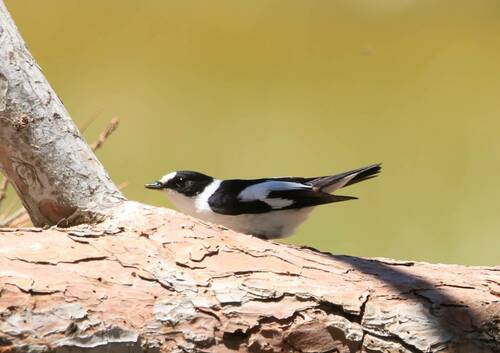 Collared Flycatcher
In short
The most reliable field mark to separate Semicollared from Collared Flycatcher is the presence of a distinct white bar on the median coverts, visible in most plumages of Semicollared but typically absent in Collared. This mark is especially helpful on non-breeding and immature birds, which are otherwise extremely similar. Adult breeding males can be separated by the extent of the white collar and the presence of a pale grey rump in Semicollared, but beware overlap and individual variation. Both species are small, black-and-white Ficedula flycatchers with similar size and structure, so careful attention to wing and collar pattern is essential, especially outside the breeding season.
Identification tips
- White median covert bar: Look for a clear white bar on the median coverts in non-breeding, female, and immature plumages—this is typical of Semicollared and rare in Collared. It is the best mark on dull birds, but first-winter Collared can occasionally show a faint bar, so use with caution.
- Tertial edges: Semicollared often has narrower white edges to the tertials than Collared in non-breeding and immature plumages. This is subtle and best used in combination with other marks.
- Extent of white collar: In adult breeding males, Collared shows a full white collar that wraps around the neck, while Semicollared has a half-collar that does not fully encircle. However, collar extent can be variable, so check other marks.
- Rump color: Semicollared breeding males often have a pale grey rump, while Collared's rump is pale but not distinctly grey. This is a supporting mark, not always visible.
- White on tail sides: Semicollared usually has more extensive white on the tail sides than Collared, but some Collared males can show white, so this is not fully diagnostic.
- White wing patch: Both species have a large white wing patch; this is not useful for separation.
- Forehead patch: Both have a large white forehead patch; do not use this feature to separate them.
- Bill and structure: Both have a broad, pointed bill typical of aerial insectivores; structure is not a reliable separator.
- Feeding behavior: Semicollared feeds almost exclusively on aerial insects, while Collared also takes caterpillars among foliage. This is subtle and not a practical field mark.
- Habitat context: If in a strictly montane, southeastern Balkan or northwest Iranian deciduous forest, Semicollared is more likely; in more widespread lowland or parkland habitats, Collared is more likely. Overlap occurs, so use with caution.
- Hybridization: These species can hybridize where ranges overlap, so odd or intermediate birds may occur—prioritize multiple field marks.
- Song: Both have slow, strained whistles, but differences are too subtle for reliable field separation.
- Seasonal variation: Spectral traits in Collared males decline over the breeding season, so plumage may appear duller later—be cautious when judging brightness or contrast.
- Vagrancy: Both are rare vagrants in western Europe; do not rely on range alone for identification.
- Pitfalls: Female and immature plumages are extremely similar; always check for the median covert bar and use a suite of marks rather than relying on a single feature.
Size
Both Semicollared and Collared Flycatchers are very similar in size, with adults of both species measuring 12–13.5 cm in length [wikipedia]. There are no consistent differences in overall size, bill shape, or proportions that are useful in the field to separate these two species.
Plumage
- Juvenile, first-winter, and female-type plumages: Both species are notoriously difficult to separate at these ages, as the black is replaced by pale brown and most markings are subdued. However, Semicollared Flycatcher often shows a white bar on the median coverts (sometimes present in Collared, but much less typical), and narrower white edges to the tertials. Collared Flycatcher rarely shows a median covert bar in these plumages. Both can show a large white wing patch, but this is not diagnostic.
- Adult breeding males: Both are black above and white below, with a large white forehead patch and a prominent white wing patch. Semicollared Flycatcher has a half-collar (white extending further back than in Pied, but not fully encircling as in Collared), a pale grey rump (Collared is paler but not grey), and extensively white tail sides (Collared usually has a black tail, though some males show white sides). Collared Flycatcher has a full white collar that wraps around the neck, and the rump is pale but not distinctly grey. The white median covert bar is absent in Collared breeding males.
- In all plumages: Both have a large white forehead patch and a broad white wing patch, so these are not useful for separation. The white on the tail sides is more extensive in Semicollared, but can be variable.
Behaviour
Both species are typical Ficedula flycatchers, sallying from perches to catch insects in flight. Semicollared Flycatcher is noted for feeding almost exclusively on aerial insects, rarely hunting caterpillars among foliage (unlike Collared, which does both). Both use tree holes or nest boxes for nesting. Behavioral differences are subtle and not reliable for field identification.
Habitat
Semicollared Flycatcher breeds in montane deciduous forests, especially oak and hornbeam, mainly in the southeastern Balkans to northwest Iran. Collared Flycatcher prefers deciduous woodlands, parks, and gardens with old trees and is more widespread in southeast Europe, including isolated Baltic populations. Both are rare vagrants in western Europe. Habitat overlap is significant in the Balkans, so habitat alone is not diagnostic, but Semicollared is more strictly montane and eastern.
Voice
Both species have songs described as slow, strained whistles, intermediate between Pied and each other. The songs are similar and not reliably separable in the field. Collared's song is said to be quite unlike Pied, but the difference between Collared and Semicollared is subtle and not a practical field mark.
Semicollared Flycatcher · Collared Flycatcher · My Tricky Birds