
Short-toed Eagle vs Golden Eagle
Circaetus gallicus versus Aquila chrysaetos
Play a quiz with Short-toed Eagle and Golden Eagle
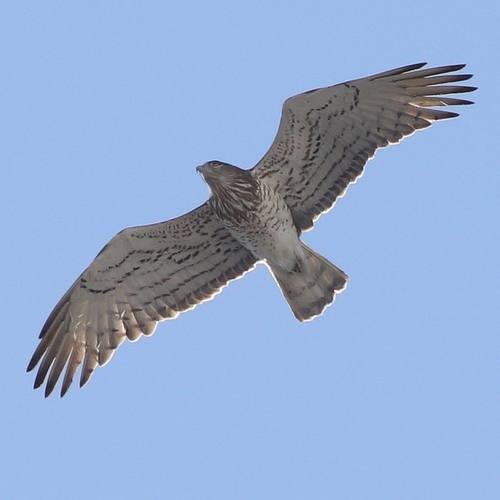 Short-toed Eagle
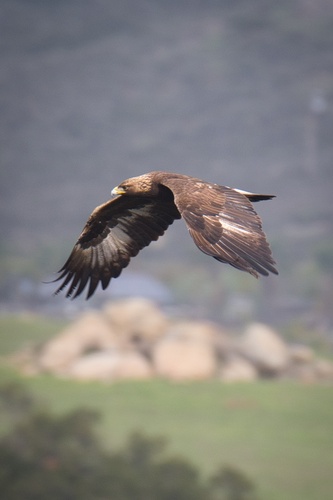 Golden Eagle
In short
The most reliable way to separate Short-toed Eagle from Golden Eagle is by overall structure and underwing pattern in flight, especially in immatures. Short-toed Eagle shows a predominantly white underside with lightly barred underwings and a rounded, owl-like head, while Golden Eagle is much larger, darker below, and juveniles show bold white patches on the wings and tail. Size is a major clue: Golden Eagle is more than twice as heavy, with a much broader wingspan and bulkier build. In perched or distant flight views, focus on the Short-toed Eagle's pale underparts and small head versus the Golden Eagle's long tail, golden nape, and massive proportions.
Identification tips
- Size is a major clue: Golden Eagle is more than twice as heavy as Short-toed Eagle and has a much larger wingspan. If you see a truly massive eagle, especially in Eurasia, it's almost certainly a Golden Eagle.
- Juvenile/immature Golden Eagle in flight: Look for bold white patches at the base of the primaries (on the upperwing) and a large white base to the tail with a dark terminal band. Short-toed Eagle never shows these marks at any age.
- Short-toed Eagle underwing: All ages show a predominantly white underside with lightly barred underwings and a few (3–4) tail bars. The underwing is pale and relatively unmarked compared to Golden Eagle.
- Adult Golden Eagle plumage: Uniformly dark brown below with a golden or rufous nape. No pale underparts or barred underwings as in Short-toed Eagle.
- Head shape: Short-toed Eagle has a rounded, owl-like head with bright yellow eyes, giving it a small-headed look. Golden Eagle's head is larger, longer, and more angular, with a powerful bill and a golden nape.
- Tail shape and length: Golden Eagle's tail is long and often appears two to three times the length of the head in flight. Short-toed Eagle's tail is shorter and shows distinct barring.
- Flight style: Short-toed Eagle soars on flat wings and frequently hovers, especially when hunting. Golden Eagle soars with a slight dihedral and rarely hovers, using deep, powerful wingbeats.
- Perched posture: Short-toed Eagle appears upright, slim, and pale below, while Golden Eagle is bulkier, darker, and longer-tailed.
- Habitat: If in open, cultivated, or semi-desert areas with scattered trees, Short-toed Eagle is more likely. In remote mountains or uplands, Golden Eagle is favored.
- Voice: Not useful for separation; both are generally silent.
- Pitfalls with distant birds: Large size alone can be misleading—use plumage and structure together. Juvenile Golden Eagle's white patches are diagnostic, but beware of lighting and molt effects.
- Seasonal context: Short-toed Eagle is migratory in Europe (absent in winter), while Golden Eagle is resident year-round in most of its range.
- Bill size: Golden Eagle has a much larger, more powerful bill than Short-toed Eagle, visible at close range.
- Eye color: Short-toed Eagle has striking yellow eyes, especially visible in good light; Golden Eagle's eyes are darker.
- Overall jizz: Short-toed Eagle looks like a pale, long-winged, small-headed raptor; Golden Eagle is a huge, dark, long-tailed, heavy-headed eagle with a golden nape.
Size
Golden Eagle is dramatically larger than Short-toed Eagle. Golden Eagle averages about 4383 g in body mass [wikidata], while Short-toed Eagle averages around 1700 g [wikipedia]. In the field, Golden Eagle's wingspan and bulk dwarf not only Short-toed Eagle but almost all other raptors. Even a large Short-toed Eagle will look slim and mid-sized next to a Golden Eagle. When perched, Golden Eagle's heavy body, large bill, and long tail are obvious, while Short-toed Eagle appears much lighter and more slender, with a smaller head and less massive bill.
Plumage
Juvenile and immature Golden Eagles are best recognized in flight by their striking white patches at the base of the primaries (forming a bold white 'flash' on the upperwing) and a large white base to the tail, often with a dark terminal band. These marks are absent in Short-toed Eagle of any age. Instead, Short-toed Eagle of all ages shows a mostly white underside with lightly barred underwings and a few tail bars (3–4), and a pale brown chin/throat/upper breast. Adult Golden Eagles are uniformly dark brown with a golden or rufous nape, lacking the white underparts of Short-toed Eagle. In perched birds, Short-toed Eagle's pale underparts and rounded, owl-like head contrast with Golden Eagle's darker, bulkier look and longer tail. The underwing pattern is the most reliable mark in flight: Short-toed Eagle is pale and lightly barred, Golden Eagle (especially juveniles) is dark with bold white wing and tail patches.
Behaviour
Short-toed Eagle spends much time soaring on flat wings, often over hills and open country, and frequently hovers like a kestrel when hunting. Its flight is buoyant and less forceful compared to the powerful, steady, and sometimes dihedral (V-shaped) soaring of Golden Eagle. Golden Eagles rarely hover and are more likely to be seen gliding with deep, powerful wingbeats or soaring with wings held in a slight dihedral. Perched, Short-toed Eagle often looks upright and slim, while Golden Eagle appears massive and imposing.
Habitat
Short-toed Eagle prefers open cultivated plains, arid scrub, foothills, and semi-desert, always requiring trees for nesting but hunting over open ground. Golden Eagle is more versatile but typically favors mountainous, hilly, or open upland terrain, often in remote or rugged areas. Both may overlap in some Mediterranean or Eurasian regions, but Short-toed Eagle is more associated with lower, warmer, and more open habitats, while Golden Eagle is more often found in higher, wilder, and less cultivated areas.
Voice
Both species are generally silent. Short-toed Eagle is described as very quiet, with only occasional musical whistling notes, especially near the nest. Golden Eagle is also mostly silent and does not offer reliable vocal field marks for separation.