
Smew vs Goosander
Mergellus albellus versus Mergus merganser
Play a quiz with Smew and Goosander
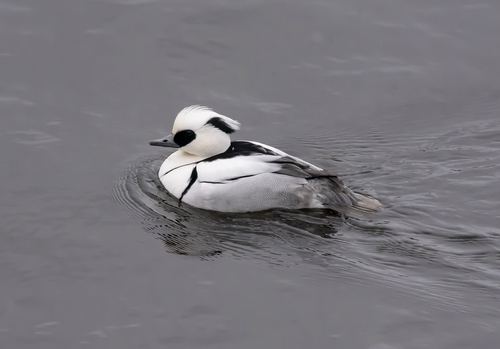 Smew
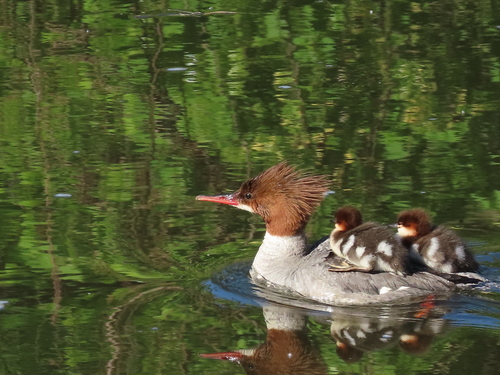 Goosander
In short
The most reliable way to separate Smew from Goosander is by size and overall structure: Goosander is much larger and bulkier, with a longer body and bill. In flight, Smew (especially females and immatures) shows neat oval white wing-patches, while Goosander has a more extensive white inner wing and a contrasting black outer wing. Adult male Smew is strikingly black-and-white ('panda' or 'cracked ice'), while Goosander males are white with a green-black head and often a salmon-pink tinge. Females and immature Smew are small, neat, and grey with a chestnut cap, while female Goosander is much larger, with a shaggy reddish-brown head and a longer, heavier bill. Both species may be seen together on lakes or rivers in winter, but their size and plumage differences are usually clear with good views.
Identification tips
- Size is the first check: Goosander is much larger and bulkier than Smew. If you see both together, the difference is obvious. If alone, compare to other ducks nearby.
- Bill shape and length: Goosander has a long, heavy, red to brownish-red bill; Smew's bill is much shorter and neater, though both are 'sawbills.'
- Adult male plumage: Smew drake is pure white with crisp black lines and a black mask, giving a 'panda' or 'cracked ice' look. Goosander drake is white with a green-black head and often a salmon-pink tinge, with a grey rump and tail.
- Female/immature head pattern: Female/immature Smew has a neat chestnut cap, white cheeks and chin, and black lores, appearing small and tidy. Female Goosander has a shaggy, reddish-brown head with a clear demarcation at the neck and a white chin, looking larger and rougher.
- Juvenile Goosander face stripe: Juvenile Goosander shows a short black-edged white stripe between eye and bill, absent in Smew.
- Wing pattern in flight: Smew (all ages) shows a neat oval white wing-patch; Goosander (all ages) shows a broad white panel on the inner wing with black outer primaries, more extensive than Smew's patch.
- Body shape: Smew is compact and short-necked; Goosander is long-bodied and long-necked, with a more horizontal posture on water.
- Crest: Both have crests, but Smew's is short and neat (especially in females/immatures), while Goosander's is longer and shaggier, especially in females.
- Behavior: Smew is shy, often close to cover and flushes easily; Goosander is less wary, often in the open, sometimes fishing in groups.
- Habitat context: Smew prefers smaller, quieter waters with overhanging trees; Goosander is more likely on large, open lakes and rivers.
- Leg color: Goosander's legs are red to brownish-red, brightest in adult males, duller in juveniles; Smew's leg color is not a strong field mark.
- Vocalization: Not usually helpful, but Goosander may give a low croak or soft whistle; Smew is mostly silent.
- Eclipse plumage: Male Smew in eclipse resembles female but retains more white in the wing; male Goosander in eclipse looks like female but is still much larger and heavier-billed.
- Mixed flocks: If you see a small, neat, grey-and-chestnut duck among a group of large, white-bodied ducks with green-black heads, it's likely a Smew among Goosander.
- When in doubt: Focus on size, bill length, and the shape of the white wing patch in flight—these are the most reliable field marks for all ages and sexes.
Size
Goosander is more than twice as heavy as Smew (average adult mass: Goosander 1470.5 g, Smew 610 g) and is also much longer (Goosander 58–72 cm vs. Smew 38–44 cm). The wingspan of Goosander (78–97 cm) is substantially greater than Smew (56–69 cm). Even at a distance, Goosander appears long-bodied and heavy-billed, while Smew is compact and dainty. When seen together, the size gap is obvious.
Plumage
- Juveniles and Females in Flight: Smew (female/immature) shows a neat, oval white wing-patch on otherwise grey wings; Goosander (female/juvenile) shows a broad white panel on the inner wing (secondaries) with black outer primaries, and a more extensive white area overall.
- Adult Males: Smew male is unmistakable: pure white with crisp black lines and a black mask, looking 'cracked ice' or 'panda-like.' Goosander male is white-bodied with a glossy green-black head and a variable salmon-pink wash; the back and tail are grey, and the wing pattern is a large white inner wing with black outer primaries.
- Females/Eclipse Males: Smew females/immatures are small, neat, and grey with a chestnut forehead and crown, white cheeks and chin, and black lores. Goosander females/eclipses are much larger, mostly grey-bodied, with a shaggy reddish-brown head, white chin, and a clear demarcation between head and neck. Juvenile Goosander has a short black-edged white stripe between eye and bill, which Smew lacks.
- Bill: Both have saw-edged bills, but Goosander's is much longer and heavier, accentuating the size difference.
Behaviour
Goosander is often seen fishing in groups, sometimes herding fish into shallow water. They may rest on rocks or ice, sometimes with wings half-open, and move clumsily on land. Smew is shyer, often keeping to the edges of lakes or under overhanging trees, and flushes easily when disturbed. Both dive for fish, but Smew is more likely to be seen alone or in small groups, and rarely sits out in the open for long.
Habitat
Both species breed in forested areas near lakes and rivers and nest in tree holes. In winter, both may be found on large lakes, slow rivers, or sheltered coastal waters. Smew tends to prefer smaller, quieter waters and often stays close to cover, while Goosander is more at home on larger, open rivers and lakes, and is more likely to be seen out in the open or on exposed rocks.
Voice
Vocalizations are not usually diagnostic in the field. Goosander gives a low, harsh croak and, in breeding season, males and juveniles may give a soft whistle. Smew is generally quiet and shy, rarely vocalizing in the field.