
Motmot

Steppe Eagle vs Golden Eagle

Aquila nipalensis versus Aquila chrysaetos

Play a quiz with Steppe Eagle and Golden Eagle
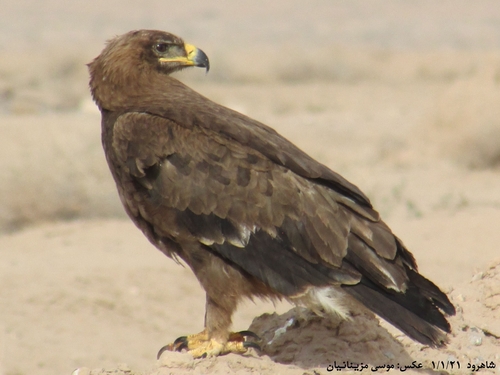
Steppe Eagle (Aquila nipalensis) Steppe Eagle
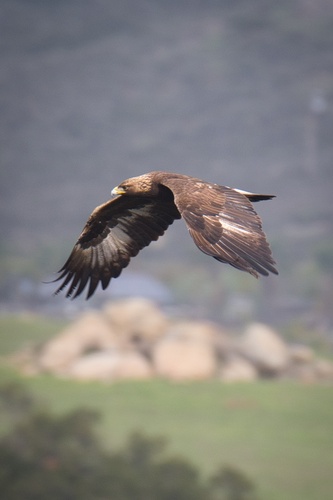
Golden Eagle (Aquila chrysaetos) Golden Eagle

Media

Loading…

In short

Juvenile Steppe Eagles show broad white tips to the greater coverts, wings, and tail, plus a narrow cream band on the median coverts—these pale panels are absent in Golden Eagle of any age. Golden Eagle juveniles instead have large, well-defined white patches at the base of the primaries and tail, but not as broad or uniform as Steppe Eagle's white tips. Structurally, Steppe Eagle is more robust with a thick neck, smaller head, and a very long gape-line, while Golden Eagle is even larger, longer-tailed, and has a golden nape. Adults are best separated by the Steppe Eagle’s bulkier build, longer gape, and (in eastern birds) rufous nape patch, versus the Golden Eagle’s golden nape and longer tail. Both can appear dark at a distance, so focus on age-specific wing and tail patterns in flight.

Identification tips

  1. Juvenile Steppe Eagle: broad white tips to greater coverts, wings, and tail—look for these bold, regular pale edges in flight or when perched with wings spread; absent in Golden Eagle.
  2. Juvenile Golden Eagle: large white patches at base of primaries and tail—these are more patchy, less uniform, and do not form broad pale edges as in Steppe Eagle.
  3. Steppe Eagle’s long, thick neck and small head—gives a robust, almost bull-necked look, especially when perched; Golden Eagle’s head is proportionally larger and more elongated.
  4. Gape-line: Steppe Eagle’s gape-line extends to the rear of the eye, longer than in Golden Eagle; this is visible at close range and gives a fierce facial expression.
  5. Nape color: Adult Golden Eagle has a golden to rufous nape-shawl, often visible even at a distance; Steppe Eagle adults (especially eastern birds) may have a rufous nape patch, but it is typically less extensive and more orange-yellow.
  6. Tail shape and length: Golden Eagle has a longer tail relative to body and head, especially obvious in soaring flight; Steppe Eagle’s tail is longish but more rounded.
  7. Flight style: Golden Eagle soars with a pronounced dihedral (V-shape), while Steppe Eagle’s flight is more aquiline—powerful, deep, and with more rectangular or squarish wing tips.
  8. Perching behavior: Steppe Eagles are more likely to perch in the open or on the ground, sometimes for long periods; Golden Eagles usually perch in more secluded, elevated spots.
  9. Leg feathering: Both are booted eagles, but Steppe Eagle’s legs often look especially well-feathered, almost disheveled.
  10. Overall color: Both are dark brown, but Steppe Eagle tends to be more uniformly dark, while Golden Eagle adults show a golden nape; beware that both can look nearly black at a distance.
  11. Eye color: Adult Steppe Eagles have brown to hazel eyes, juveniles dark brown; Golden Eagle adults also have brown to hazel eyes, but this is rarely diagnostic in the field.
  12. Size: Golden Eagle is much heavier and larger overall, but size alone is unreliable unless both species are seen together.
  13. Habitat context: In open, flat steppe or grassland, Steppe Eagle is more likely; in mountainous or rugged uplands, Golden Eagle is more likely.
  14. Aging confusion: As Steppe Eagles age, their pale wing and tail tips wear away and may be lost by the third year; Golden Eagle juveniles lose their white patches as they mature, becoming more uniformly dark with a golden nape.
  15. When in doubt: Focus on the combination of age-specific wing/tail pattern, structure (neck, head, gape), and nape color—these are the most reliable field marks for separating these two large Aquila eagles.

Size

Golden Eagle is significantly heavier (average adult mass ~4383 g) than Steppe Eagle (~2723 g), making it one of the largest eagles globally. In the field, Golden Eagle appears longer-winged and longer-tailed, with a more imposing presence. Steppe Eagle is still large and bulky, but is noticeably less massive and slightly more compact, especially in the neck and head. Both are much larger than most other raptors, but Golden Eagle is the more powerful and longer bird overall.

Plumage

Juvenile Steppe Eagles (first and second years) have broad white tips to the greater coverts, wings, and tail, plus a narrow cream band on the brown median coverts—these pale markings are bold and regular, forming a crisp contrast against otherwise brown upperparts. The white uppertail coverts are usually hidden when perched. As Steppe Eagles age, these pale tips become worn and narrower, and by the third year, immatures look scruffy with a mix of old and new feathers, losing much of the pale. Adults are dark brown, sometimes with a rufous nape patch (especially eastern birds), and have a strong, long gape-line.

Golden Eagle juveniles lack the Steppe Eagle’s broad white tips, instead showing large white patches at the base of the primaries and tail—these are more patchy and less uniform than the Steppe Eagle’s pale panels. The rest of the plumage is dark brown, with a golden to rufous nape-shawl in adults (a key mark). Adults are solidly dark brown with a golden nape, lacking the Steppe Eagle’s rufous nape patch and long gape-line. Both species have yellow cere and feet at all ages, and eye color is brown to hazel in adults, darker in juveniles.

Behaviour

Steppe Eagles often perch upright and in the open, using isolated trees, posts, rocks, or even on the ground for long periods, sometimes walking with a horizontal posture and wingtips just exceeding the tail-tip. They can be relatively tame and approachable. Golden Eagles are more often seen soaring or gliding with a pronounced dihedral, rarely perching in the open for extended periods except in remote areas. Their flight is powerful and steady, with less tendency to walk on the ground than Steppe Eagles.

Habitat

Both species are large, open-country eagles, but Steppe Eagle is more associated with open steppes, grasslands, and semi-arid regions, often perching on low lookouts or on the ground. Golden Eagle occupies a broader range of habitats, including mountains, cliffs, and open uplands across the Northern Hemisphere. In overlapping areas, Steppe Eagle is more likely in flat, open terrain, while Golden Eagle prefers rugged, elevated landscapes.

Submit a better description

Use the same sections as the comparison. Your text is published immediately.

Juvenile Steppe Eagles show broad white tips to the greater coverts, wings, and tail, plus a narrow cream band on the median coverts—these pale panels are absent in Golden Eagle of any age. Golden Eagle juveniles instead have large, well-defined white patches at the base of the primaries and tail, but not as broad or uniform as Steppe Eagle's white tips. Structurally, Steppe Eagle is more robust with a thick neck, smaller head, and a very long gape-line, while Golden Eagle is even larger, longer-tailed, and has a golden nape. Adults are best separated by the Steppe Eagle’s bulkier build, longer gape, and (in eastern birds) rufous nape patch, versus the Golden Eagle’s golden nape and longer tail. Both can appear dark at a distance, so focus on age-specific wing and tail patterns in flight.

  1. Juvenile Steppe Eagle: broad white tips to greater coverts, wings, and tail—look for these bold, regular pale edges in flight or when perched with wings spread; absent in Golden Eagle.
  2. Juvenile Golden Eagle: large white patches at base of primaries and tail—these are more patchy, less uniform, and do not form broad pale edges as in Steppe Eagle.
  3. Steppe Eagle’s long, thick neck and small head—gives a robust, almost bull-necked look, especially when perched; Golden Eagle’s head is proportionally larger and more elongated.
  4. Gape-line: Steppe Eagle’s gape-line extends to the rear of the eye, longer than in Golden Eagle; this is visible at close range and gives a fierce facial expression.
  5. Nape color: Adult Golden Eagle has a golden to rufous nape-shawl, often visible even at a distance; Steppe Eagle adults (especially eastern birds) may have a rufous nape patch, but it is typically less extensive and more orange-yellow.
  6. Tail shape and length: Golden Eagle has a longer tail relative to body and head, especially obvious in soaring flight; Steppe Eagle’s tail is longish but more rounded.
  7. Flight style: Golden Eagle soars with a pronounced dihedral (V-shape), while Steppe Eagle’s flight is more aquiline—powerful, deep, and with more rectangular or squarish wing tips.
  8. Perching behavior: Steppe Eagles are more likely to perch in the open or on the ground, sometimes for long periods; Golden Eagles usually perch in more secluded, elevated spots.
  9. Leg feathering: Both are booted eagles, but Steppe Eagle’s legs often look especially well-feathered, almost disheveled.
  10. Overall color: Both are dark brown, but Steppe Eagle tends to be more uniformly dark, while Golden Eagle adults show a golden nape; beware that both can look nearly black at a distance.
  11. Eye color: Adult Steppe Eagles have brown to hazel eyes, juveniles dark brown; Golden Eagle adults also have brown to hazel eyes, but this is rarely diagnostic in the field.
  12. Size: Golden Eagle is much heavier and larger overall, but size alone is unreliable unless both species are seen together.
  13. Habitat context: In open, flat steppe or grassland, Steppe Eagle is more likely; in mountainous or rugged uplands, Golden Eagle is more likely.
  14. Aging confusion: As Steppe Eagles age, their pale wing and tail tips wear away and may be lost by the third year; Golden Eagle juveniles lose their white patches as they mature, becoming more uniformly dark with a golden nape.
  15. When in doubt: Focus on the combination of age-specific wing/tail pattern, structure (neck, head, gape), and nape color—these are the most reliable field marks for separating these two large Aquila eagles.

Golden Eagle is significantly heavier (average adult mass ~4383 g) than Steppe Eagle (~2723 g), making it one of the largest eagles globally. In the field, Golden Eagle appears longer-winged and longer-tailed, with a more imposing presence. Steppe Eagle is still large and bulky, but is noticeably less massive and slightly more compact, especially in the neck and head. Both are much larger than most other raptors, but Golden Eagle is the more powerful and longer bird overall.

Juvenile Steppe Eagles (first and second years) have broad white tips to the greater coverts, wings, and tail, plus a narrow cream band on the brown median coverts—these pale markings are bold and regular, forming a crisp contrast against otherwise brown upperparts. The white uppertail coverts are usually hidden when perched. As Steppe Eagles age, these pale tips become worn and narrower, and by the third year, immatures look scruffy with a mix of old and new feathers, losing much of the pale. Adults are dark brown, sometimes with a rufous nape patch (especially eastern birds), and have a strong, long gape-line.

Golden Eagle juveniles lack the Steppe Eagle’s broad white tips, instead showing large white patches at the base of the primaries and tail—these are more patchy and less uniform than the Steppe Eagle’s pale panels. The rest of the plumage is dark brown, with a golden to rufous nape-shawl in adults (a key mark). Adults are solidly dark brown with a golden nape, lacking the Steppe Eagle’s rufous nape patch and long gape-line. Both species have yellow cere and feet at all ages, and eye color is brown to hazel in adults, darker in juveniles.

Steppe Eagles often perch upright and in the open, using isolated trees, posts, rocks, or even on the ground for long periods, sometimes walking with a horizontal posture and wingtips just exceeding the tail-tip. They can be relatively tame and approachable. Golden Eagles are more often seen soaring or gliding with a pronounced dihedral, rarely perching in the open for extended periods except in remote areas. Their flight is powerful and steady, with less tendency to walk on the ground than Steppe Eagles.

Both species are large, open-country eagles, but Steppe Eagle is more associated with open steppes, grasslands, and semi-arid regions, often perching on low lookouts or on the ground. Golden Eagle occupies a broader range of habitats, including mountains, cliffs, and open uplands across the Northern Hemisphere. In overlapping areas, Steppe Eagle is more likely in flat, open terrain, while Golden Eagle prefers rugged, elevated landscapes.

Discard your changes?

You have unsaved edits. If you leave now, those changes will be lost.

Steppe Eagle · Golden Eagle · My Tricky Birds