
Twite vs Lesser Redpoll
Linaria flavirostris versus Acanthis cabaret
Play a quiz with Twite and Lesser Redpoll
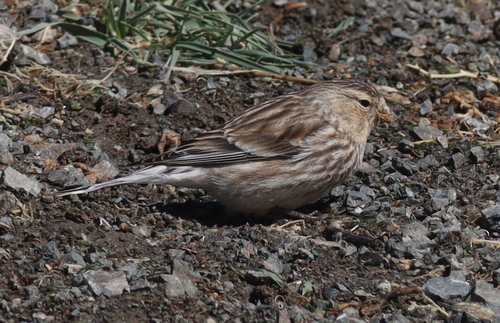 Twite
 Lesser Redpoll
In short
The most reliable field mark for separating Twite from Lesser Redpoll is the presence of a bright red forehead patch and black bib on the redpoll, which the Twite completely lacks. Twite is a streaky brown finch with a yellow bill (in winter) and, for adult males, a pink rump, while Lesser Redpolls show a red crown, black chin, and (in males) a pinkish breast. Immature and female Twite have a brown rump, while redpolls always show a streaked rump. Both species are small, streaky finches, but careful attention to head and rump coloration, bill color, and flocking context will help you avoid confusion, especially in mixed winter flocks.
Identification tips
- Red Forehead Patch: Only Lesser Redpoll shows a bright red patch on the forehead (all ages, but brightest in males). Twite never shows any red on the head.
- Black Bib: Lesser Redpoll always has a small black bib under the bill; Twite never does.
- Rump Color: Twite adult males have a pink rump (best seen in flight or when preening), while females and immatures have a plain brown rump. Lesser Redpolls always have a streaked rump, never plain or pink.
- Breast Color: Male Lesser Redpolls often have a pinkish flush on the breast; Twite never shows any pink or red on the breast.
- Bill Color: Twite's bill is yellow in winter, turning grey in summer. Lesser Redpoll's bill is yellowish with a dark tip year-round, but is generally less bright than Twite's winter bill.
- Wingbars: Lesser Redpoll shows two pale wingbars; Twite's wingbars are less distinct and can be hard to see.
- Underparts: Twite has buff to whitish underparts with brown streaks; Lesser Redpoll is brownish-grey with dark streaks and (in males) a pinkish wash.
- Head Pattern: Twite's head is plain and streaky brown with no red or black; Lesser Redpoll has a contrasting red forehead and black bib.
- Size and Shape: Both are similar in size, but Twite may appear slightly longer-tailed and more 'linnet-like'; Lesser Redpoll is more compact and round-headed.
- Flocking Behavior: Both species can be found in mixed flocks in winter, but Twite are more likely on open coasts and saltmarshes, while redpolls are more common in birch and alder trees.
- Habitat: Twite prefer open, grassy or shrubby uplands and coastal areas; Lesser Redpolls are more often in woodland or feeding in trees.
- Voice: Listen for Twite's nasal 'twaa-it' call, which is very different from the metallic twitters of Lesser Redpoll.
- Flight Views: In flight, check rump color (pink or plain brown in Twite, streaked in Redpoll) and look for the red forehead of Redpolls.
- Seasonal Context: In winter, Twite's yellow bill is a good clue; in summer, bill color is less helpful, so rely more on head and rump pattern.
- Sex/Age Pitfalls: Female and immature Twite can be especially plain, lacking any red or black on the face, while even young Lesser Redpolls show at least a hint of red on the crown and a black bib.
Size
Twite and Lesser Redpoll are very close in size, with Twite measuring 13–13.5 cm in length and Lesser Redpoll 11.5–14 cm [wikipedia]. Both are small, slim finches, and size alone is not a reliable separator in the field. Weight and wingspan overlap considerably as well, so focus on plumage and structural differences instead.
Plumage
- Juvenile/Immature/Non-breeding birds: Twite immatures and females have a plain brown rump, while Lesser Redpolls (all ages) show a streaked rump. In flight, this rump contrast is often visible and is a key separation point, especially in autumn and winter flocks. Twite lacks any red on the head or breast at all ages, while Lesser Redpolls (even immatures) show at least a faint red forehead patch and a black bib.
- Adult males: Twite males have a pink rump (sometimes visible in flight or when perched), but never any red on the head or breast. Lesser Redpoll males have a bright red forehead, black bib, and a pinkish wash on the breast, with a streaked rump.
- Bill color: Twite has a yellow bill in winter, turning grey in summer; Lesser Redpoll has a yellowish bill with a dark tip year-round.
- Underparts: Twite shows buff to whitish underparts with brown streaks, while Lesser Redpoll is brownish-grey with dark streaks and often a pinkish flush on the breast (males).
- Wing pattern: Lesser Redpoll has two pale wingbars; Twite's wingbars are less distinct.
Behaviour
Both species are highly social outside the breeding season and often form large flocks, sometimes together. Twite are particularly noted for forming big winter flocks on coasts and saltmarshes, feeding mainly on seeds on the ground. Lesser Redpolls forage more in trees, especially birch and alder, but will also come to the ground. Both are agile and active, but Twite may appear slightly longer-tailed and more 'linnet-like' in flight, while redpolls can seem more compact and bouncy.
Habitat
Twite breed in open, grassy or shrubby uplands, coastal machair, and high-altitude grasslands, especially in northern and western Britain and across Asian mountains. In winter, they move to lowland coasts and saltmarshes. Lesser Redpolls are more closely associated with birch and alder woodland, especially in boreal and temperate zones, and are more likely to be found feeding in trees. In the UK, redpolls are more widespread in lowland woodland and parks, while Twite are more restricted to open country and coasts outside the breeding season.
Voice
Twite has a distinctive nasal 'twaa-it' call, which is quite different from the Lesser Redpoll's sharper, more metallic calls. Twite's song includes fast trills and twitters, but the call is usually the best clue in the field. Lesser Redpoll gives a variety of twittering and rattling calls, but always lacks the nasal quality of Twite.