
Motmot

Whiskered Tern vs Black Tern

Chlidonias hybrida versus Chlidonias niger

Play a quiz with Whiskered Tern and Black Tern
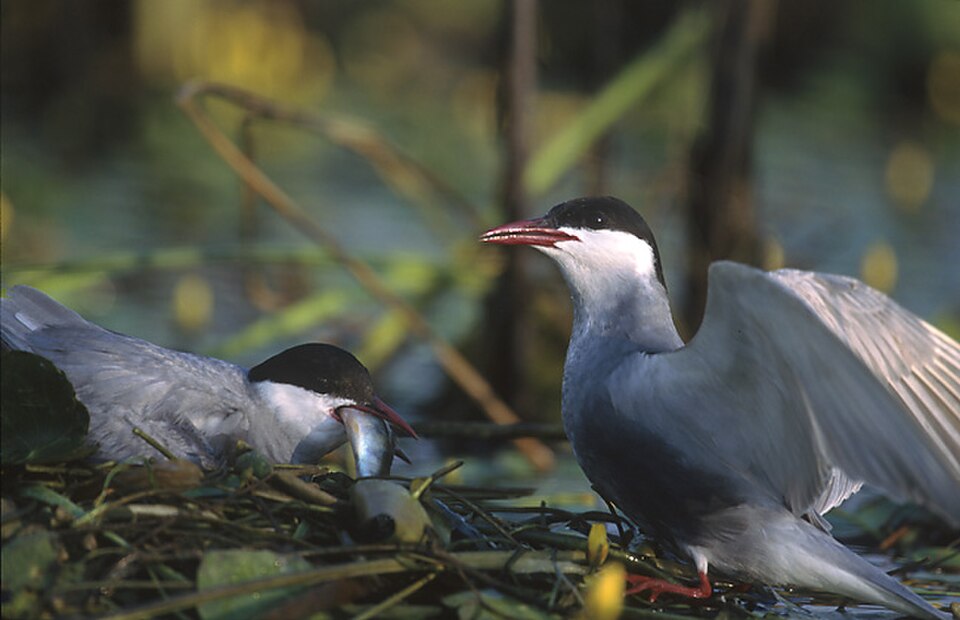
Whiskered Tern (Chlidonias hybrida) Whiskered Tern
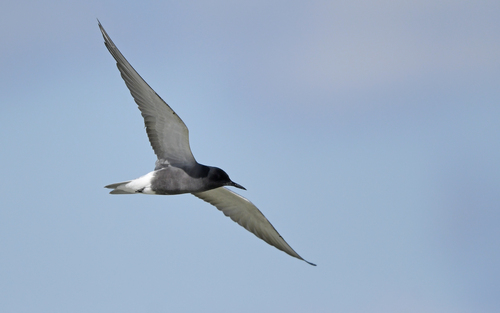
Black Tern (Chlidonias niger) Black Tern

Media

Loading…

In short

Juvenile and first-winter Whiskered and Black Terns are most reliably separated by upperpart and mantle coloration: juvenile Whiskered Terns show a ginger, scaly back with broad buff edgings, while Black Tern juveniles have a drabber, pale-edged upperpart with a distinct white collar and a dark triangular patch in front of the eye. In adults, Whiskered Terns have a strong, red bill and legs, and a dark grey body with white cheeks, while Black Terns show a slimmer, black bill and legs, and a black head and belly with a white face in breeding plumage. Whiskered Terns are larger and heavier, with a more robust build and a short, forked tail, compared to the Black Tern’s lighter, slimmer, and squarer-tailed appearance. Both species can be found in marshy habitats, but Black Tern is more erratic in flight and appears more delicate overall.

Identification tips

  1. Juvenile/first-winter upperparts: Juvenile Whiskered Tern shows a ginger, scaly back with broad buff edges and often subterminal bars; Black Tern juvenile is drabber, with pale feather-edgings and lacks the ginger tones. This is the most reliable field mark for immatures.
  2. White collar (juvenile Black Tern): Look for a broad white collar and a dark triangular patch in front of the eye on juvenile Black Tern; Whiskered Tern juveniles lack this combination.
  3. Adult bill and leg color: Whiskered Tern adults have a strong, red bill and legs (especially in breeding), while Black Tern’s bill and legs are black and more slender.
  4. Adult face pattern: In breeding, Whiskered Tern has white cheeks and a black cap, with the black forming a C-shaped band behind the ear-coverts; Black Tern has a black or blackish-brown cap that joins the ear-coverts, forming a near-complete hood, and a white face.
  5. Body color (breeding adult): Whiskered Tern is dark grey above and below, with white cheeks; Black Tern has a black head, neck, and belly, with a dark grey back and white forewing.
  6. Tail shape: Whiskered Tern has a short, forked-looking tail; Black Tern’s tail is squarer and less obviously forked.
  7. Flight style: Whiskered Tern flies with strong, positive wingbeats and appears robust; Black Tern is more buoyant and erratic, often foraging with quick, agile movements.
  8. Size and structure: Whiskered Tern is heavier and bulkier (84 g vs 60 g), with a longer, stouter bill; Black Tern is slimmer, lighter, and has a shorter, slender bill.
  9. Rump color: Whiskered Tern has a pale grey rump year-round; Black Tern’s rump is brownish-grey.
  10. Winter adult: Whiskered Tern’s forehead becomes white, and the body is paler grey; Black Tern loses most of the black except the cap, and upperparts are drab with pale edges.
  11. Mantle color (adult): Whiskered Tern adult mantle is silvery-grey; Black Tern’s is dark grey with pale feather-edgings in non-breeding.
  12. Perched jizz: Whiskered Tern stands more upright and looks heavier; Black Tern is more delicate and slender.
  13. Habitat context: Both use marshes, but Black Tern is more likely in North America and can be seen wintering on coasts; Whiskered Tern is more likely to be found breeding among Black-headed Gulls.
  14. Voice: Whiskered Tern gives a 'krekk' call, Black Tern a high 'kik'; calls are useful if heard clearly.
  15. Hybrid confusion: Both species can hybridize with White-winged Tern, so birds showing mixed features may be hybrids; focus on the combination of upperpart, face, and bill/leg color for best separation.

Size

Whiskered Tern is noticeably heavier (84 g vs 60 g) and generally more robust than Black Tern. The Whiskered Tern’s bill is longer and stouter (males up to 34 mm), while the Black Tern’s bill is shorter (27 mm), slender, and looks slightly decurved. In the field, Whiskered Tern appears bulkier with a more positive, strong flight, while Black Tern is slimmer and lighter, with a more buoyant, erratic flight style. Tail shape also differs: Whiskered Tern has a short, forked-looking tail, while Black Tern’s tail is squarer.

Plumage

Juvenile and first-winter birds are best separated by upperpart and mantle pattern: juvenile Whiskered Terns have dark brown back and scapulars with broad buff edges and often subterminal buff bars, giving a ginger, scaly look; Black Tern juveniles have drabber upperparts with pale feather-edgings, a broad white collar, and a dark triangular patch in front of the eye. Whiskered Tern juveniles may show patchy ginger on the back into first winter. Adult Whiskered Terns in summer have a black cap, white cheeks, red bill and legs, and dark grey above and below; in winter, the forehead becomes white and the body paler grey, with the crown flecked white. Black Tern adults in breeding plumage have a black head, neck, and belly, dark grey back, white forewing, and a white face; in non-breeding, most black is replaced by grey, the upperparts are drab with pale feather-edgings, and the rump is brownish-grey. The Black Tern’s cap forms an almost complete hood in breeding plumage, while Whiskered Tern’s black is more of a cap with a C-shaped band behind the ear-coverts.

Behaviour

Both species forage over marshes and open water, but Black Tern is more aerial and erratic, often picking insects from the air or water surface with quick, agile movements. Whiskered Tern’s flight is stronger and more direct, recalling Common or Arctic Tern, and it often appears more robust and less buoyant than Black Tern. Perched, Whiskered Tern stands more upright and looks heavier, while Black Tern is more delicate and slender.

Habitat

Both species breed in freshwater marshes, but Black Tern has a broader range, including North America, and migrates to coastal areas of Africa and South America in winter. Whiskered Tern is found in Europe, Asia, and Africa, with tropical forms being resident. Both species can be seen in mixed flocks, but Whiskered Tern is more likely to be found breeding among Black-headed Gulls, while Black Tern is more strictly associated with marshes and floating vegetation.

Voice

Whiskered Tern gives a characteristic 'krekk' call, while Black Tern’s call is a high-pitched 'kik', and large flocks can be very noisy. The calls are distinct, but not always easy to separate at a distance or in mixed flocks.

Submit a better description

Use the same sections as the comparison. Your text is published immediately.

Juvenile and first-winter Whiskered and Black Terns are most reliably separated by upperpart and mantle coloration: juvenile Whiskered Terns show a ginger, scaly back with broad buff edgings, while Black Tern juveniles have a drabber, pale-edged upperpart with a distinct white collar and a dark triangular patch in front of the eye. In adults, Whiskered Terns have a strong, red bill and legs, and a dark grey body with white cheeks, while Black Terns show a slimmer, black bill and legs, and a black head and belly with a white face in breeding plumage. Whiskered Terns are larger and heavier, with a more robust build and a short, forked tail, compared to the Black Tern’s lighter, slimmer, and squarer-tailed appearance. Both species can be found in marshy habitats, but Black Tern is more erratic in flight and appears more delicate overall.

  1. Juvenile/first-winter upperparts: Juvenile Whiskered Tern shows a ginger, scaly back with broad buff edges and often subterminal bars; Black Tern juvenile is drabber, with pale feather-edgings and lacks the ginger tones. This is the most reliable field mark for immatures.
  2. White collar (juvenile Black Tern): Look for a broad white collar and a dark triangular patch in front of the eye on juvenile Black Tern; Whiskered Tern juveniles lack this combination.
  3. Adult bill and leg color: Whiskered Tern adults have a strong, red bill and legs (especially in breeding), while Black Tern’s bill and legs are black and more slender.
  4. Adult face pattern: In breeding, Whiskered Tern has white cheeks and a black cap, with the black forming a C-shaped band behind the ear-coverts; Black Tern has a black or blackish-brown cap that joins the ear-coverts, forming a near-complete hood, and a white face.
  5. Body color (breeding adult): Whiskered Tern is dark grey above and below, with white cheeks; Black Tern has a black head, neck, and belly, with a dark grey back and white forewing.
  6. Tail shape: Whiskered Tern has a short, forked-looking tail; Black Tern’s tail is squarer and less obviously forked.
  7. Flight style: Whiskered Tern flies with strong, positive wingbeats and appears robust; Black Tern is more buoyant and erratic, often foraging with quick, agile movements.
  8. Size and structure: Whiskered Tern is heavier and bulkier (84 g vs 60 g), with a longer, stouter bill; Black Tern is slimmer, lighter, and has a shorter, slender bill.
  9. Rump color: Whiskered Tern has a pale grey rump year-round; Black Tern’s rump is brownish-grey.
  10. Winter adult: Whiskered Tern’s forehead becomes white, and the body is paler grey; Black Tern loses most of the black except the cap, and upperparts are drab with pale edges.
  11. Mantle color (adult): Whiskered Tern adult mantle is silvery-grey; Black Tern’s is dark grey with pale feather-edgings in non-breeding.
  12. Perched jizz: Whiskered Tern stands more upright and looks heavier; Black Tern is more delicate and slender.
  13. Habitat context: Both use marshes, but Black Tern is more likely in North America and can be seen wintering on coasts; Whiskered Tern is more likely to be found breeding among Black-headed Gulls.
  14. Voice: Whiskered Tern gives a 'krekk' call, Black Tern a high 'kik'; calls are useful if heard clearly.
  15. Hybrid confusion: Both species can hybridize with White-winged Tern, so birds showing mixed features may be hybrids; focus on the combination of upperpart, face, and bill/leg color for best separation.

Whiskered Tern is noticeably heavier (84 g vs 60 g) and generally more robust than Black Tern. The Whiskered Tern’s bill is longer and stouter (males up to 34 mm), while the Black Tern’s bill is shorter (27 mm), slender, and looks slightly decurved. In the field, Whiskered Tern appears bulkier with a more positive, strong flight, while Black Tern is slimmer and lighter, with a more buoyant, erratic flight style. Tail shape also differs: Whiskered Tern has a short, forked-looking tail, while Black Tern’s tail is squarer.

Juvenile and first-winter birds are best separated by upperpart and mantle pattern: juvenile Whiskered Terns have dark brown back and scapulars with broad buff edges and often subterminal buff bars, giving a ginger, scaly look; Black Tern juveniles have drabber upperparts with pale feather-edgings, a broad white collar, and a dark triangular patch in front of the eye. Whiskered Tern juveniles may show patchy ginger on the back into first winter. Adult Whiskered Terns in summer have a black cap, white cheeks, red bill and legs, and dark grey above and below; in winter, the forehead becomes white and the body paler grey, with the crown flecked white. Black Tern adults in breeding plumage have a black head, neck, and belly, dark grey back, white forewing, and a white face; in non-breeding, most black is replaced by grey, the upperparts are drab with pale feather-edgings, and the rump is brownish-grey. The Black Tern’s cap forms an almost complete hood in breeding plumage, while Whiskered Tern’s black is more of a cap with a C-shaped band behind the ear-coverts.

Both species forage over marshes and open water, but Black Tern is more aerial and erratic, often picking insects from the air or water surface with quick, agile movements. Whiskered Tern’s flight is stronger and more direct, recalling Common or Arctic Tern, and it often appears more robust and less buoyant than Black Tern. Perched, Whiskered Tern stands more upright and looks heavier, while Black Tern is more delicate and slender.

Both species breed in freshwater marshes, but Black Tern has a broader range, including North America, and migrates to coastal areas of Africa and South America in winter. Whiskered Tern is found in Europe, Asia, and Africa, with tropical forms being resident. Both species can be seen in mixed flocks, but Whiskered Tern is more likely to be found breeding among Black-headed Gulls, while Black Tern is more strictly associated with marshes and floating vegetation.

Whiskered Tern gives a characteristic 'krekk' call, while Black Tern’s call is a high-pitched 'kik', and large flocks can be very noisy. The calls are distinct, but not always easy to separate at a distance or in mixed flocks.

Discard your changes?

You have unsaved edits. If you leave now, those changes will be lost.

Whiskered Tern · Black Tern · My Tricky Birds